Hot and Sour Soup
酸辣湯
Suānlà tāng
酸辣湯 — sour spicy soup.
A brothy Sichuan-style soup thickened with a cornflour slurry and finished with vinegar and beaten egg off the heat, so both stay sharp.
- Prep
- 20 min
- Cook
- 20 min
- Resting
- 30 min
- Total
- 1 hr 10 min
- Serves
- 4
- Revisions
- 5
Allergens
- Celery (via Chicken Stock)
- Cereals containing gluten
- Eggs
- Sesame
- Soya
Named from the ingredients as written, including those carried in from sub-recipes. This is not a guarantee — check the labels on what you actually buy, and note that a product’s recipe can change.
Ingredients
Serves
Method
Put the dried shiitake in a heatproof bowl and pour over the 200ml of just-boiled water.
Soak for 30 minutes, until the caps are soft right through and give when you pinch the thickest part.
Lift the mushrooms out and squeeze them over the bowl.
Slice them thinly, discarding the hard stems.
Pour the soaking liquid through a fine sieve into a jug and stop before the last spoonful. Grit settles at the bottom, and the liquor above it is worth more than the mushrooms themselves.
Heat the oil in a large pan over medium-high heat.
Fry the ginger for 30 seconds, until it smells sharp.
Add the fresh mushrooms and cook for 4-5 minutes, until they have given up their water and begun to brown at the edges.
Pour in the stock and the strained mushroom liquor.
Add the sliced shiitake, the bamboo shoots, the soy sauce, the sugar and the white pepper.
Simmer for 8-10 minutes, until the broth tastes savoury rather than like seasoned water.
Slide in the tofu and warm it through for 2 minutes, stirring gently and as little as you can. Tofu breaks into crumbs under a hard spoon and clouds the soup.
Whisk the cornflour into the 60ml of cold water until there is not a lump left.
Whisk it again immediately before it goes in. A slurry left standing even a few minutes settles into a cake at the bottom of the cup, and what you pour in is water.
Pour the slurry into the simmering soup in a thin stream, stirring constantly.
Never tip cornflour in dry. It seizes into lumps the moment it meets hot liquid and no amount of stirring breaks them up again.
Simmer for 1-2 minutes, until the soup turns from cloudy to glossy and coats the back of a spoon.
Turn the heat down until the surface is barely shivering.
Stir the soup in one direction to set it turning.
Pour the beaten eggs in a thin stream from about 20cm above the moving surface.
Leave it alone for 10 seconds before stirring again. That pause is what sets the egg into ribbons; stirred straight away it breaks into a haze and clouds the whole pot.
Take the pan off the heat.
Stir in the black vinegar and the sesame oil.
Add the vinegar last and off the heat. Sourness here is a top note and it boils away within a minute, so a soup simmered with the vinegar in tastes dull and needs twice as much to fix.
Taste and season with fine salt and more white pepper, which is where the heat in this soup comes from rather than chilli.
Scatter the spring onions over the bowls as you serve.
Serve straight away. Cornflour keeps thickening as it cools and loosens again on reheating, so a bowl poured an hour later is neither one thing nor the other.
Cool any left over in a shallow container, refrigerate within two hours and eat it within two days, accepting that the egg will have toughened.
Nobody has rated this recipe yet.
Sign in to rate this recipe. One rating per person, and you can change it.
What to expect
- Taste
Sour arrives first and it is a specific kind of sour — Chinkiang black vinegar is malty, faintly sweet and rounder than rice vinegar, closer to a good balsamic than to anything sharp. Savoury depth follows immediately from the dried shiitake liquor and the soy, and it is a deeper savour than the ingredient list suggests, because drying the mushrooms builds a compound the fresh ones barely carry. The teaspoon of sugar is not detectable as sweetness and is there to round the vinegar's edge. And then the heat, which is white pepper rather than chilli: dry, warm, slightly musty and barnyard-ish, and it behaves completely differently from chilli heat.
- Aroma
Vinegar first and unmistakably — it goes in off the heat, so it is still volatile when the bowl reaches the table and it lifts straight off the surface. Under it, sesame oil, nutty and warm, and the deep mushroom smell of the soaking liquor. There is no smell of chilli at all, which surprises people who expect one from the name.
- Texture
A broth with real body that coats the back of a spoon and clings to everything in it, which is the cornflour doing its work. Suspended in it are three deliberately different textures cut to the same length: bamboo shoots, which stay properly crunchy; shiitake, which are slippery and a little chewy; and tofu, soft and yielding. The egg is in long tender ribbons rather than pieces.
- Sound
The quietest dish in this group. The final stages happen on a surface that is barely shivering, which is almost silent by design — if it is bubbling audibly when the egg goes in, the heat is wrong. The one sound worth listening for is at the table: the ladle lifted high and the soup falling back in a single unbroken ribbon rather than in drips, which is how the thickening is judged.
- How the flavour moves
Sour first, immediately, at the front of the mouth. Savoury mushroom and soy fill the middle and are what give it weight. The heat is the slowest thing in the bowl and it arrives last, building in the throat rather than on the tongue, so the second spoonful is warmer than the first and the fifth is warmer than the second. Sesame is the closing note, nutty and lingering after everything else has gone. The order of the name is the order of the mouthful, which is unusual and worth noticing.
- Serve it
Hot, and it wants serving straight away rather than held. Cornflour keeps thickening as it cools and loosens again on reheating, so a bowl poured an hour later is neither one thing nor the other. The thickened broth also holds heat far longer than a clear one, so it stays hot in the bowl for a long time.
- Goes with
Dumplings, and it is served alongside them more often than not. Plain rice. It is a first course or part of a table rather than a meal in itself. Black vinegar on the table for people who want more sourness, and it will be needed by the time the bowl is half empty.
Cook's notes
- Difficulty
Easy, with three moments of technique that decide it: the slurry, the egg ribbons and the timing of the vinegar.
- Cost
Cheap. Dried shiitake and Chinkiang vinegar are cupboard purchases that last a long time.
- Equipment
A large pan, a fine sieve for the mushroom liquor, and a whisk for the slurry. Nothing specialised.
- When to make it
Cold weather, and any evening that wants something restorative rather than heavy.
- Best season
None; everything in it is dried, tinned or available year round.
- You know it is done when
The soup turns from cloudy to glossy when the cornflour takes, and that change is unmistakable — it goes from looking like stock with things in it to looking like soup. The egg should be in long ribbons you can see individually, not a cloud. Held on a ladle and poured back, it should fall in one thick unbroken ribbon rather than in drips.
- And it feels like
Enough body to coat the back of a spoon without being gluey. Bamboo shoots still crunchy, shiitake slippery and slightly chewy, tofu intact rather than crumbled.
- Food safety
Nothing unusual. The egg is cooked by the heat of the soup rather than by boiling, and the soup should be at a shivering simmer when it goes in.
- Where it goes wrong
- Adding the vinegar while the soup is still on the heat, so most of the sourness boils off within a minute.
- Tipping the cornflour in dry, which seizes into lumps the moment it meets hot liquid and no amount of stirring breaks them up again.
- Pouring in a slurry that has been standing, so the starch has settled and what goes in is water.
- Stirring the egg immediately instead of leaving it 10 seconds, which breaks it into a haze and clouds the whole pot.
- Using fresh mushrooms in place of dried, which removes most of the savoury depth.
- Stirring the tofu hard, which breaks it into crumbs and clouds the soup.
- Holding the soup before serving, since the cornflour keeps thickening as it cools.
- If it does go wrong
Hot but not sour: the vinegar went in over heat, and more vinegar off the heat now will fix it. Cloudy with no visible egg ribbons: the soup was too hot when the egg went in, or it was stirred too soon. Lumpy: the cornflour went in dry or the slurry was not whisked immediately before pouring. Thin: the slurry needed a further minute at a simmer to take. Gluey by the time it is eaten: it was made too far ahead. Flat and stock-like: the mushroom liquor was discarded, or the broth was not simmered long enough before the thickening.
- Making it ahead
Poorly suited to it. The broth up to the point before the slurry can be made a day ahead; everything from the cornflour onwards should happen just before it is eaten.
- Keeping it
Keeps 2 days refrigerated, accepting that the egg will have toughened.
- Reheating
Gently. Cornflour keeps thickening as it cools and loosens again on reheating, so a reheated bowl will be a different consistency and may want a splash of stock.
- Freezing
Not recommended — the cornflour thickening and the egg ribbons both break down on thawing.
- Leftovers
Better used as a base for noodles the next day than served as soup again.
- Scaling it
Scales cleanly, with the slurry and the egg scaled proportionally. Pour the egg from a height over a larger surface in the same thin stream rather than faster.
- Substitutions
Dried shiitake are not a stand-in for fresh and cannot be replaced by them: drying builds guanylate, a savoury compound the fresh mushroom barely carries, and it is most of the depth of this broth. Chinkiang black vinegar is the one worth sourcing specifically — rice vinegar is sharper and thinner and lacks the malty roundness. Vegetable stock in place of chicken makes it vegetarian with very little loss, since the mushroom liquor is carrying the savour.
- Dietary swaps
Contains cereals containing gluten from the soy sauce, eggs, sesame and soya. Vegetarian with vegetable stock; vegan without the egg, though the egg ribbons are a defining feature. Tamari in place of the soy sauce makes it gluten free.
- Shopping for it
Chinkiang black vinegar and ground white pepper are the two worth buying specifically, and both keep for a long time. Dried shiitake from a Chinese grocer are considerably better value than supermarket packets.
- Keeping the cost down
Dried shiitake look expensive by weight and are not — 15g does the whole pot, and the bag lasts months.
- Sustainability
Almost entirely plant-based, and vegetarian outright if the stock is.
- Nutrition
Light, with protein from the tofu and egg and very little fat. The salt is in the soy sauce and whatever is added at the end.
- Worth it?
Worth making for one reason above all — the sourness in a homemade bowl is a completely different thing from the sourness in a restaurant one, and the only cause is the last thirty seconds.
Where it comes from
- Origin
Northern China and Sichuan.
- Also called
酸辣汤, suān là tāng.
- Said out loud
swan la tang, roughly.
- What the name means
Sour spicy soup, and the order is worth noting — sour comes first in the name and first in the mouthful.
- History
No recorded origin date and no attributed inventor. It belongs to northern Chinese and Sichuan cooking and is documented as a regional dish rather than as an invention. It reached Western restaurant menus with the spread of Sichuan and Hunan cooking through the United States and Britain from the 1970s, and the version most people outside China have eaten is a restaurant adaptation of it.
- Why it matters
Standard across northern China and Sichuan, and one of the two or three most ordered soups in Chinese restaurants in Britain and North America.
- When it is eaten
Everyday, and particularly cold weather. It is also widely eaten as a hangover and cold remedy, which the white pepper has a good deal to do with.
- The traditional way
Cornflour thickening added as a slurry to a simmering soup, egg poured in a thin stream onto a turning surface and left alone to set into ribbons, and acid added off the heat at the end.
- How it changed
The most common change abroad is chilli oil replacing or supplementing white pepper as the source of heat, which changes the dish's character considerably — the two heats behave differently and the name refers to the pepper.
- Regional variations
Wood-ear fungus, dried lily buds and shredded pork all appear in versions of this soup, and the ratio of sour to hot varies sharply between restaurants and regions.
- How this version differs
Built on dried shiitake and their soaking liquor rather than wood-ear, and heated with white pepper alone rather than with chilli oil. The vinegar goes in off the heat, which is the step most restaurant reproductions skip.
- Sources and credit
No author. A regional dish with no documented invention.
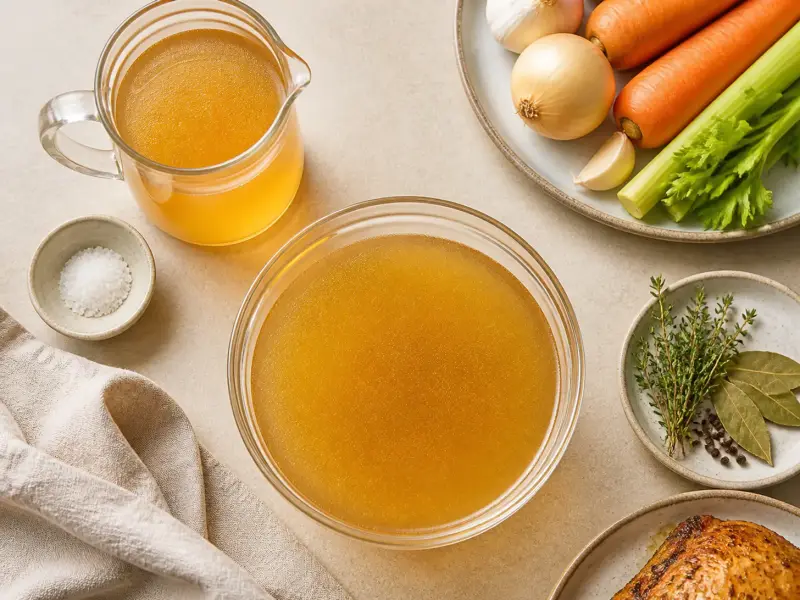 Chicken Stock
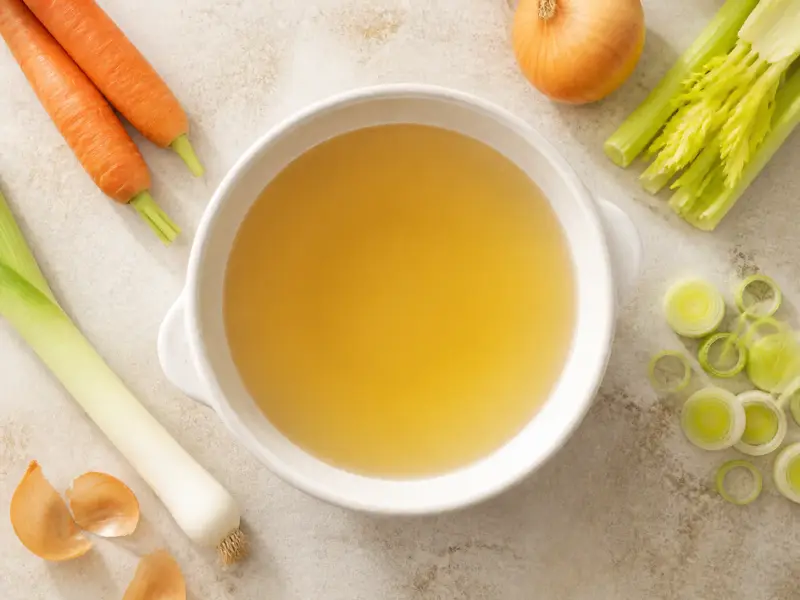 Vegetable Stock