Carnitas
Carnitas
Carnitas — little meats.
Pork shoulder simmered in its own fat until it falls apart, then crisped in the same pan so half of it shatters.
- Prep
- 15 min
- Cook
- 3 hr 30 min
- Total
- 3 hr 45 min
- Serves
- 8
- Revisions
- 5
Ingredients
Serves
Method
Season the pork all over with the salt and leave it for 20 minutes.
Melt the lard in a heavy casserole over a medium heat.
Add the pork, onion, garlic, bay, oregano, cumin and cinnamon stick.
Squeeze the orange over, then drop both halves in, skin and all.
Pour in the milk and enough water to almost cover the meat.
Bring to a bare simmer, cover partly, and cook for 2.5 to 3 hours until the pork gives way completely to a spoon.
Fish out the orange halves, onion, garlic, bay and cinnamon and discard them.
Turn the heat up and let the remaining liquid boil away. This takes 20-30 minutes and you must stay with it.
Once only fat is left, keep cooking, turning the pieces, until the edges are deep brown and crisp — 10 minutes or so.
Shred coarsely with two forks, leaving some pieces whole, and serve with tortillas, onion, coriander and lime.
Nobody has rated this recipe yet.
Sign in to rate this recipe. One rating per person, and you can change it.
What to expect
- Taste
Deeply savoury pork with a faint, genuine sweetness at the crisped edges from the caramelised milk and orange sugars, warm background notes from cumin and cinnamon, and a light citrus lift from the orange throughout.
- Aroma
Warm spice and citrus rising through the long simmer, turning richer and more caramelised as the final frying stage browns the meat.
- Texture
A genuine contrast within the same dish — some pieces meltingly soft, others brittle and crisp at the edges.
- Sound
A quiet, slow simmer for most of the cook, building to an active, spitting sizzle once the liquid has gone and the final fry begins.
- How the flavour moves
Savoury, well-seasoned pork registers first, warm spice and citrus build through the middle of the mouthful, and the faint caramelised sweetness of the crisped edges is what lingers longest at the finish.
- Serve it
Served hot, straight from the pan, ideally soon after the final crisping stage while the texture contrast is at its most pronounced.
- Goes with
Warm corn tortillas, chopped white onion, fresh coriander and a squeeze of lime, in the classic taco format.
Cook's notes
- Difficulty
Easy technique, but the final frying stage needs to be watched closely rather than left.
- Cost
Cheap — pork shoulder and lard are the main costs, both relatively inexpensive.
- Equipment
A heavy casserole large enough to hold the meat mostly submerged in fat and liquid.
- When to make it
A weekend cook given the long simmer, though it reheats and freezes well enough to make well ahead of when it is needed.
- Best season
None; every ingredient is shelf-stable or standard fresh produce available year round.
- You know it is done when
The meat should collapse completely under light pressure from a spoon at the end of the simmering stage, and by the end of the frying stage the exposed edges should be deep brown and visibly crisp against soft, still-moist interior pieces.
- And it feels like
Two distinct textures in the same dish — some pieces soft and falling apart, others with genuinely crisp, almost brittle edges — rather than a single uniform texture throughout.
- Food safety
The long simmer takes the pork well past any safety threshold; standard care applies to handling raw pork before it goes into the pot.
- Where it goes wrong
- Using a leaner cut such as loin rather than shoulder, which turns dry rather than tender given the fat and collagen the method depends on.
- Walking away during the final frying stage, risking the meat burning rather than crisping evenly.
- Stopping as soon as the liquid has boiled away rather than continuing to fry the meat in the remaining fat, missing the crisp texture that defines the dish.
- Discarding the orange halves or bay leaves too early, before they have had the full simmering time to contribute their flavour.
- If it does go wrong
Dry, stringy meat: a leaner cut was likely used instead of pork shoulder, or the meat was over-fried at the end. Burnt rather than crisp edges: the final frying stage was left unattended for too long. No crisp texture at all: the frying stage was stopped too early, as soon as the liquid boiled away, rather than continuing to actually fry the meat in the fat.
- Making it ahead
Excellent made ahead through the simmering stage and refrigerated, with the final frying done fresh; also reheats and recrisps well from fully cooked and refrigerated.
- Keeping it
Keeps for up to four days refrigerated.
- Reheating
Reheat in a hot, dry pan rather than a microwave, which helps recrisp the edges rather than leaving everything uniformly soft.
- Freezing
Freezes well for up to three months, ideally before the final crisping stage, which is best done fresh after thawing.
- Leftovers
Excellent reheated in a hot pan to recrisp, and equally good the next day cold in a sandwich or salad.
- Scaling it
Scales up well in a larger pot, though the final frying stage takes proportionally longer and needs even closer attention with a larger quantity.
- Substitutions
Pork shoulder is specifically chosen for its fat and collagen content, both of which the long simmer and fry depend on; a leaner cut such as loin turns dry and stringy well before the two-texture result this method is built to give.
- Dietary swaps
Contains milk. Naturally free of gluten, egg and nut allergens as written.
- Shopping for it
A whole boneless pork shoulder from a butcher gives more control over portioning than a pre-cut supermarket joint.
- Keeping the cost down
Pork shoulder is one of the most affordable cuts available, and this method makes particularly good use of its fat and collagen.
- Sustainability
An efficient way of using a whole, less expensive cut of meat, with almost nothing beyond the aromatics discarded.
- Nutrition
A good source of protein from the pork, with a meaningful amount of fat given the cooking method, though much of the cooking fat itself is not eaten.
- Worth it?
A dish whose deliberate two-texture result rewards staying with the pan for the final ten minutes rather than treating it as a set-and-forget braise throughout.
Where it comes from
- Origin
Michoacán, Mexico.
- Also called
Carnitas.
- Said out loud
car-NEE-tas.
- What the name means
Carnitas means little meats in Spanish, describing the small shredded pieces the pork is broken into.
- History
Carnitas developed in Michoacán, traditionally cooked in large copper cazos over a wood fire, rendering down a whole pig at a time in its own fat. The confit technique this depends on — meat slow-cooked fully submerged in fat — was arrived at independently in Mexico rather than being derived from the French technique of the same name, despite the similarity in method.
- Why it matters
A weekend and celebratory food across Mexico, traditionally sold by weight from large cazos at markets and eaten in tacos almost immediately, often before getting home.
- When it is eaten
Weekend markets and gatherings across Mexico, rather than an everyday household dish given the traditional scale of preparation.
- The traditional way
A whole pig, or a large quantity of pork, rendered slowly in its own fat in a large copper cazo, finished by frying in the same fat once the meat is fully tender.
- How it changed
The home version given here scales the traditional cazo method down to a single casserole and a more modest quantity of pork shoulder, while keeping the same two-stage simmer-then-fry technique.
- Regional variations
Some versions add Coca-Cola, beer, or additional citrus such as lime alongside the orange, though the core simmer-then-fry method in the meat's own fat is consistent across most versions.
- How this version differs
This recipe uses a single cut of pork shoulder in a casserole rather than the traditional whole-pig, large-cazo method, scaled for home cooking.
- Sources and credit
No individual is credited with the dish; it belongs to Michoacán regional cooking generally.
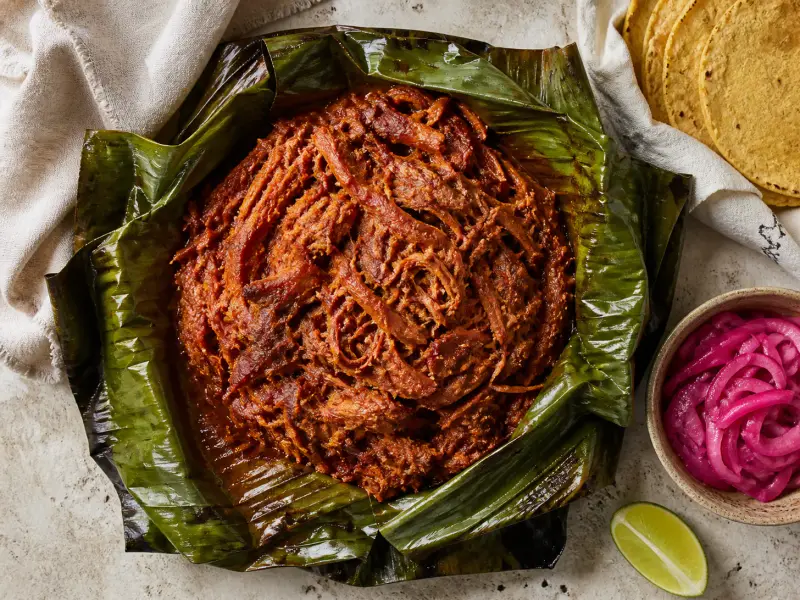 Cochinita Pibil
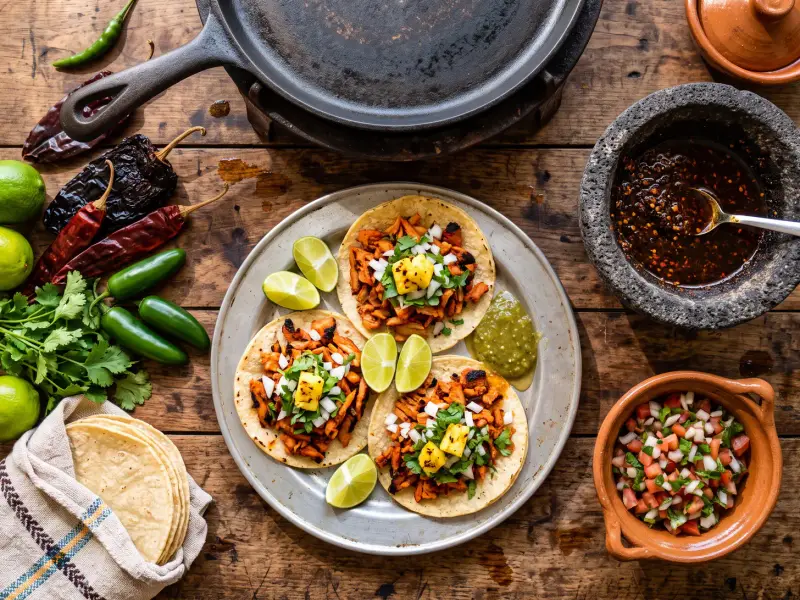 Tacos al Pastor