Glazed Carrots
Carottes Vichy
Carrots cooked in one layer under a paper lid until the butter, sugar and stock reduce to a syrup that coats them.
- Prep
- 10 min
- Cook
- 25 min
- Total
- 35 min
- Serves
- 4
- Revisions
- 5
Allergens
- Celery (via Chicken Stock)
- Milk
Named from the ingredients as written, including those carried in from sub-recipes. This is not a guarantee — check the labels on what you actually buy, and note that a product’s recipe can change.
Ingredients
Serves
Method
Choose a wide pan that holds the carrots in a single layer with a little room to spare.
The pan decides this dish. Too deep and the carrots pile up, steam and go soggy long before the liquid reduces; too wide and the liquid boils away while the batons are still raw at the core.
Put the carrots, butter, sugar, the 4g of fine salt and the thyme sprig into the pan.
Pour in the stock, which should come about two-thirds of the way up the carrots rather than covering them.
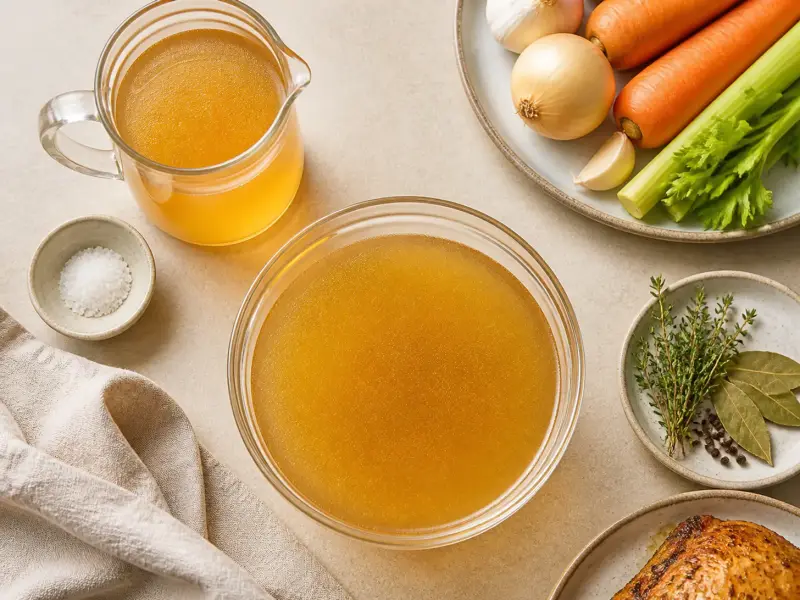
Use a ladleful of the chicken stock in this collection if you have it. Water and butter alone make the plainer French version and want a little more salt.
Cut a circle of baking paper the width of the pan, crumple it, open it out and press it down onto the surface.
Bring the pan to a simmer over medium heat.
Cook under the paper for 12-15 minutes, until a knife tip goes into a baton with only slight resistance at the centre.
Lift the paper off and pull out the thyme sprig.
Turn the heat up to high.
Boil hard for 4-6 minutes, shaking the pan every 30 seconds, until the liquid has fallen to two or three spoonfuls and turned syrupy enough to cling to the carrots.
Watch that last minute closely. A moment past the syrup stage the sugar catches on the base and the butter splits out as a greasy pool, and there is no bringing it back, so pull the pan off while the glaze still slides.
Roll the carrots through the glaze off the heat until every baton shines.
Season with the ground peppercorns.
Scatter over the parsley and serve straight away.
Nobody has rated this recipe yet.
Sign in to rate this recipe. One rating per person, and you can change it.
What to expect
- Taste
Sweet, and much sweeter than the 15g of sugar accounts for. Carrots are among the sweetest common vegetables and cooking makes them sweeter still, because heat breaks down cell walls and makes the sugars more available. Butter is the second flavour and is doing most of the work — it is glossy, lactic and slightly nutty by the end. The stock brings savouriness and salt and is what stops the dish being a dessert; made with water instead, the same carrots taste noticeably one-dimensional. Thyme is resinous and faintly medicinal and sits underneath. Black pepper, added at the end and coarsely ground, is the only sharp thing on the plate and it is important — without it this is a very sweet side dish with nothing pulling against it. Parsley is a green, slightly bitter freshness.
- Aroma
Very little for the first fifteen minutes, which is what a covered simmer smells like. Then a real change once the paper comes off and the liquid reduces: butter, sugar and carrot concentrating into something that smells almost like caramel. Thyme comes through in the middle. It is a quiet dish that gets loud in the last five minutes.
- Texture
Yielding with a slight resistance at the centre, and a slippery, coating exterior. There is no crispness anywhere and none is wanted. If they squeak they are undercooked; if they collapse under a fork they went too long under the paper.
- Sound
Almost nothing under the paper. Then the reduction, which is genuinely informative: a thin, fast bubbling that slows and thickens as the water goes, ending in a slower, heavier plopping. When the sound changes character, look at the pan — that change is a minute or so ahead of the glaze catching.
- How the flavour moves
Butter first, then sweetness spreading across the whole mouth, then the savoury note from the stock underneath. Thyme is in the background throughout. Pepper is the last thing and it is what stops the sweetness sitting — it arrives at the finish and clears. Over a plate it becomes progressively sweeter, which is why the pepper and the parsley are not decoration.
- Serve it
Hot, served immediately, in a warm dish. The glaze thickens as it cools and a cold plate makes it claggy.
- Goes with
Roast meat of any kind, and this is the classic French position — glazed carrots are a garnish for a roast rather than a dish. Chicken, pork, lamb, duck. Braises. They are very good with anything salty and cured, since the sweetness contrasts. Where they fail is next to anything else sweet on the same plate, which is a real risk on a Sunday table already carrying parsnips and red cabbage.
Cook's notes
- Difficulty
Easy for twenty minutes and briefly demanding for four. The reduction at the end goes from correct to broken in under a minute and it needs watching.
- Cost
Very low.
- Equipment
A wide pan that holds the carrots in a single layer — this is the actual requirement of the recipe and the reason it specifies it twice. Baking paper for the cartouche. Nothing else.
- When to make it
Sunday lunches, Christmas, and any roast. Carrots are available year-round and are at their sweetest in autumn and winter.
- Best season
Carrots are stored year-round and are at their best from late summer through winter.
- You know it is done when
A knife tip should go into a baton with only slight resistance at the centre. Then the glaze: it is ready when two or three spoonfuls remain and the liquid has gone from thin and watery to syrupy and glossy, sliding rather than pooling. A moment past that the sugar catches on the base and the butter splits out as a greasy pool, and it cannot be brought back.
- And it feels like
Tender with a little bite left. The glaze should coat each baton in a thin shining film rather than sitting in the pan.
- Food safety
Nothing to manage.
- Where it goes wrong
Piling the carrots two or three deep, which means the ones underneath overcook while the top layer is raw and there is not enough surface area to reduce properly. Using a lid instead of paper, which traps all the steam and boils them. Walking away during the reduction, which is a sixty-second error. Cutting the batons unevenly. And under-salting — a sweet dish needs salt to have any structure at all.
- If it does go wrong
Split and greasy with butter pooling: the reduction went too far and it cannot be recovered; the carrots are still edible and are simply buttery rather than glazed. Watery and dull: not reduced enough — put it back on high heat and keep shaking. Carrots collapsing: too long under the paper, or cut too thin. Carrots still hard when the liquid has gone: add a splash more stock, replace the paper and keep going. Bland: salt, and consider using stock rather than water.
- Making it ahead
They can be cooked through the first stage and left in their liquid for a few hours, then reduced to order in five minutes. That is how a restaurant does it and it works perfectly at home.
- Keeping it
Two days in the fridge. The glaze sets solid and re-melts.
- Reheating
Well, gently in a pan with a splash of water. This is one of the more reheatable vegetable dishes.
- Freezing
No. Cooked carrots go mushy.
- Leftovers
Good cold, and very good blitzed into a soup with stock.
- Scaling it
Badly in one pan, because the single layer is the requirement. Two pans or two batches; the first batch reheats well.
- Substitutions
Turnips, parsnips, pearl onions, chestnuts and swede all take the same treatment and the same timings, roughly. Honey or maple syrup instead of sugar changes the flavour and behaves similarly, though both catch faster. Vegetable stock or water for a vegetarian version, and oil for butter for a vegan one, at real cost — butter is a large part of what makes the glaze glossy.
- Dietary swaps
Vegetarian with vegetable stock. Gluten-free and nut-free. Contains milk, declared. A vegan version with oil works and is noticeably less glossy, because butter's milk solids contribute to the shine.
- Shopping for it
Ordinary carrots. Older, larger carrots are actually sweeter than young ones and are better here than expensive baby carrots, which are watery and mild. If they come with tops, the tops make a decent pesto.
- Keeping the cost down
Carrots are among the cheapest vegetables there are and this dish makes them look expensive, which is the whole appeal. Buy them loose and with their tops off, and use whatever stock you have rather than buying any.
- Sustainability
Very good — a cheap, local, long-storing root vegetable with almost no waste.
- Nutrition
Around 160 calories a serving, most of it butter. Carrots are a very good source of beta-carotene, and the butter genuinely helps — beta-carotene is fat-soluble and considerably more of it is absorbed from a carrot cooked in fat than from a raw one.
- Worth it?
Worth it, and it is the best thing you can do to a carrot in half an hour. It costs pennies, it makes a roast dinner look considered, and the technique — cartouche, then reduce — transfers directly to turnips, onions and chestnuts. Watch the last minute and take the pan off early rather than late.
Where it comes from
- Origin
France, as part of the classical vegetable repertoire.
- Also called
Carottes glacées, or carottes Vichy in the named version.
- Said out loud
ka-ROT gla-SAY. Vichy is VEE-shee.
- What the name means
Glazed carrots. The French distinguish glacer à blanc — glazed pale, as here — from glacer à brun, where the reduction is taken further until the sugar caramelises and the vegetables colour.
- History
Glazing is a technique rather than a dish and it appears throughout French classical cookery as the standard treatment for root vegetables and small onions. The Vichy version is named for the spa town whose bicarbonate-rich mineral water was traditionally used, on the reasoning that alkaline water softens vegetables — which is true, since alkalinity breaks down pectin, and is also why bicarbonate of soda turns green vegetables to mush if overdone. The cartouche is the other piece of classical apparatus here and its name simply means a paper cartridge; it does a job no lid can, holding humidity at the surface while still permitting reduction.
- Why it matters
Its significance is pedagogical. Glazing is one of the standard techniques taught early in a professional kitchen, because it teaches reduction, emulsion and judging a syrup all at once on something that costs nothing to fail at.
- When it is eaten
Sunday lunch, roast dinners, and anywhere a roast needs a vegetable that is not another potato.
- The traditional way
The cartouche, and the two-stage cook. Both are classical and both are frequently replaced in modern recipes by a lid and a longer simmer, which produces boiled carrots with butter on them.
- How it changed
Very little. The main modern departure is roasting carrots instead, which is a different and excellent dish with no glaze in it.
- Regional variations
Vichy carrots with mineral water; à brun with the reduction taken to caramel; with orange juice replacing some of the stock, which is a common Anglo-American variation and takes it towards dessert.
- How this version differs
It does not. What it adds is the two warnings — single layer, and pull the pan off while the glaze still slides — which are the difference between the technique working and producing a greasy pan.
- Sources and credit
None. Classical technique with no author.
Related recipes
 Chicken Stock
You might also like
 Gratin Dauphinois
 Green Beans with Brown Butter and Almonds
Categories
Cuisines
Courses & dish types