Gratin Dauphinois
Gratin dauphinois
Thin potato slices simmered in cream on the hob until their own starch thickens it, then baked slowly until set.
- Prep
- 25 min
- Cook
- 1 hr 10 min
- Resting
- 15 min
- Total
- 1 hr 50 min
- Serves
- 6
- Revisions
- 5
Allergens
- Milk
Named from the ingredients as written, including those carried in from sub-recipes. This is not a guarantee — check the labels on what you actually buy, and note that a product’s recipe can change.
Ingredients
Serves
Method
Heat the oven to 160C/325F.
Rub the cut face of the halved garlic clove over the inside of a 25cm baking dish and discard it.
Butter the dish generously with the softened butter.
Slice the peeled potatoes 2-3mm thick, on a mandoline if you have one.
Do not rinse the slices, however cloudy they look. The starch clinging to them is the only thickener in the dish, and rinsed potatoes bake in a thin liquid that never sets, so the gratin runs across the plate the moment it is cut.
Put the cream, milk, grated garlic, nutmeg, the 8g of fine salt, the ground white peppercorns and the bay leaves into a wide pan.
Add the potato slices and separate them with your fingers so none are stuck together.
Bring the pan to a bare simmer over medium-low heat, where bubbles break in two or three places only.
Never let it boil. Cream at a rolling boil splits into grains of protein and a slick of butterfat, and it does not come back together in the oven.
Cook for 8-10 minutes, lifting the slices gently off the base with a spatula every couple of minutes, until the liquid thickens enough to coat a slice and a slice bends without snapping.
Fish out the bay leaves.
Tip the whole panful into the buttered dish.
Press the slices flat with the back of a spoon, until the liquid rises just level with the top layer.
Bake for 55-65 minutes, until the top is deep gold and blistered and a knife goes into the centre with no resistance at all.
Lay a sheet of foil loosely over the dish if the top colours before the middle has softened.
Stand the gratin for 15 minutes before serving. Straight from the oven the sauce is still loose and floods the plate, and a quarter of an hour sets it enough to hold a cut edge.
Nobody has rated this recipe yet.
Sign in to rate this recipe. One rating per person, and you can change it.
What to expect
- Taste
Cream, first and last, and there is no pretending otherwise. Against it, potato is mild and starchy and faintly sweet, and it absorbs the cream rather than sitting in it. Garlic is present as a warmth rather than as a flavour you would name — rubbed on the dish and grated into the liquid, it disappears into the background. Nutmeg is the traditional partner to dairy in French cooking and it does something specific here: a small amount makes cream taste more like itself, and a large amount tastes of Christmas. White pepper is floral rather than sharp. And salt, which needs to be assertive — 8g in 1.2kg of potato and 800ml of dairy is not much, and an under-salted gratin tastes of nothing at all. There is no acidity anywhere in the dish, which is why it needs something sharp on the plate beside it.
- Aroma
Almost nothing for the first ten minutes. Then, as it bakes, warm cream and garlic filling the kitchen, with nutmeg over the top — a smell more like a custard than like a potato dish, which tells you what it actually is. The last twenty minutes, once the top starts browning, smell of toasted dairy.
- Texture
Yielding, dense and completely smooth, with the slices distinguishable but bound into a single mass. There is one contrast and it matters: the crisp browned top against everything soft underneath. Straight from the oven the sauce is still fluid and the whole thing slumps; fifteen minutes sets it enough to cut, and cold it is firm enough to slice like cake.
- Sound
Almost none. The hob stage is silent by design — audible bubbling means it is about to split. In the oven the last twenty minutes make a faint spitting as the surface browns. A knife going into a finished gratin should meet no sound and no resistance at all, which is the doneness test.
- How the flavour moves
Cream first and spreading. Then potato through the middle, mild and starchy. Garlic and nutmeg arrive at the back. The finish is long, rich and fatty and does not clear — which is exactly why the dish needs something acid alongside and why a plate of gratin on its own becomes hard work after a few mouthfuls.
- Serve it
Hot, after fifteen minutes of standing. It holds heat exceptionally well because of its density, so a dish brought to a table stays hot through a long meal, which is a genuine practical advantage on a Sunday.
- Goes with
Roast lamb above all, which is the classic French pairing and works because lamb fat and cream are both rich in a way that somehow cancels rather than compounds. Beef, roast chicken, game. A sharply dressed green salad, which is not optional in practice — it is the acid the dish has none of. A red with tannin. Where it fails is next to anything else creamy, and beside another potato dish, which happens more often on a Christmas table than anyone admits.
Cook's notes
- Difficulty
Easy, with two things to control: the simmer, which must never boil, and the slicing, which must be even. Neither requires skill so much as attention.
- Cost
Moderate. Potatoes are nothing and half a litre of double cream is the whole cost.
- Equipment
A mandoline, ideally — 2 to 3mm by hand across 1.2kg of potatoes is a long and inconsistent job, and consistency is what makes the layers cook evenly. A wide pan and a 25cm baking dish.
- When to make it
Winter, Sundays, Christmas. It is a cold-weather dish.
- Best season
None. Potatoes store year-round.
- You know it is done when
On the hob, the liquid thickens enough to coat a slice and a slice bends without snapping. In the oven, the top is deep gold and blistered — that crust is the gratin — and a knife goes into the centre with no resistance at all. Any resistance means it needs longer, whatever the clock says.
- And it feels like
The whole thing should hold a cut edge after standing, with the slices distinguishable but bound. If it collapses, it either needed longer or the potatoes were too floury.
- Food safety
Nothing to manage.
- Where it goes wrong
Rinsing the potato slices, which removes the only thickener and guarantees a runny gratin. Boiling the cream, which splits it irreversibly. Slicing unevenly, so some layers are still firm when the rest is soft. Using a floury potato, which disintegrates. Cutting into it straight from the oven, when it floods the plate. And adding cheese, which is not a fault exactly but makes a different dish under a borrowed name.
- If it does go wrong
Runny after standing: the slices were rinsed, or the potatoes were low in starch, or it needed longer. Split and grainy: the cream boiled — it will still taste fine and will look wrong. Top burnt and middle hard: the oven was too hot; cover with foil and drop the temperature. Bland: salt, and more than you think — a large volume of dairy and starch absorbs a surprising amount. Slices still firm: back in the oven, foil on, and check every ten minutes.
- Making it ahead
Very well. Cook it completely a day ahead, cool it, and reheat covered at 160°C for half an hour. It is arguably better, since it sets fully and the edges crisp on the second bake. That makes it one of the most useful dishes on a Christmas table.
- Keeping it
Three days in the fridge, and it sets very firm.
- Reheating
Extremely well — arguably better. A cold slice reheated in a hot oven crisps on its edges in a way the fresh gratin does not. Cover with foil if it is colouring too fast.
- Freezing
Two months, and the texture suffers a little as the emulsion breaks slightly. Acceptable rather than good.
- Leftovers
Genuinely excellent. A cold slab fried in butter until crisp on both faces is one of the better things you can do with a leftover.
- Scaling it
Doubles into a larger dish, with the caveat that a deeper gratin takes considerably longer in the oven and browns on top before the middle is soft. Two shallower dishes beat one deep one.
- Substitutions
Waxy or all-rounder potatoes are specified for a reason — a very floury potato disintegrates into the cream and you get a purée rather than layers. Desiree, Charlotte, Yukon Gold and Maris Piper all work. Single cream will not set properly; the fat content is doing structural work. There is no substitute for the potato starch.
- Dietary swaps
Vegetarian and gluten-free and nut-free. Contains milk, declared, and it is not sensibly adaptable — a plant-cream version can be made and sets less well, since the emulsion behaves differently.
- Shopping for it
Waxy or all-rounder potatoes — Desiree, Charlotte, Yukon Gold, Maris Piper. Double cream rather than single or whipping. Whole nutmeg, grated fresh, since ground nutmeg loses its aromatics within weeks of opening.
- Keeping the cost down
Potatoes cost almost nothing and the cream is the whole expense. Shifting the ratio towards milk saves money and costs texture; going below about 400ml of cream in this quantity it stops setting properly. Buying potatoes loose rather than in bags is cheaper and lets you pick even-sized ones, which makes slicing easier.
- Sustainability
The cream is the footprint; the potatoes are among the most efficient crops there are. As an occasional dish it is unremarkable either way.
- Nutrition
Around 540 calories a serving, and it is unapologetically rich — 500ml of double cream between six people is the bulk of it. There is no lighter version that is still this dish; the milk-heavy alternatives do not set.
- Worth it?
Worth it, and worth making the day before. It is the best potato dish in the collection and the one most often ruined by a single well-meaning step — rinsing the slices. Leave the starch on, keep the cream below a boil, let it stand for a quarter of an hour, and serve a sharp green salad next to it.
Where it comes from
- Origin
The Dauphiné, in south-eastern France, around Grenoble.
- Also called
Gratin dauphinois. Its close relative is the gratin savoyard, from neighbouring Savoie, made with stock and cheese instead of cream.
- Said out loud
gra-TAN doh-fee-NWAH.
- What the name means
Gratin comes from gratter, to scrape — originally the crust scraped from the bottom of the dish, which was the prized part. So the word names the browned surface, not any ingredient, and that is why a dish with cheese on it is not automatically a gratin and a gratin does not automatically have cheese.
- History
The 1788 reference is the standard first citation: a dinner given by Charles-Henri, duc de Clermont-Tonnerre, then lieutenant-general of the Dauphiné, for the municipal officers of Gap, at which a gratin of potatoes was served. That date is interesting for a second reason. Potatoes had been treated with deep suspicion in France for most of the eighteenth century — blamed for leprosy, thought fit only for animals — and their rehabilitation is credited largely to the agronomist Antoine-Augustin Parmentier, whose campaign to promote them ran through the 1770s and 1780s. So this dish appears almost exactly at the moment the potato became respectable French food, which makes it one of the earliest French potato dishes rather than an ancient peasant one.
- Why it matters
It is one of the small set of French regional dishes that became national and then international without changing much, and it is the standard accompaniment to a roast in French home cooking. The cheese question is a real and slightly heated point of correctness in France.
- When it is eaten
Sunday lunches, Christmas, and any roast. It is a special-occasion side rather than a weeknight one, mostly because of the cream.
- The traditional way
Slicing thin, not rinsing, and cooking slowly. Some traditional versions bake from raw for two hours or more; the hob-start here is a modern professional shortcut that also improves reliability.
- How it changed
Cheese crept in, and it is now on most versions sold outside France. Some recipes also add flour, which is unnecessary if the starch is left on the potatoes and is a sign that someone rinsed them.
- Regional variations
Gratin savoyard, from Savoie, uses beef stock and grated cheese — usually Beaufort — instead of cream, and is genuinely different: leaner, saltier and more savoury. Elsewhere in France the same technique is applied to cardoons, endive and macaroni.
- How this version differs
It starts on the hob, which not every traditional recipe does. It is also unusually firm about the two things that decide the outcome: not rinsing the slices, and never letting the cream boil.
- Sources and credit
The 1788 Gap dinner is the standard citation in French food history.
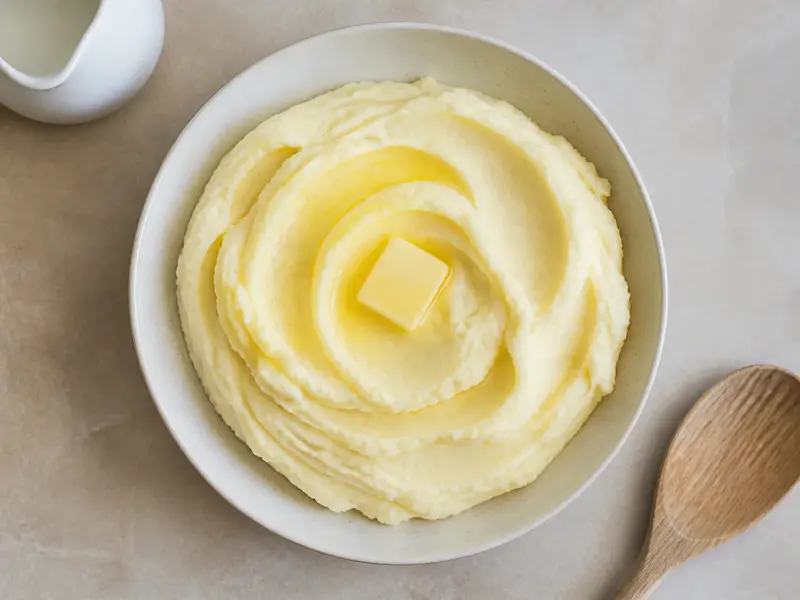 Buttery Mashed Potato
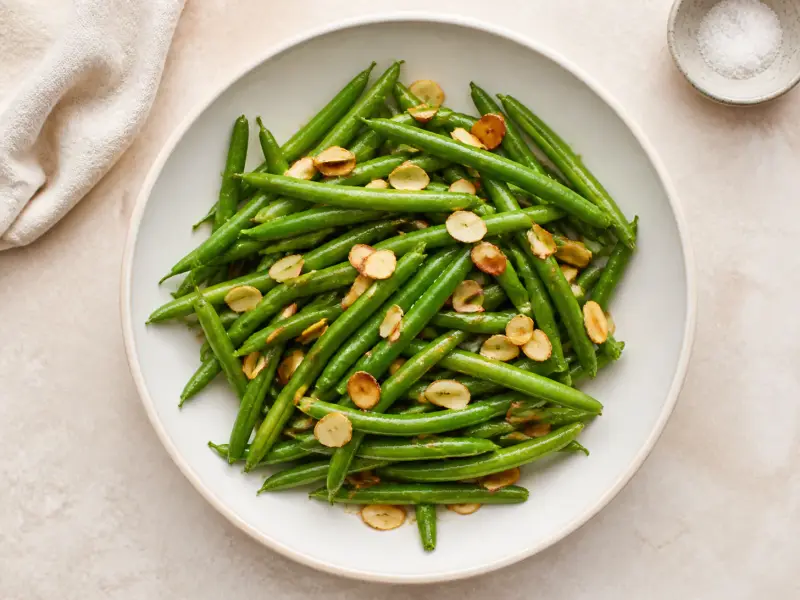 Green Beans with Brown Butter and Almonds
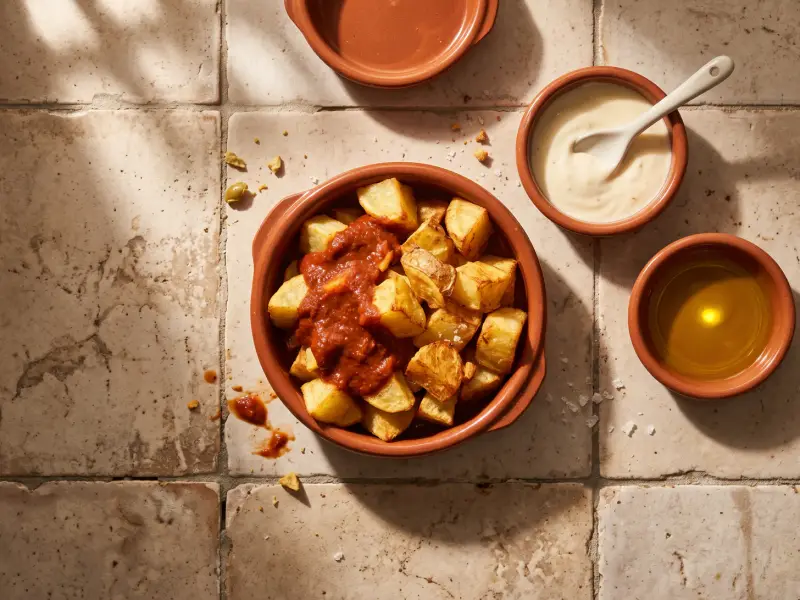 Patatas Bravas
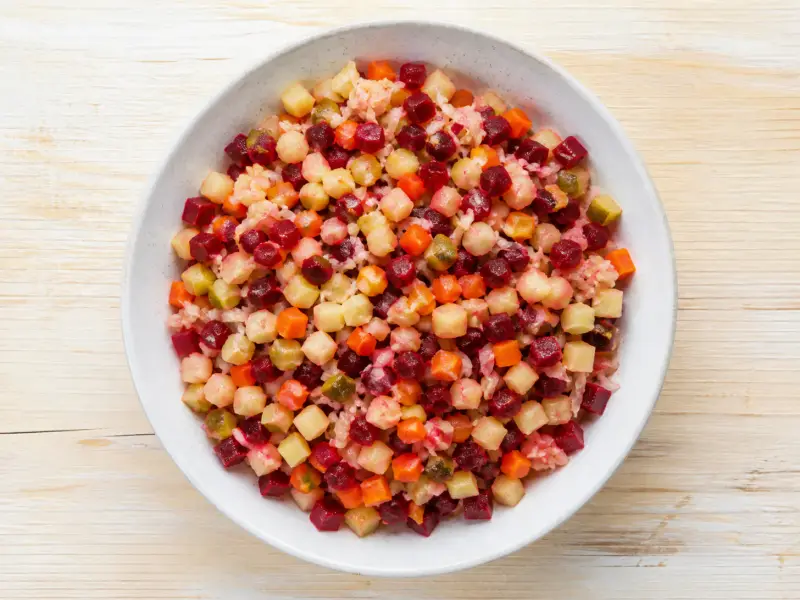 Vinegret
 Apple and Almond Tart
 Braised Red Cabbage