Roast Leg of Lamb with Garlic and Rosemary
A bone-in leg studded with garlic and rosemary, roasted hot then moderate and pulled off the heat pink, with gravy made in the tin.
- Prep
- 20 min
- Cook
- 1 hr 15 min
- Resting
- 20 min
- Total
- 1 hr 55 min
- Serves
- 6
- Revisions
- 5
Allergens
- Celery (via Chicken Stock)
- Sulphites
Named from the ingredients as written, including those carried in from sub-recipes. This is not a guarantee — check the labels on what you actually buy, and note that a product’s recipe can change.
Ingredients
Serves
Method
Take the lamb out of the fridge an hour before it goes in the oven, so the middle is not fridge-cold when it meets the heat.
Pat the surface dry all over with kitchen paper.
Cut about twenty slits into the joint with the tip of a small knife, each one roughly 2cm deep and spread evenly over both sides.
Push a sliver of garlic and a piece of rosemary into each slit, burying both below the surface. Anything left standing proud burns black in the first twenty minutes and tastes of it for the rest of the meal.
Rub the lamb all over with the olive oil.
Season it on every side with the 8g of fine salt and the ground peppercorns.
Heat the oven to 220C/425F.
Spread the onion rounds and the halved carrots across the base of a roasting tin.
Lay the 2 whole rosemary sprigs among the vegetables.
Set the lamb on top of the vegetables, which hold it clear of the tin so the underside roasts instead of frying in the rendered fat.
Roast at 220C/425F for 20 minutes, until the fat has coloured and the tin is sizzling.
Turn the oven down to 180C/350F.
Roast for a further 45-55 minutes, basting once with the fat in the tin at the halfway point.
Start checking with a thermometer at the 45-minute mark, pushed into the thickest part of the leg with the tip kept off the bone.
Read it against the range: 54C/130F rare, 57C/135F medium rare, 63C/145F medium, 68C/155F medium well, 71C/160F well done.
Take it out 3-4C below the figure you want. The middle of a 2kg joint keeps climbing for several minutes after it leaves the oven, and a leg pulled at exactly 57C/135F is medium by the time it is carved.
Judge it by the thermometer rather than the clock. A leg is thick at the top and thin at the shank, so it varies along its own length, and fifteen minutes past done is the difference between pink and grey right through.
Lift the lamb onto a warm board.
Rest it for 20 minutes, loosely tented with foil. Carved straight from the oven it spills its juice onto the board and eats dry.
Tip most of the fat out of the roasting tin, leaving the vegetables and the browned juices behind.
Set the tin over medium heat and pour in the wine.
Scrape the base clean with a wooden spoon while the wine bubbles, until nothing is left stuck to the metal.
Simmer for 3-4 minutes, until the sharp smell of alcohol has gone.
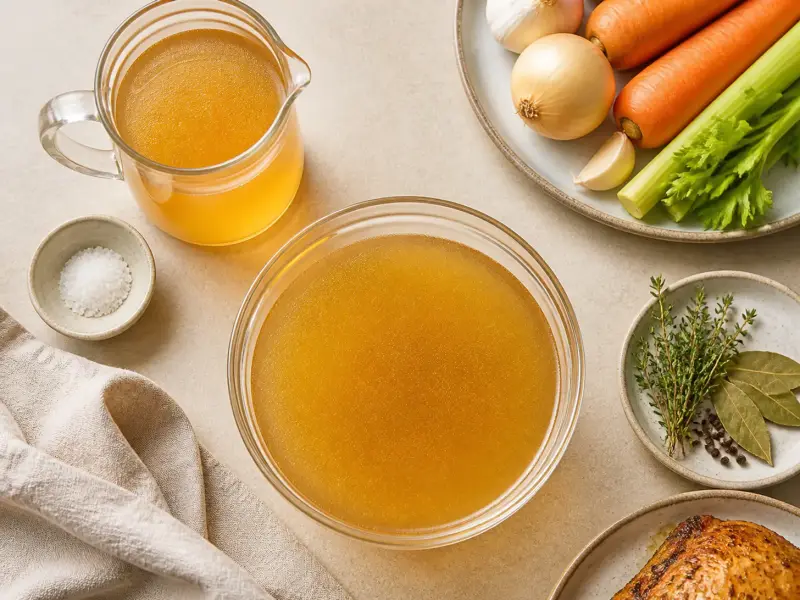
Pour in the hot stock. A batch of the chicken stock in this collection makes this gravy six times over.
Simmer for 8-10 minutes, until the liquid has reduced by about a third and coats the back of a spoon in a thin film.
Strain it into a warm jug, pressing the onion and carrot against the sieve with a ladle to get the last of the juice out of them.
Carve in thick slices at an angle, working down towards the bone and turning the joint over to take the meat off the underside.
Pour any juice left on the board into the gravy.
Scatter the slices with flaky salt and serve with the gravy.
Nobody has rated this recipe yet.
Sign in to rate this recipe. One rating per person, and you can change it.
What to expect
- Taste
Sweet, which surprises people who expect lamb to taste strong. The fat on a young leg is genuinely sweet and it is the dominant flavour of the first mouthful, with the meat's own mineral, faintly iron note underneath it. The garlic buried in the slits does not taste of raw garlic at all — an hour of enclosed heat turns it soft and mild and it reads as savoury sweetness rather than pungency. Rosemary is the thing that has travelled furthest: it is resinous and slightly pine-like and it is inside the meat rather than on it. The gravy is where the salt and the acidity live.
- Aroma
The first twenty minutes at high heat is the smell of the whole meal — rosemary and garlic in hot lamb fat, which is unmistakable from another room. As it settles at 180C the smell gets rounder and sweeter and less herbal. At the table what comes off the platter is the fat and the hot juices rather than the herbs.
- Texture
Three textures on one plate, deliberately. A crisp, well-seasoned fat cap that shatters slightly under the knife. Meat that is yielding and slightly springy at the thick end and firmer towards the shank, because a leg genuinely is more done at one end than the other. And the flaky salt on top, which gives a distinct crunch and a burst of salt against meat that has been seasoned only from the outside.
- Sound
The tin sizzling hard when it comes out at the twenty-minute mark, which is the cue that the fat has started rendering. Nothing much for the next hour. Then the quiet of the rest, and at the table the sound of a sharp knife going through crisp fat, which is a different noise from a knife going through meat.
- How the flavour moves
Fat and sweetness first, immediately and generously. The rosemary comes through the middle of the mouthful from inside the meat, and this is the part that people cannot place when the herb is buried rather than scattered. The finish is salt and the meat's own iron, extended by the gravy's acidity from the wine. Each slice differs slightly depending on how close it was cut to one of the slits.
- Serve it
Warm rather than scalding — twenty minutes of rest takes the edge off, which is the intention. The gravy needs to be genuinely hot to make up for it, and the plates want warming, because lamb fat sets on a cold plate faster than any other roast in this collection.
- Goes with
Roast potatoes, and specifically ones crisped in the same kind of fat. Something green and sharp against the sweetness — mint sauce is the traditional answer and vinegar is doing the work in it. Red wine with some tannin, which the fat needs.
Cook's notes
- Difficulty
Easy to cook and easy to overshoot. The technique is nothing; the judgement is everything, and a thermometer removes almost all of it.
- Cost
The most expensive dish in this section. A 2kg bone-in leg is the whole cost and it feeds six.
- Equipment
A roasting tin, and a probe thermometer — not optional here, since a leg is thick at the top and thin at the shank and varies along its own length.
- When to make it
Easter, a Sunday, or any occasion with enough people to justify a 2kg joint — this does not scale down.
- Best season
Spring lamb is the association and the Easter timing follows from it, though good lamb is available year round and autumn animals are larger and stronger flavoured.
- You know it is done when
The fat cap deeply browned and crisp with the garlic and rosemary visible only as darker marks under the surface rather than as anything standing proud and blackened; the cut face rosy and even from edge to centre with only a thin band of grey under the crust; juices pooling clear and pink-tinged rather than red at the low end of the platter.
- And it feels like
Firm to a fingertip with real spring rather than the wobble of raw meat or the resistance of well done. Carved, the slices should hold together and give under the knife rather than shredding.
- Food safety
63C/145F is the official figure for whole cuts of lamb served pink; anything below that is a matter of preference and the risk sits on the surface of a whole joint, which is fully seared here. Rest the meat away from where the raw joint sat, and probe with the tip off the bone, which conducts heat and reads high.
- Where it goes wrong
- Leaving the garlic and rosemary standing proud of the surface, where they burn black in the first twenty minutes and taste of it for the whole meal.
- Cooking straight from the fridge, so the middle is still catching up when the outside is done.
- Trusting a minutes-per-kilo chart on a joint that is thick at the top and thin at the shank.
- Taking it out at exactly the temperature you want, when it will climb another 3 to 4C on the board.
- Carving it straight from the oven, which spills the juice onto the board and leaves the meat dry.
- Probing through to the bone, which conducts heat and reads high, so the joint comes out underdone.
- If it does go wrong
Grey right through: it went too far, and there is nothing to do but slice it thin and make the gravy generous. Bitter black flecks in every mouthful: the aromatics were on the surface rather than in the slits. Dry despite being pink: it was not rested, or it was carved on a cold board. Thin gravy: it needed longer at the simmer, and the cue is a film on the back of a spoon rather than a time. Underdone at the shank and overdone at the top: normal and unavoidable on a bone-in leg — serve people the end they prefer.
- Making it ahead
Very little of it can be. The studding and seasoning can be done in the morning, and the joint kept covered in the fridge with an hour out before it goes in. Everything else happens on the day.
- Keeping it
Carved meat keeps 3 days refrigerated, and the gravy the same. Keep the joint whole if you can — sliced meat dries much faster.
- Reheating
Cold is better than reheated for lamb this pink. If it must be warmed, do it in the gravy over low heat rather than in an oven.
- Freezing
Cooked lamb freezes acceptably for 2 months and is best used in something wet afterwards rather than served as slices.
- Leftovers
Among the best leftovers in the collection — cold with pickles and bread, shredded into a shepherd's pie, or sliced thin into a sandwich with the cold set gravy.
- Scaling it
A larger leg wants the same two-stage oven and a longer second stage, judged entirely by the probe. Two smaller legs in one tin cook faster than one large one, not slower.
- Substitutions
A boned and rolled leg can be used but is thicker through the middle than a bone-in one of the same weight, so it takes noticeably longer to reach the same internal temperature — go by the thermometer, not by this recipe's timings. Hogget and mutton are one to two years and older respectively and both want slower, wetter cooking than this. Thyme can stand in for rosemary, though it is less able to survive an hour of dry heat buried in meat.
- Dietary swaps
Contains sulphites from the wine. Dairy free, gluten free, egg free and nut free as written. The wine in the gravy can be replaced with more stock and a spoonful of vinegar for a sulphite-free version, though the gravy is flatter for it.
- Shopping for it
Ask for a leg with the fat left on and the aitchbone removed, which makes it far easier to carve. Lamb is meat from a sheep under a year old — hogget and mutton are older, cheaper and want a different recipe.
- Keeping the cost down
Bone-in is cheaper per kilo than boned and rolled and cooks more evenly here, so the cheaper option is also the better one. The bone is worth keeping for stock.
- Sustainability
Sheep are among the higher-impact meats per kilogram, and this is a 2kg joint. It is a dish to cook occasionally and use completely, which the leftovers make easy.
- Nutrition
High in protein and in fat, and the fat is most of what makes it taste of anything. Iron-rich.
- Worth it?
Worth doing properly once rather than approximately four times. The thermometer is the whole difference and it costs less than the joint does.
Where it comes from
- Origin
No single origin. Roast leg of lamb belongs to Britain, Ireland, Greece, Italy and most of the Mediterranean simultaneously.
- Also called
Roast leg of lamb.
- History
Roasting a leg of sheep over a fire predates written cookery and cannot be attributed. Studding the meat with garlic and herbs is documented Mediterranean practice with no author attached to it. Lamb's association with Easter across Christian Europe is generally explained by the Passover lamb; the connection is old and widely attested but is not datable to a year or a place, and accounts that give it one are guessing.
- Why it matters
The Easter table in Britain, Greece, Italy and much of the Mediterranean, and a year-round Sunday joint in Britain, Ireland, Australia and New Zealand.
- When it is eaten
Easter above all, and Sunday lunch. In Greece the Easter lamb is more often whole and spit-roasted than a leg in an oven.
- The traditional way
Studding rather than rubbing, and roasting the joint clear of the tin on a bed of vegetables so the underside roasts instead of frying in the rendered fat. The vegetables are a trivet first and a gravy base second.
- How it changed
The thermometer is the real change. Minutes-per-kilo charts were how everybody cooked a joint for most of a century, and they cannot account for a bone-in leg being thick at one end and thin at the other, which is why so many people's memory of roast lamb is grey.
- Regional variations
Greek versions add oregano and lemon and take the meat considerably further than pink; Italian ones lean on rosemary and sometimes anchovy in the slits; the British version is the plainest of the three and relies on the gravy.
- Sources and credit
No individual credit exists or could exist. It is one of the oldest cooked dishes there is.
 Chicken Stock
 Beef and Ale Stew with Herb Dumplings
 Roast Chicken with Lemon and Thyme
 Chicken Thigh and Potato Traybake
 Potato Gnocchi with Sage Butter