Chicken à la King
Poached chicken and mushrooms in a sherry cream sauce with pimento, served over rice, toast or pastry depending on the decade.
- Prep
- 20 min
- Cook
- 35 min
- Total
- 55 min
- Serves
- 4
- Revisions
- 6
Allergens
- Celery (via Chicken Stock)
- Cereals containing gluten
- Milk
- Sulphites
Named from the ingredients as written, including those carried in from sub-recipes. This is not a guarantee — check the labels on what you actually buy, and note that a product’s recipe can change.
Ingredients
Serves
Method
Put the chicken breasts in a pan with the stock, bring to a bare simmer and poach for 12-14 minutes, until just cooked through.
Lift the chicken out and keep the stock.
Shred or cut the chicken into large bite-sized pieces once it is cool enough to handle.
Melt the butter in a wide pan and cook the mushrooms over high heat for 5 minutes, until browned.
Add the onion and green pepper, turn the heat down and cook for 8 minutes until soft.
Stir in the flour and cook for 2 minutes, stirring constantly.
Add the sherry and let it bubble for 30 seconds.
Pour in the reserved stock a ladleful at a time, whisking each addition smooth before the next.
Simmer for 8 minutes, until the sauce is thick enough to coat a spoon.
Stir in the cream, the roasted peppers, the salt and the pepper.
Beat the egg yolks in a small bowl with a ladleful of the hot sauce, then stir that back into the pan off the heat.
Fold the chicken through and warm it gently without letting it boil, which would scramble the yolks.
Scatter the parsley over and serve over rice or on toast.
Nobody has rated this recipe yet.
Sign in to rate this recipe. One rating per person, and you can change it.
What to expect
- Taste
Rich and savoury from the roux-based sauce, with sherry's warm, slightly nutty depth running through it, sweetness from the roasted peppers, and a rounding richness from the cream and egg yolk that ties everything together.
- Aroma
Butter and mushroom first, sherry's warm, slightly sweet aroma rising as it bubbles into the sauce, and a rich, creamy smell once the cream and egg yolk go in.
- Texture
A smooth, thick, coating sauce around tender chicken, with a little bite from the mushroom and pepper throughout.
- Sound
A steady simmer as the sauce reduces, quieting to near silence once the egg yolks go in and the heat is kept gentle.
- How the flavour moves
The sauce's savoury, buttery richness arrives first, sherry's warmth builds through the middle, and the sweetness of the roasted pepper and the roundness of the cream and egg yolk are what linger at the finish.
- Serve it
Served hot, over hot rice or toast.
- Goes with
Steamed rice or buttered toast, both there to soak up the sauce.
Cook's notes
- Difficulty
Moderate — the roux, the sherry reduction and the final egg-yolk enrichment all need some care.
- Cost
Moderate — chicken breast, mushrooms and a modest amount of sherry and cream.
- Equipment
Two pans: one for poaching the chicken, one for the sauce.
- When to make it
A comforting dinner, and a good dish for entertaining given how well it can be kept warm.
- Best season
None; every ingredient is shelf-stable or standard fresh produce available year round.
- You know it is done when
The sauce should be thick enough to coat the back of a spoon before the cream and egg yolk enrichment go in, and the chicken should look opaque and just cooked through rather than dry or stringy.
- And it feels like
Tender, moist chicken in a smooth, glossy sauce with real body from the roux, egg yolk and cream together.
- Food safety
The egg yolks are tempered with hot sauce before going back into the pan and are then only gently warmed rather than boiled, which is enough to bring them to a safe temperature without scrambling them.
- Where it goes wrong
- Simmering the chicken in the sauce itself rather than poaching it separately, which dries it out.
- Adding the egg yolks directly to the hot pan rather than tempering them first, which scrambles them.
- Not cooking the roux long enough, leaving a raw, pasty taste in the finished sauce.
- Boiling the sauce hard once the cream and egg yolks are in, risking it splitting.
- If it does go wrong
Dry, stringy chicken: it was cooked in the sauce rather than poached separately and folded in at the end. Scrambled bits in the sauce: the egg yolks were added directly to hot liquid rather than tempered first. Pasty, raw flavour: the roux was not cooked long enough before liquid was added.
- Making it ahead
The sauce and poached chicken can both be made a little ahead and combined just before serving, though the egg-yolk enrichment is best done close to serving time.
- Keeping it
Keeps for up to two days refrigerated, though the sauce can thicken further and the texture of the chicken softens somewhat.
- Reheating
Reheat gently over low heat, stirring, and avoid a hard boil which risks the sauce splitting given the egg yolk content.
- Freezing
Not ideal for freezing — cream-and-egg-yolk sauces can separate on thawing and reheating.
- Leftovers
Good reheated gently over low heat within a day or two, served the same way over rice or toast.
- Scaling it
Scales up reasonably well, though the egg-yolk tempering step needs proportionally more care in a larger batch to avoid scrambling.
- Substitutions
Chicken thigh can replace breast for a richer, more forgiving result, though it departs slightly from the classical, plainer version. Dry sherry is fairly specific to the dish's character; a dry white wine can be substituted but changes the flavour noticeably.
- Dietary swaps
Contains milk, cereals containing gluten and sulphites. Not easily adapted to major allergen-free categories without changing the sauce's basic structure.
- Shopping for it
A genuinely dry sherry, rather than a sweet one, gives the correct balance in the finished sauce.
- Keeping the cost down
Chicken breast and a modest amount of sherry keep the cost reasonable relative to the dish's rich, restaurant-style character.
- Nutrition
A rich source of protein from the chicken, with a meaningful amount of fat from the cream, butter and egg yolks.
- Worth it?
A dish whose reputation suffered mostly from a 1950s shortcut rather than any flaw in the original recipe, and one worth revisiting properly rather than dismissing on the strength of the tinned-soup version.
Where it comes from
- Origin
Disputed among several American establishments, including Delmonico's in New York and the Brighton Beach Hotel.
- Also called
Chicken à la King.
- Said out loud
Not applicable.
- What the name means
No single documented explanation is settled for the name; it is generally treated as an evocative, prestige-suggesting title rather than one with a fixed, traceable meaning.
- History
The dish is claimed by at least four different establishments, with competing accounts placing its creation somewhere between the 1880s and 1900s and no single claim definitively established over the others. It became a fixture of American hotel and railway dining in the following decades, and then, in the 1950s, a home-cook staple frequently built from a tin of condensed soup rather than a proper roux-based sauce, a shortcut widely blamed for damaging the dish's reputation.
- Why it matters
A defining dish of American hotel and railway dining in its earlier form, and later a fixture of buffet chafing dishes by the 1960s.
- When it is eaten
Formal hotel and railway dining historically, and casual buffet-style entertaining more recently.
- The traditional way
A proper roux-based sauce, sherry cooked in with the stock rather than added at the end, and chicken poached separately and folded in only near the finish.
- How it changed
The 1950s shortcut version built from tinned condensed soup replaced the roux, sherry and egg-yolk enrichment with a considerably blander, less carefully built sauce, and is largely responsible for the dish's declined reputation compared with its earlier hotel-dining form.
- Regional variations
Served variously over rice, on toast, or in a pastry vol-au-vent case depending on the era and setting.
- How this version differs
This recipe follows the earlier, properly built roux-and-sherry version rather than the later tinned-soup shortcut.
- Sources and credit
Claimed by multiple establishments including Delmonico's and the Brighton Beach Hotel, with no single claim settled as definitive.
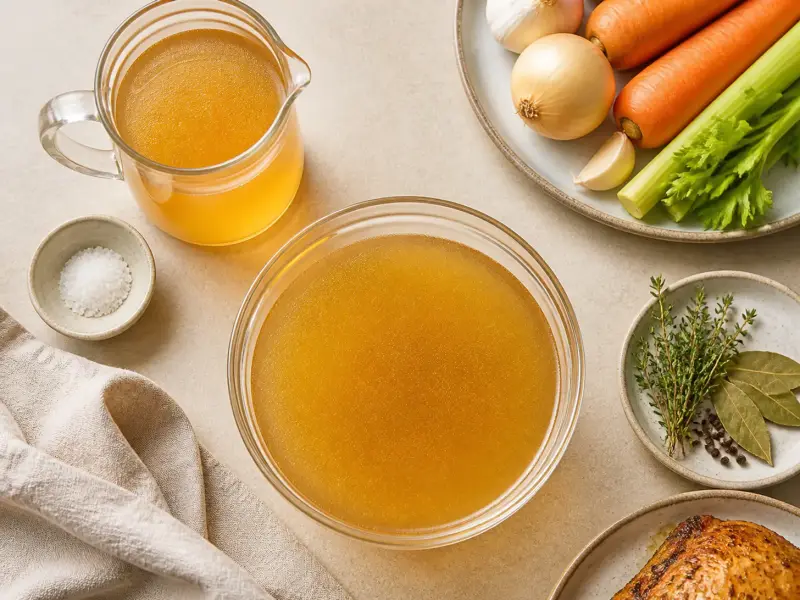 Chicken Stock
 Chicken Tikka Masala
 Jerk Chicken
 Roast Chicken with Lemon and Thyme
 Steak Diane
 Brown Stew Fish
 Cacio e Pepe