Chicken Tikka Masala
चिकन टिक्का मसाला
Yogurt-marinated chicken charred hard under a grill, then finished in a spiced tomato and cream sauce that only works if the char goes in with it.
- Prep
- 25 min
- Cook
- 35 min
- Resting
- 4 hr
- Total
- 5 hr
- Serves
- 4
- Revisions
- 6
Allergens
- Milk
- Nuts
Named from the ingredients as written, including those carried in from sub-recipes. This is not a guarantee — check the labels on what you actually buy, and note that a product’s recipe can change.
Ingredients
Serves
Method
Whisk the yogurt, lemon juice, half the garlic, half the ginger, 1 tsp of the garam masala, the turmeric, 1 tsp of the cumin and the salt together in a bowl.
Fold the chicken through until every piece is coated.
Cover and refrigerate for at least 4 hours, and up to overnight.
Heat the grill to its highest setting and line a tray with foil.
Shake the excess marinade off each piece and spread the chicken out on the tray in one layer, not touching.
Grill for 8-10 minutes, until the edges are blackened in patches and the yogurt has dried onto the surface.
Turn the pieces and grill for a further 5 minutes. They do not need to be cooked through here; they finish in the sauce.
Set the tray aside and keep every scrap of blackened residue on the foil.
Heat the oil in a wide heavy pan over medium heat and cook the onion for 10 minutes, until soft and starting to colour at the edges.
Add the remaining garlic and ginger and cook for 1 minute, until it smells sweet rather than raw.
Stir in the remaining cumin, the chilli powder and the tomato puree and cook for 30 seconds.
Tip in the tomatoes, the ground almonds and 150ml water, and scrape the base of the pan clean.
Simmer uncovered for 15 minutes, until the sauce has thickened and no longer tastes of raw tomato.
Add the chicken and every blackened scrap from the foil, and simmer for 8 minutes, until the chicken is cooked through.
Take the pan off the heat.
Stir in the cream, the sugar and the remaining garam masala.
Taste and correct the salt.
Scatter the coriander over and serve.
Nobody has rated this recipe yet.
Sign in to rate this recipe. One rating per person, and you can change it.
What to expect
- Taste
Sweet before anything else, and more so than people expect from something called a curry: 400g of tomatoes cooked down, a teaspoon of sugar and 150ml of double cream all pull the same way. Against that sits the char, which is bitter and smoky and faintly like burnt milk — because burnt milk is exactly what scorched yogurt is. The ground almonds give a soft, faintly marzipan sweetness underneath the tomato rather than any recognisable nuttiness. Lemon and yogurt from the marinade survive as a lactic tang at the edges of the meat. The chilli is a warmth in the throat rather than a heat on the tongue, and the garam masala stirred in off the heat reads as cardamom and clove sitting on top of everything, quite separate from the ground cumin cooked into the base.
- Aroma
Two completely different smells, ten minutes apart. Under the grill it is scorched yogurt and cumin — a burnt-milk smell that reads as wrong for a second before it reads as right, and if it never appears the grill was not hot enough. In the finished pan it is sweet cooked tomato and cream, and then the garam masala goes in off the heat and lifts cardamom and clove straight off the surface. That last thirty seconds is the only point in the recipe where a home kitchen smells like a curry house.
- Texture
The whole method exists so that two textures reach the bowl. The sauce is thick, coating and slightly grainy from the almonds. The chicken has a dried, faintly chewy charred crust on its outer edges that has not dissolved in eight minutes of simmering, and soft yielding thigh meat under it. A version cooked entirely in the pan has one texture and it is the sauce's — which is the single clearest way to tell a good tikka masala from a mediocre one without tasting it.
- Sound
Real spitting and cracking under the grill as fat renders onto hot foil, and it is the loudest thing that happens in the recipe. Everything after it is quiet: ten minutes of slow onion sizzle, a brief hiss as the ground spices hit the oil, then a low thick blip of a simmer that gets slower and heavier as the sauce reduces — which is a usable doneness cue on its own.
- How the flavour moves
Sweet, then warm, then smoke. Tomato and cream arrive first and are the softest thing in the bowl. The ground spices build through the middle of the mouthful without any single one stepping forward. The last thing, and the thing that makes the dish, is the char — bitter and smoky, arriving from the chicken rather than the sauce, so it lands after most of the mouthful has already gone. The chilli is the only element that accumulates: the fourth forkful is hotter than the first, and a whole bowl is hotter than any single bite of it.
- Serve it
Served properly hot, and it holds heat far longer than a thin sauce does, so it will scald straight from the pan and wants a minute in the bowl. Rice and naan are partly there to bring each mouthful down to a temperature you can actually taste.
- Goes with
Plain basmati, or garlic naan for the sauce that a fork will not lift. Cucumber raita or plain yogurt as a cooling counterweight, and raw red onion in lemon juice for something sharp and crunchy against a bowl that has nothing crisp in it. Lager or a soft low-tannin red; a salted lassi if the chilli has been taken seriously.
Cook's notes
- Difficulty
Easy in technique and dependent on nerve at one stage — the grill has to be left on long enough to blacken the chicken, which looks like ruining it.
- Cost
Moderate. Chicken thighs, a tin of tomatoes, cream and ground almonds, with the spices as the only up-front outlay.
- Equipment
An overhead grill that gets genuinely hot, a foil-lined tray, and a wide heavy pan. There is no tandoor here and no substitute for one — the grill is standing in for it, which is why it goes to its highest setting and why the tray goes as close to the element as it will fit.
- When to make it
Any evening the marinade can be started in the morning, and a good dish to cook for people because everything except the last fifteen minutes can be done in advance.
- Best season
None. Every ingredient is available year round and none of them is better at one time than another.
- You know it is done when
The chicken wants blackened patches rather than an even brown, with the yogurt dried to a matte crust between them, and it should look slightly overdone rather than handsome. The sauce is ready when a spoon dragged across the base of the pan leaves a line that closes slowly rather than instantly. Once the cream goes in it marbles pale through the orange for a few seconds before it is stirred through.
- And it feels like
The sauce should coat the back of a spoon and cling to the chicken rather than pooling under it, with a faint grain from the ground almonds rather than a silky smoothness. The chicken should be yielding all the way through with the charred outer edges still slightly chewy — eight minutes in the sauce is deliberately not long enough to soften them.
- Food safety
The chicken leaves the grill deliberately underdone, so the eight minutes in the sauce is a cooking stage and not a warming one — check the thickest piece rather than assuming. Raw marinated chicken and its bowl want the usual care; the marinade itself is discarded with the excess shaken off, and nothing is poured back into the pan except the cooked residue from the foil.
- Where it goes wrong
- Roasting the chicken in the oven instead of grilling it, which browns evenly and slowly and never chars — the grill is standing in for a tandoor and needs to blacken the edges before the middle cooks.
- Crowding the tray so the pieces touch, which steams them grey rather than charring them.
- Wiping the marinade off instead of shaking the excess off, leaving nothing on the surface to dry and blacken.
- Throwing the foil away with the blackened residue still on it, which is the single most consequential mistake available in this recipe.
- Letting the sauce boil after the cream goes in, which splits it into grainy curd and oil.
- Adding all the garam masala at the start, so the aromatics that make it worth using have boiled off by the time it is served.
- Using breast meat, which dries out under the grill and again in the sauce.
- If it does go wrong
Tastes flat and sweet with no depth: the chicken did not char, or the foil residue went in the bin. Sauce split and grainy: it boiled with the cream in it, and it will not come back — next time take the pan off the heat first. Chicken dry and stringy: breast rather than thigh, or too long under the grill on the second side. Sauce thin: it needed longer than fifteen minutes uncovered, or the almonds went in too late to swell. Sharp and acidic: the tomatoes were not cooked down enough, and the sugar is a corrective for this rather than a sweetener. Smells of raw spice: the ground spices went into oil that was not hot enough, or came out again within seconds.
- Making it ahead
The marinade can go on the night before. The sauce can be made a full day ahead and held at the point just before the cream. Grill the chicken, combine and finish on the night — about fifteen minutes of work.
- Keeping it
Three days refrigerated, and it is arguably better on the second day once the smoke has spread through the sauce.
- Reheating
Gently, covered, over low heat with a splash of water, and never at a boil — the cream will split on reheating just as readily as it would have on the night.
- Freezing
Freezes for three months, but freeze the sauce before the cream goes in and add the cream fresh on reheating. A finished cream sauce comes out of the freezer grainy.
- Leftovers
Excellent in a wrap with red onion, or thinned with a little water and used to poach eggs in the way shakshuka does. The charred edges on the chicken have gone soft by day two, which is worth knowing before serving it to somebody as the dish rather than as leftovers.
- Scaling it
Doubles cleanly in a large enough pan, with one thing that does not scale: the grill tray. Chicken must stay in one uncrowded layer, so a doubled batch needs two trays or two rounds, and squeezing it onto one loses the char that the whole recipe is built around.
- Substitutions
Cashews blitzed to a paste do the same job as ground almonds and are the more common thickener in restaurant kitchens. Full-fat coconut milk in place of the double cream works and moves the dish somewhere else entirely, sweeter and more fragrant. Kashmiri chilli powder gives far more colour than heat, which is worth knowing if you want the takeaway red without the takeaway burn. Chicken breast is possible if cut into larger pieces and grilled two minutes less each side.
- Dietary swaps
Contains milk and nuts. Gluten free as written. Paneer or halloumi cut into 3cm cubes, marinated the same way and grilled the same way, makes a genuinely good vegetarian version — both are firm enough to take the grill and both char at the edges. Coconut cream in place of the double cream makes it dairy free apart from the yogurt marinade, which can be swapped for a thick coconut yogurt.
- Shopping for it
Skinless boneless thighs, or bone them yourself from a pack of whole thighs for a good deal less. Full-fat natural yogurt rather than low-fat, which is thinner, clings badly and is likelier to split. Kashmiri chilli powder from a South Asian grocer if you want the colour without the heat.
- Keeping the cost down
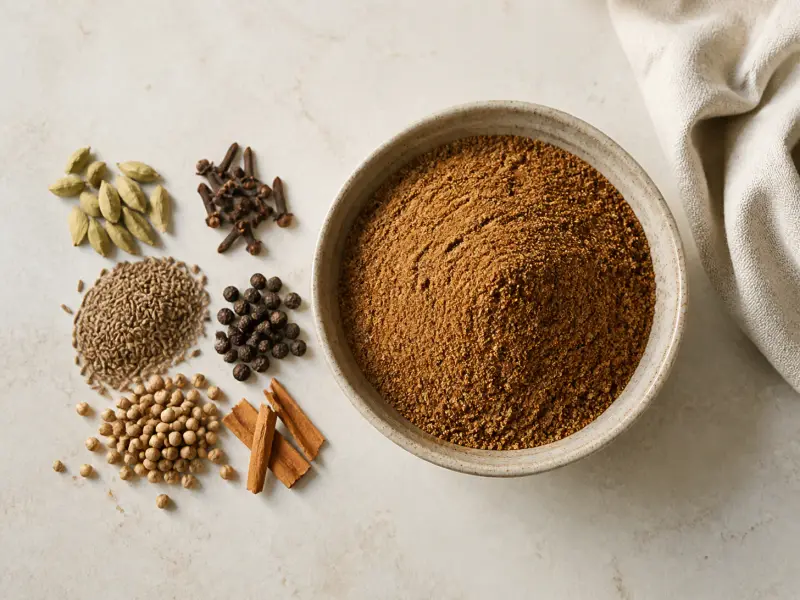
Boneless thighs are both cheaper than breast and better here, which is unusual enough to be worth saying. Grinding your own garam masala from the recipe in this collection costs a fraction of a jar and is noticeably more aromatic, which matters especially for the half that goes in off the heat.
- Sustainability
Thigh meat is the cheaper, more abundant part of the bird and using it rather than breast is the lower-waste choice by a clear margin. A whole chicken jointed at home gives the thighs for this and a carcass for stock.
- Nutrition
Rich. The cream, the almonds and the thigh meat are all contributing fat, though most of the yogurt marinade is shaken off before cooking rather than eaten. A high-protein main course with more sugar in it than the ingredient list suggests, most of it from the tomatoes.
- Worth it?
The best-known curry in Britain and one of the most commonly disappointing to make at home, for a single reason that takes ten minutes to fix — put the grill on maximum, let the chicken go black at the edges, and scrape the foil into the pan.
Where it comes from
- Origin
Disputed. Glasgow, the British curry house generally, and northern India are all argued for, and the dish is claimed by British and Indian food writing in roughly equal measure.
- Also called
Chicken tikka masala, usually shortened to CTM on British menus.
- Said out loud
TIK-ah muh-SAH-lah.
- What the name means
Tikka means pieces or chunks — the marinated, skewered, tandoor-cooked cubes that came first and exist as a dish in their own right. Masala means a spice blend, and by extension the spiced sauce made from one. The name is therefore a description of assembly: tandoori chicken pieces put into a sauce.
- History
Chicken tikka on its own is not in dispute: marinated pieces cooked on skewers in a tandoor are long-established north Indian and Punjabi cooking, and reached Britain with post-war migration. The argument is entirely about the sauce. The Glasgow account, given by Ali Ahmed Aslam of the Shish Mahal, is that he improvised one in the 1970s from tinned tomato soup, yogurt and spices for a customer who complained his chicken tikka was dry; it was reported widely and in 2009 a Glasgow MP tabled a Commons motion seeking protected origin status for the city, which went nowhere. A second account has no inventor at all: Britain's curry houses, overwhelmingly run by Bangladeshi and particularly Sylheti families, developed a set of standard house gravies to serve tandoori meat in, and this is the one that stuck. A third points at butter chicken, murgh makhani, developed in Delhi in the mid-twentieth century, and argues that tikka masala is a version of it rather than a British invention. There is no contemporary documentary evidence that settles any of them, and the dispute is now old enough that it is unlikely to be settled.
- Why it matters
In 2001 the British Foreign Secretary, Robin Cook, used it in a speech as his example of a genuinely British national dish — his point being that Britain adapts what it absorbs. Whatever that says about origins, it says something reliable about reach: it has been among the most ordered dishes in the country for decades and is what most people in Britain picture when they hear the word curry.
- When it is eaten
Friday night, takeaway night, and the first curry most British children are given because it is the mild sweet one. Not tied to any festival or ceremony anywhere.
- The traditional way
Two separate cooking methods that meet at the end, which is what the dish actually is. Dry, fierce heat for the meat — a tandoor traditionally, a grill at home — so the yogurt coating dries and blackens rather than stewing. Then a wet, slow onion-and-tomato masala made independently, enriched with a nut paste in the Mughlai manner rather than with flour or roux. The two are combined only in the last few minutes, which is why the char survives into the finished bowl.
- How it changed
The bright red-orange most people associate with it is largely a colouring decision rather than an ingredient one, and has softened over time as restaurants moved away from added colour. Cream has increasingly replaced or supplemented yogurt in the sauce, making the dish richer and milder than earlier versions. And the tandoor has quietly disappeared from most kitchens making it, home and professional, in favour of a grill or a hot pan.
- Regional variations
Butter chicken is its closest relative and the two are frequently confused: butter chicken is generally milder, smoother, more heavily butter- and cream-led and made without the onion base this recipe uses. Beyond Britain the dish travelled largely as a British export, so the versions found in North America and Australia descend from curry-house cooking rather than from anything in India. It is not a standard restaurant dish across most of India itself.
- How this version differs
No food colouring, so the finished sauce is brick orange rather than red. Ground almonds rather than cream alone do most of the thickening, which is the older Mughlai approach and gives the sauce body without another 200ml of dairy. The garam masala is split, half into the marinade and half stirred in off the heat, because its aromatics are volatile and a spice blend simmered for half an hour has given up most of what it was for. And the recipe insists on the blackened residue going into the pan, which restaurant kitchens do as a matter of course and home recipes almost always omit.
- Sources and credit
Contested. Ali Ahmed Aslam of the Shish Mahal in Glasgow is the most frequently named individual, and the claim is neither proven nor disproven. It sits against a serious argument that the dish had no single inventor and emerged across many kitchens at once.
 Garam Masala
 Goan Fish Curry
 Lamb Rogan Josh
 Chana Masala
 Chicken à la King
 Curry Goat
 Green Curry with Chicken and Thai Basil