Goan Fish Curry
मासळी कढी
Masli kodi
White fish poached in a coconut and tamarind sauce ground from whole spices, sour and hot in equal measure and cooked in under half an hour.
- Prep
- 15 min
- Cook
- 20 min
- Total
- 35 min
- Serves
- 4
- Revisions
- 6
Allergens
- Fish
Named from the ingredients as written, including those carried in from sub-recipes. This is not a guarantee — check the labels on what you actually buy, and note that a product’s recipe can change.
Ingredients
Serves
Method
Rub the fish with half the turmeric and half the salt and leave it on a plate while you build the sauce.
Heat the oil in a wide pan over medium heat and cook the onion for 8 minutes, until soft and pale gold.
Add the garlic and ginger and cook for 1 minute.
Stir in the coriander, cumin, chilli powder and the remaining turmeric and cook for 30 seconds.
Pour in the coconut milk and 100ml water and stir until smooth.
Bring it to the barest shiver, with the surface moving but not bubbling, and hold it there for 5 minutes.
Stir in the tamarind paste, the green chillies and the remaining salt.
Slide the fish into the sauce in one layer and spoon the sauce over it.
Poach for 6-8 minutes without stirring, until the fish flakes when pressed at its thickest point.
Take the pan off the heat and let it stand for 2 minutes.
Taste the sauce and correct the salt and sourness.
Scatter the coriander over and serve with plain rice.
Nobody has rated this recipe yet.
Sign in to rate this recipe. One rating per person, and you can change it.
What to expect
- Taste
Sour first, and that is what makes it Goan rather than generically Indian. Tamarind is fruity, dark and sharp all at once — closer to a date than to a lemon — and there is enough of it here to be the leading flavour. Behind it, coconut milk is sweet, fatty and slightly grassy, and the two of them together are the dish. Ginger is warm and sharp, garlic mellow, and the ground coriander gives a citrusy earthiness that is the largest of the dry spices. Chilli powder brings heat and the slit green chillies bring a different, greener heat that sits higher in the mouth. Turmeric is bitterness and colour. And the fish is mild and sweet and does not compete, which is exactly right — this is a sauce dish and the fish is the thing being carried.
- Aroma
Onions in oil first. Then the thirty seconds of ground spices, which is the loudest aromatic moment in the cook — coriander and cumin hitting hot fat. Coconut milk mutes everything and the pan goes quiet-smelling for a while. Then tamarind, which is sharp and slightly fermented, and finally fresh coriander at the end, which is the brightest thing in the dish.
- Texture
Silky and light, which is the coconut milk emulsion doing its job. It should coat rice without being thick or claggy. Against it, fish that flakes into large soft pieces. There is no crunch anywhere, which is why plain rice and perhaps a raw onion salad are the right accompaniments.
- Sound
Very little, and the absence of sound is the doneness cue. A properly held shiver makes almost no noise; if you can hear the pan bubbling, the heat is too high and the sauce is about to split. Before that, the ground spices hitting the pan give a brief sharp sizzle.
- How the flavour moves
Sour first and immediately. Then coconut fat spreading and softening it. The spices come through the middle, and the heat builds behind them and keeps building — green chilli heat in particular accumulates across a plate. The finish is long, sour and slightly sweet from the coconut, and it makes you want rice rather than water. Over a bowl the sourness stays constant and the heat rises.
- Serve it
Hot but not fierce, with hot rice. It also eats well at room temperature, which is a property of coconut-and-tamarind curries generally and makes it useful for a table where things sit.
- Goes with
Plain steamed rice, and a lot of it — this is the accompaniment the dish is designed around. A simple salad of raw onion, tomato and lime, which is what a Goan table would have. Plain yoghurt for the heat. Cold lager, or an off-dry white with enough sweetness to handle the chilli. Where it fails is with tannic red wine, which the tamarind and the chilli both wreck, and next to anything else creamy.
Cook's notes
- Difficulty
Easy, with one thing to control: the heat under the coconut milk. Everything else is stirring.
- Cost
Moderate, and mostly the fish. A tin of coconut milk and a jar of tamarind cost very little and the tamarind lasts a year.
- Equipment
A wide pan that will hold the fish in a single layer. That width is the requirement — fish stacked on top of itself cooks unevenly and has to be turned, and turning is what breaks it.
- When to make it
Any time. It is light enough for summer and warming enough for winter.
- Best season
None in the store cupboard. Fish availability varies and taking the fishmonger's advice is the whole of the seasonality here.
- You know it is done when
The sauce should be smooth, glossy and pale gold, with no visible oil separating at the edges — separation is the failure here, unlike in a north Indian masala where it is the goal. The fish is done when it flakes cleanly at the thickest point and is opaque throughout.
- And it feels like
Fish should flake into large pieces rather than shred. If it is falling apart it was stirred, or it overcooked.
- Food safety
Fish is cooked when opaque throughout with no translucent grey at the centre. Buy it fresh, keep it cold, and cook it the day you buy it — it should smell of clean sea and nothing else. Anything with an ammonia note goes in the bin.
- Where it goes wrong
Boiling the sauce, which splits the coconut milk — the single fault that ruins this dish. Stirring after the fish goes in, which breaks it up. Using light or reduced-fat coconut milk, which has less fat to emulsify and splits far more readily. Overcooking the fish, which is a two-minute error. Under-souring at the end, because tamarind pastes vary enormously in strength and the recipe is right to make you taste. And adding the tamarind before the coconut milk has come together, which can curdle it.
- If it does go wrong
Split and grainy with oil on top: it boiled. It is still edible and cannot be fixed; keep the heat lower next time. Not sour enough: more tamarind, half a tablespoon at a time. Too sour: a teaspoon of sugar and more salt, both of which suppress acid perception. Fish fallen apart: it was stirred or overcooked. Thin: simmer the sauce longer before the fish goes in, never after. Bland: salt, then more tamarind — this dish is more often under-soured than under-spiced.
- Making it ahead
The sauce can be made a day ahead and kept in the fridge; reheat it gently and poach the fish fresh, which takes eight minutes. That is much the best way to use this recipe on a weeknight.
- Keeping it
Two days in the fridge. The fish firms up and the sauce is arguably better; this is a curry that keeps unusually well for a fish dish, because of the acid.
- Reheating
Very gently and never to a boil, for the same reason it was never boiled in the first place.
- Freezing
The sauce alone freezes well for three months. Frozen cooked white fish goes watery.
- Leftovers
Good cold, and genuinely good the next day at room temperature with rice.
- Scaling it
The sauce scales freely. The fish does not — it must sit in a single layer, so more people means a wider pan or two batches.
- Substitutions
Kokum — a dried sour fruit used across the Konkan coast — is the more traditional souring agent in many Goan households and gives a cleaner, less fruity sourness than tamarind; if you find it, use six or seven pieces and no tamarind. Any firm white fish works: pollock, cod, haddock, hake, monkfish, kingfish. Avoid delicate flat fish, which fall apart. Prawns work very well and need three minutes rather than eight. Coconut milk cannot be replaced by cream, which curdles at the first hint of acid.
- Dietary swaps
Pescatarian, dairy-free, gluten-free and nut-free as written — coconut is classed as a tree nut in some jurisdictions and anyone with that allergy should treat it accordingly. Vegan with firm tofu, aubergine or chickpeas in place of the fish, and the sauce is genuinely good enough to carry any of them. Contains fish, declared.
- Shopping for it
Firm white fish, and ask what is cheap and fresh rather than asking for cod. Full-fat coconut milk with a high coconut percentage — check the label, since some brands are largely water and thickener. Tamarind paste or, better, kokum from an Indian grocer.
- Keeping the cost down
Pollock, coley and hake are a fraction of the price of cod and are better suited to this dish, since they are firmer and hold together in the sauce. Frozen white fish works perfectly well here and is cheaper — thaw it properly and pat it dry. Tamarind in a block is cheaper than paste and needs twenty minutes of soaking.
- Sustainability
Worth thinking about. Cod stocks vary enormously by fishery and pollock, coley, hake and farmed white fish are generally better choices as well as cheaper. Ask where it came from; a fishmonger who cannot say is a reason to buy something else.
- Nutrition
Around 420 calories a serving. Most of the fat is coconut, which is highly saturated; against that, white fish is very lean and high in protein, and there is no added dairy or butter. Tamarind contributes a useful amount of potassium.
- Worth it?
Worth it, and it is the best weeknight curry in the collection. Thirty-five minutes, one pan, and a genuinely different flavour profile from anything else here — sour-led rather than sweet or smoky. Keep the heat low once the coconut milk is in and it is close to foolproof.
Where it comes from
- Origin
Goa, on India's Konkan coast.
- Also called
Xitti kodi in Konkani — literally rice curry, since it is what is eaten with rice almost every day. It is also called ambot tik, sour and hot, which is the most accurate description of it in any language.
- Said out loud
Ambot tik is AM-bot teek.
- What the name means
Ambot means sour and tik means hot or pungent. Naming a dish after its two dominant sensations rather than its ingredients is unusual and tells you what matters.
- History
Goa is a narrow coastal strip with coconut palms, tamarind trees, kokum and a great deal of fish, and this curry is what those four things become. The Portuguese held Goa from 1510 to 1961 and their influence on Goan food is enormous — vindaloo is the clearest example — but this dish is largely the older, indigenous Konkani tradition, with one Portuguese import in it. Chillies are American plants and reached India via Portuguese trade in the sixteenth century; before that the heat in this curry came from black pepper, which grows on the same coast and was the spice that brought European ships to it in the first place. The dish is genuinely old and its heat is not.
- Why it matters
It is everyday food rather than special-occasion food, eaten most days in coastal Goan households, and it is one of the clearest demonstrations that Indian regional cooking bears almost no relation to the north Indian dishes that represent the country abroad. There is no cream, no butter, no browned onion base and no garam masala in it.
- When it is eaten
Every day. It is lunch.
- The traditional way
Grinding fresh grated coconut with the spices, chillies and tamarind on a stone into a wet masala, which is then loosened with water. That paste is a different thing from tinned coconut milk — coarser, fresher, and with the spices fully integrated — and it is what a Goan kitchen does. The version here is a weeknight adaptation and is honest about it.
- How it changed
Tinned coconut milk is the main change and it is a real trade: much faster, slightly sweeter, and less textured than fresh ground coconut. Tamarind paste in a jar has similarly replaced soaking tamarind blocks.
- Regional variations
The Konkan coast runs from Maharashtra to Kerala and every stretch of it has a version. Kerala's meen curry uses kokum or fish tamarind and often curry leaves and coconut oil. Mangalorean versions are redder and hotter. Within Goa, Hindu and Catholic households cook differently — the Catholic versions more often use vinegar alongside or instead of tamarind, which is the Portuguese influence showing.
- How this version differs
It uses tinned coconut milk and jarred tamarind, which is a weeknight version of a ground-paste dish. It is also explicit about the temperature, which most recipes leave as 'simmer' and which is the one thing that decides whether the sauce holds together.
- Sources and credit
None. Traditional and unauthored.
Related recipes
 Crisp-Skinned Salmon
 Brown Stew Fish
 Chicken Tikka Masala
 Escovitch Fish
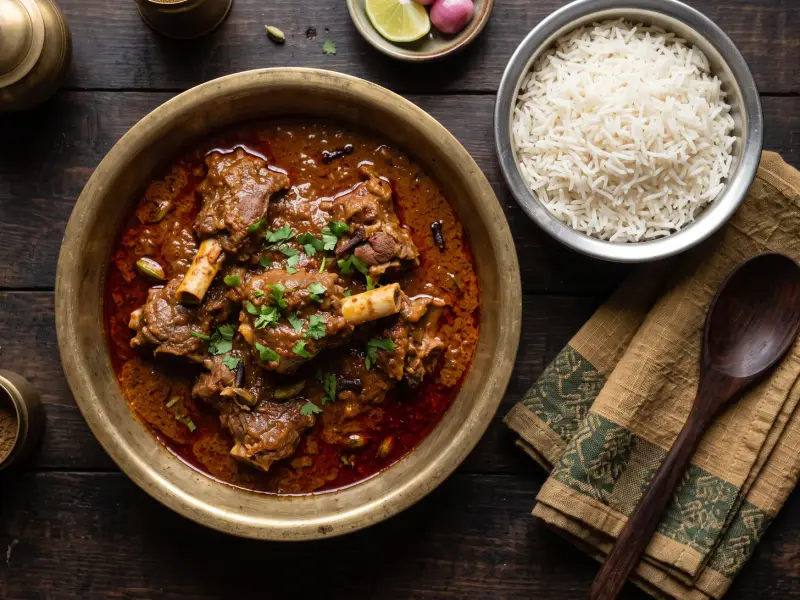 Lamb Rogan Josh
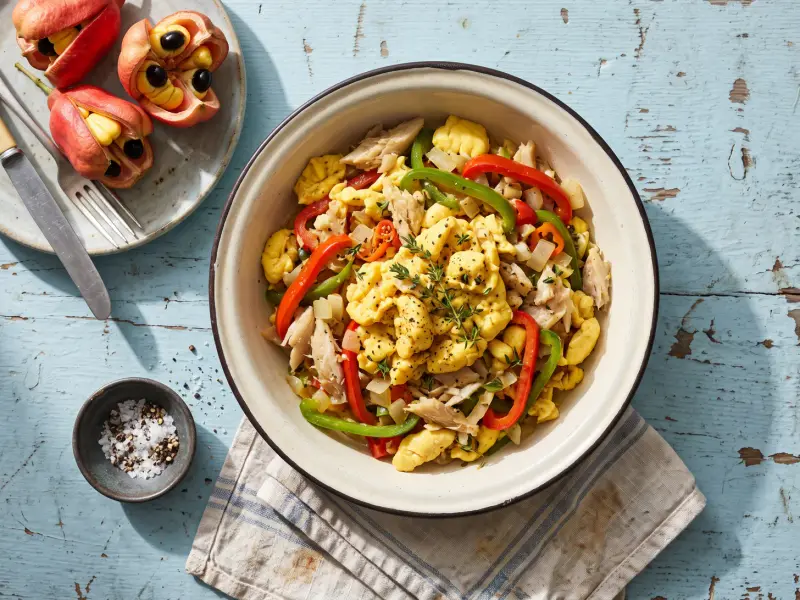 Ackee and Saltfish
Categories
Cuisines
Courses & dish types
Main ingredients
Diets
Time & effort