Crisp-Skinned Salmon
Salmon fillets cooked almost entirely on the skin side in one pan, which crisps the skin and leaves the flesh barely set.
- Prep
- 5 min
- Cook
- 10 min
- Total
- 15 min
- Serves
- 2
- Revisions
- 5
Allergens
- Fish
- Milk
Named from the ingredients as written, including those carried in from sub-recipes. This is not a guarantee — check the labels on what you actually buy, and note that a product’s recipe can change.
Ingredients
Serves
Method
Take the salmon out of the fridge 10 minutes before you cook it.
Blot the skin with kitchen paper, pressing rather than wiping, until the paper comes away dry.
Season both sides of the fillets with the 3g of fine salt.
Pour the oil into a cold heavy frying pan and tilt it to coat the base.
Lay the fillets skin-side down in the cold pan.
Set the pan over medium heat. Starting cold gives the fat under the skin time to render as the pan comes up; skin dropped into a pan already smoking seizes and sticks before any of it has rendered out.
Press each fillet flat with a fish slice for the first 20-30 seconds, until it stops trying to lift at the edges. Salmon skin contracts as it heats and bows the fillet into a curve, and the middle of the skin then never touches the metal at all.
Leave the fish alone once it sits flat.
Cook skin-side down for 6-8 minutes, until the flesh has turned opaque up the sides to about two-thirds of its depth.
Do not try to lift it before then. The skin releases itself the moment it is properly crisp, and a fillet prised up early leaves the skin welded to the pan and comes away bare.
Turn the fillets with a thin slice.
Drop the cold butter into the pan.
Cook flesh-side down for 60-90 seconds, spooning the foaming butter over the fillets, until the thickest part gives easily under a finger and the very centre is still a shade darker than the edges.
Lift them onto warm plates skin-side up, so the crisp side never sits in steam.
Rest for 2 minutes, which is long enough for the centre to finish setting in the residual heat.
Finish the skin with flaky salt.
Scatter the dill over the plated fish rather than into the pan, since the fronds blacken and turn grassy the moment they hit hot butter.
Serve with the lemon wedges.
Nobody has rated this recipe yet.
Sign in to rate this recipe. One rating per person, and you can change it.
What to expect
- Taste
Clean and rich, with the fish's own natural fat carrying most of the flavour — a well-rendered, crisp skin tastes distinctly savoury and almost bacon-like at the edge, quite different from the same skin left soft. The foaming butter baste adds a nutty, faintly caramelised note in the last minute of cooking, and lemon at the table cuts cleanly through the richness of both.
- Aroma
A rich, savoury smell of rendering fish fat as the skin crisps, and a distinct nutty aroma once the butter is added and starts to foam and brown slightly in the residual heat.
- Texture
A genuinely crackling, crisp skin against flesh that flakes into large, moist curds rather than dry sheets — the contrast between the two textures is the entire reason for the method.
- Sound
A quiet, steady sizzle that builds gradually as the pan comes up to temperature, rather than the sharp, immediate hiss of a fillet dropped into an already-hot pan.
- How the flavour moves
The crisp, savoury skin is the first thing to register, rich and almost salty from the rendered fat; the flesh underneath is milder and more delicate, with the butter's nutty note and the lemon's acidity, where used, arriving last and brightening the finish.
- Serve it
Served hot, though the short rest afterwards means the very centre continues gently cooking and settling rather than being served the instant it leaves the pan.
- Goes with
Simple steamed greens or rice to let the fish's fat and crisp skin remain the focus; a squeeze of lemon at the table rather than a heavy sauce, which would compete with the point of the crisp skin.
Cook's notes
- Difficulty
Moderate. The method is simple, but it demands real patience — pressing the fillet flat and then leaving it alone for several minutes without checking it.
- Cost
Moderate. Farmed Atlantic salmon is widely available at a reasonable price; wild salmon costs considerably more.
- Equipment
A heavy frying pan, ideally one with some thermal mass, and a fish slice for pressing the fillet flat.
- When to make it
Weeknight dinners, and any meal wanting a fast, protein-forward main.
- Best season
Farmed salmon is available year round; wild salmon has a defined seasonal run depending on species and region.
- You know it is done when
The flesh should have turned from translucent to opaque up the sides to about two-thirds of its depth by the time it is turned, with a shade of translucency remaining at the very centre.
- And it feels like
The thickest part should give easily under a fingertip, with the very centre still a shade darker and softer than the rest — it continues setting during the rest.
- Food safety
Salmon is safe to eat at a range of doneness from rare to well done, unlike poultry, so the target here is texture rather than a specific safe minimum temperature; standard fish handling and hygiene otherwise apply.
- Where it goes wrong
- Starting with a hot pan, which seizes the skin before its fat has rendered and welds it to the metal.
- Not pressing the fillet flat at the start, letting it curl so the middle of the skin never touches the pan.
- Trying to lift the fish before the skin has released on its own, tearing it off in the pan.
- Adding fresh herbs to the hot pan rather than the finished plate, blackening them instantly.
- If it does go wrong
Skin sticking: the pan was too hot at the start, or the fish was lifted before it was ready to release on its own — wait longer next time. Skin not crisping: too much moisture was left on the skin before cooking, or the heat was too low throughout. Overcooked centre: it was left too long skin-side down, or rested for too long afterwards without accounting for carryover cooking.
- Making it ahead
Not a make-ahead dish; it is quick enough that it should be cooked to order.
- Keeping it
Best eaten immediately; keeps a day refrigerated but the crisp skin does not survive storage.
- Reheating
A hot dry pan, skin-side down, briefly, is the only method that has any chance of restoring some crispness; a microwave leaves the fish rubbery and the skin soft.
- Freezing
The raw fillets freeze well; the cooked dish does not freeze or reheat successfully.
- Leftovers
Good flaked cold into a salad or through pasta the next day, accepting the skin will no longer be crisp.
- Scaling it
Scales by pan size — do not crowd the pan, since fillets too close together trap steam and prevent proper crisping.
- Substitutions
Any fillet of similar thickness with skin on works the same way — trout and sea bass both respond well to the same cold-pan start.
- Dietary swaps
Contains fish and milk, from the butter. Dairy free with a neutral oil in place of the finishing butter, though the foaming-butter baste is what carries most of the dish's final flavour and richness.
- Shopping for it
Norway, Chile and Scotland produce most of the world's farmed Atlantic salmon; choose fillets of even thickness so they cook at the same rate.
- Keeping the cost down
Farmed Atlantic salmon is considerably cheaper than wild and, for this method specifically, its higher fat content actually crisps more reliably.
- Sustainability
Farmed salmon carries well-documented environmental concerns around feed sourcing, sea lice and local water impact, and independent certification schemes exist specifically to address them; choosing a certified source is a meaningful decision rather than a formality.
- Nutrition
A good source of protein and omega-3 fatty acids; the skin, once rendered and crisp, contributes meaningfully to the dish's fat content.
- Worth it?
A simple technique that solves the single most common home-cooking complaint about salmon — skin that either sticks or stays soft.
Where it comes from
- Origin
Not a single-origin dish; a contemporary technique applied to a widely farmed fish rather than a dish tied to one place.
- History
Salmon's transformation from luxury to everyday food tracks directly with the industrialisation of Norwegian salmon farming through the 1970s, which is a fisheries and economic history rather than a culinary one; the specific cold-pan technique for crisping the skin is a much more recent development in recipe writing, without a documented single inventor.
- Why it matters
Salmon is eaten in quantity across Japan, Norway, the United States and Britain in particular, and is one of the most widely sold fish anywhere a cold chain exists, making this method broadly relevant rather than tied to any specific cuisine's traditions.
- When it is eaten
A quick, everyday weeknight main course.
- The traditional way
Starting the fish skin-side down in a cold, oiled pan rather than a preheated one, and pressing it flat for the first moments of cooking to counter the skin's natural tendency to contract and bow the fillet into a curve.
- Sources and credit
No individual is credited with the cold-pan technique; it has no clearly documented single origin.
Related recipes
 Goan Fish Curry
 Brown Stew Fish
 Escovitch Fish
 Ackee and Saltfish
 Cacio e Pepe
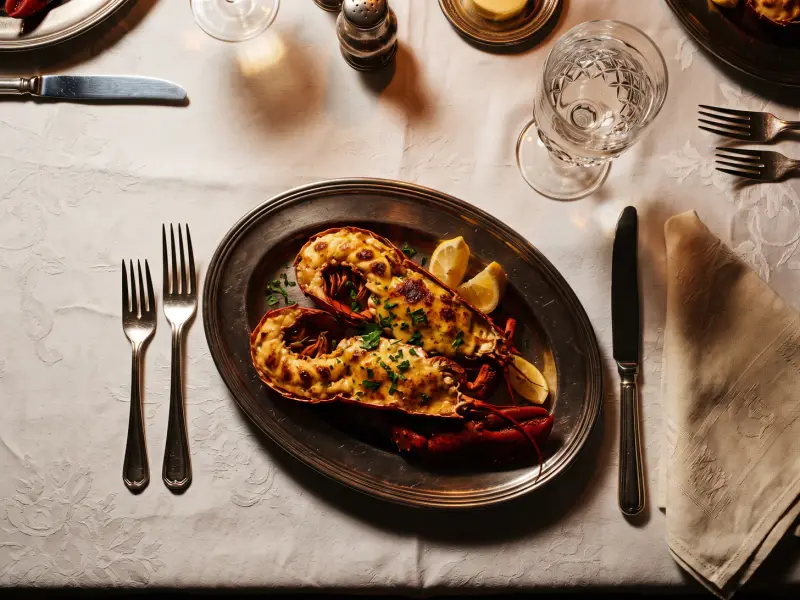 Lobster Thermidor
Categories
Courses & dish types
Main ingredients
Diets
Time & effort