Lamb Rogan Josh
روغن جوش
Rogan josh
روغن جوش — from Persian: rogan, clarified fat, and josh, heat.
Lamb shoulder browned hard then cooked for two hours in yogurt and Kashmiri chilli, until the sauce is red, glossy and clinging rather than soupy.
- Prep
- 20 min
- Cook
- 2 hr 20 min
- Total
- 2 hr 40 min
- Serves
- 6
- Revisions
- 5
Allergens
- Milk
Named from the ingredients as written, including those carried in from sub-recipes. This is not a guarantee — check the labels on what you actually buy, and note that a product’s recipe can change.
Ingredients
Serves
Method
Pat the lamb dry with kitchen paper, which is the difference between browning and steaming.
Heat 2 tbsp of the oil in a heavy casserole over high heat.
Brown the lamb in three or four batches, about 4 minutes a batch, and lift each one out to a plate. A crowded pan will not colour.
Turn the heat to medium and add the remaining oil.
Add the cardamom pods, cinnamon, cloves and bay and let them sizzle for 30 seconds.
Add the onions and cook for 12 minutes, until soft and golden.
Add the garlic and ginger and cook for 2 minutes.
Stir in the chilli powder, coriander and fennel and cook for 30 seconds, off the heat if the pan is very hot, since these burn in seconds.
Return the lamb and any juices on the plate to the pan.
Take the pan off the heat and add the yogurt a spoonful at a time, stirring each one in fully before the next goes in.
Add the salt and 200ml water.
Bring it to a bare simmer, cover, and cook over the lowest heat for 2 hours, stirring every half hour.
Uncover for the last 20 minutes if the sauce is thinner than you want.
The lamb is ready when a piece falls apart under light pressure from a spoon.
Stir in the garam masala, taste for salt, and let it stand for 10 minutes before serving.
Nobody has rated this recipe yet.
Sign in to rate this recipe. One rating per person, and you can change it.
What to expect
- Taste
Rich and warmly spiced rather than sharply hot, with the Kashmiri chilli giving colour and a gentle, building warmth rather than a fierce burn. The whole spices — cardamom, cinnamon, clove — sit underneath the chilli as a warm, faintly sweet backdrop, and the yogurt gives the sauce a rounded, faintly tangy body that ties the fat and the spice together.
- Aroma
Whole spices toasting in oil first — cardamom and cinnamon especially — followed by sweet browning onion, and finally the toasted, earthy smell of the Kashmiri chilli and ground spices as they bloom in the fat.
- Texture
Meat that falls apart at the touch of a spoon, held in a sauce with real body rather than a thin, watery gravy.
- Sound
A sharp sizzle as the lamb browns in batches, settling into a slow, occasional bubble once the yogurt and water go in and the lid goes on.
- How the flavour moves
The whole spices register first as a warm, aromatic base, the Kashmiri chilli's colour and gentle heat build through the middle, and the yogurt's tang is the last thing to round off the finish, keeping the richness from feeling heavy.
- Serve it
Served hot, and the sauce holds its heat well given how much body it has.
- Goes with
Steamed basmati rice or naan, both there to carry the sauce rather than compete with it.
Cook's notes
- Difficulty
Moderate — nothing in it is technically hard, but the yogurt has to be added carefully and the braise genuinely needs its full two hours.
- Cost
Moderate — lamb shoulder is the main cost, alongside a fuller spice list than a quick curry.
- Equipment
A heavy casserole with a lid.
- When to make it
A weekend or slow-cooked dinner rather than a weeknight dish, given the length of the braise.
- Best season
None; every ingredient is shelf-stable or standard fresh produce available year round.
- You know it is done when
The sauce should be a deep, glossy red-brown, thick enough to cling to the meat rather than sit as a thin liquid around it.
- And it feels like
A piece of lamb should fall apart under light pressure from a spoon rather than needing to be cut.
- Food safety
The long braise takes the lamb well past any safe cooking threshold; the main risk in the method is the yogurt splitting if added too fast or over too much heat, which is a texture fault rather than a safety one.
- Where it goes wrong
- Using an ordinary hot chilli powder in place of Kashmiri chilli at the same quantity, which makes the dish far too hot.
- Adding the yogurt cold and all at once, which splits it.
- Rushing the two-hour braise, which leaves the shoulder tough since its collagen has not had time to melt.
- Crowding the pan while browning the lamb, which steams rather than browns it.
- If it does go wrong
Sauce too fierce: an ordinary chilli powder was used instead of Kashmiri. Split, grainy sauce: the yogurt went in too fast or over too much heat. Tough meat: the braise was cut short before the full two hours.
- Making it ahead
Improves over a day or two in the fridge and reheats well, making it a genuinely good make-ahead dish.
- Keeping it
Keeps for 3-4 days refrigerated.
- Reheating
Reheat gently on the hob with a splash of water, since the sauce thickens considerably as it cools and can otherwise catch on the base of the pan.
- Freezing
Freezes well for up to three months.
- Leftovers
Improves over a day or two in the fridge, as the spice moves further through the meat.
- Scaling it
Scales up well in a larger, heavy pot, though the initial browning needs to be done in the same small batches regardless of the total quantity.
- Substitutions
Kashmiri chilli powder cannot be swapped for an ordinary hot chilli powder at the same quantity — it is chosen specifically for colour with comparatively little heat, and an equivalent measure of a hotter powder makes the dish far too fierce to eat. Full-fat yogurt is worth insisting on, since low-fat yogurt splits far more readily under heat.
- Dietary swaps
Contains milk from the yogurt. Naturally free of gluten, egg and nuts as written.
- Shopping for it
Kashmiri chilli powder is worth seeking from a South Asian grocer specifically for its colour-to-heat ratio, which an ordinary chilli powder does not replicate.
- Keeping the cost down
Lamb shoulder is one of the more affordable lamb cuts and is specifically suited to this long a braise.
- Sustainability
A single cut of lamb, slow-cooked, stretched across a generous number of servings.
- Nutrition
A rich source of protein and fat from the lamb shoulder, balanced by the yogurt's lighter tang.
- Worth it?
A dish whose reputation for fierce heat is largely undeserved once made with the right chilli — the colour is doing the visual work while the flavour stays warmly spiced rather than punishing.
Where it comes from
- Origin
Kashmir, in the wazwan tradition of Kashmiri celebration cooking.
- Also called
Rogan josh.
- Said out loud
ROH-gan josh.
- What the name means
Read either as Persian for oil and heat/passion, giving "cooked in hot fat", or as a word closer to red, giving "red juice" or "red gravy" — both readings are current and neither is settled as the correct one.
- History
The dish's present form is Kashmiri, and its ancestry is generally traced through Persian cooking that reached the region by trade and migration. It is one of the principal dishes of wazwan, the elaborate multi-course Kashmiri banquet served at weddings and major celebrations.
- Why it matters
One of the centrepiece dishes of wazwan, and among the most internationally recognised Kashmiri dishes through the Indian diaspora.
- When it is eaten
Weddings and major celebrations in Kashmir as part of wazwan, and an everyday restaurant and home dish in the wider Indian diaspora.
- The traditional way
Hard browning of the meat, colour and depth built from Kashmiri chilli rather than raw heat, and yogurt worked in gradually off direct heat to avoid splitting.
- How it changed
Kashmiri Pandit households traditionally make a version without onion or garlic, using asafoetida instead, reflecting Hindu Brahmin dietary practice, alongside the more widely known Muslim wazwan version that does use them — both are genuine regional traditions rather than one being a deviation from the other.
- Regional variations
The Pandit and Muslim Kashmiri versions differ chiefly in the presence of onion and garlic; both rely on Kashmiri chilli for colour.
- How this version differs
This recipe uses onion and garlic in the wazwan style rather than the Pandit style, and relies on Kashmiri chilli alone for colour without ratanjot root.
- Sources and credit
No individual is credited with the dish; it belongs to Kashmiri regional cooking with Persian roots rather than to any documented inventor.
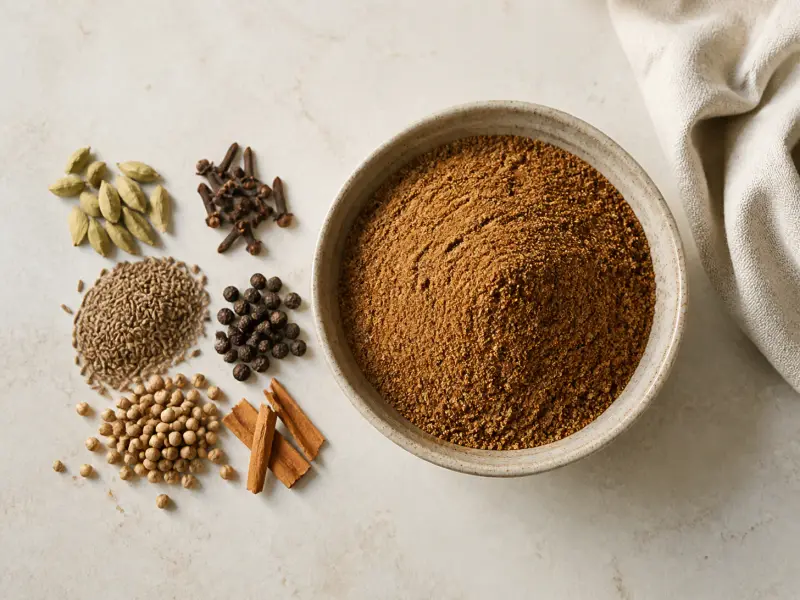 Garam Masala
 Curry Goat
 Chicken Tikka Masala
 Goan Fish Curry
 Brown Stew Fish
 Chana Masala
 Tagliatelle al Ragù