Curry Goat
Goat shoulder burned into curry powder and then cooked for two hours, until the meat gives and the sauce is thick enough to coat rice.
- Prep
- 25 min
- Cook
- 2 hr 30 min
- Resting
- 4 hr
- Total
- 6 hr 55 min
- Serves
- 6
- Revisions
- 6
Ten seconds, if you are in a hurry
The whole dish, carried in and set down, with the one thing worth knowing about it said out loud. No method, no measuring — just what it should look like when it arrives.
Watch on YouTubeIngredients
Serves
Method
Toss the goat with 2 tbsp of the curry powder, the salt and the pepper.
Cover and refrigerate for at least 4 hours, or overnight.
Heat the oil in a heavy casserole over medium-high heat.
Add the remaining 2 tbsp of curry powder and fry it for 40 seconds, stirring, until it darkens and smells toasted rather than dusty. This is the step called burning the curry.
Add the goat in two batches and brown it hard, about 5 minutes a batch, lifting each one out.
Turn the heat down, add the onions and cook for 8 minutes until soft.
Add the garlic, ginger, spring onions and thyme and cook for 2 minutes.
Return the goat and any juices, add the whole scotch bonnet, the allspice and the water.
Bring to a bare simmer, cover, and cook over the lowest heat for 2 hours.
Add the potatoes and cook uncovered for a further 30 minutes.
The goat is ready when it pulls away from the bone under a fork and the sauce coats the back of a spoon.
Lift out the scotch bonnet and the thyme stalks, taste for salt, and serve with rice and peas.
Nobody has rated this recipe yet.
Sign in to rate this recipe. One rating per person, and you can change it.
What to expect
- Taste
Deep, toasted curry spice with real weight from the turmeric, warmed rather than dominated by clove-like allspice, and the goat itself brings a distinct, slightly gamey richness that lamb does not quite match. The scotch bonnet, left whole, contributes fruity heat in the background rather than a sharp burn, and the potatoes, where used, soak up the sauce and turn genuinely savoury rather than staying a separate starch.
- Aroma
Toasted curry powder is the first and loudest smell, a warm, earthy, slightly smoky note from the frying stage, followed by garlic and ginger and the greener smell of fresh thyme.
- Texture
Meat that shreds under the lightest pressure, sitting in a sauce with real body — thick enough to cling to rice rather than pool around it — and potatoes that have gone soft enough to half-dissolve into the gravy at the edges.
- Sound
A sharp, fast sizzle as the curry powder hits hot oil, then a slow, occasional bubble through the long simmer.
- How the flavour moves
Toasted curry spice arrives first and coats the whole mouth, the goat's own richness follows a beat behind it, and the scotch bonnet heat builds in slowly at the finish rather than announcing itself early — the whole dish reads as deep and warming rather than sharply spiced.
- Serve it
Served hot, and it holds heat well because of the sauce's thickness.
- Goes with
Rice and peas is the standard base; fried plantain or a simple cabbage side rounds out the plate.
Cook's notes
- Difficulty
Moderate. Nothing in it is technically difficult, but it genuinely cannot be rushed — the goat simply is not done until it is done, however long the clock says it has been.
- Cost
Moderate to high, since goat meat is usually the most expensive ingredient in the dish relative to the rest of a Jamaican pantry.
- Equipment
A heavy casserole or Dutch oven that can go from a hard sear on the hob through hours of low, steady simmering.
- When to make it
Celebrations, large family meals, and any Sunday where the cook has the better part of a day free.
- Best season
None; goat and the spices used are available year round.
- You know it is done when
The sauce should be a deep, dark curry-brown and thick enough to coat the back of a spoon rather than run off it; the goat pieces should look like they are starting to come apart at the edges.
- And it feels like
The meat pulls away from the bone under light pressure from a fork, with no resistance at all — anything that still springs back needs more time, not more heat.
- Food safety
Goat, like any meat cooked for this long, needs to reach a safe internal temperature early in the process and stay there; the long simmer comfortably exceeds it, and the real risk is undercooking the marinating stage's raw meat handling rather than the finished dish.
- Where it goes wrong
- Stirring raw curry powder straight into liquid instead of frying it in oil first, which leaves the whole dish tasting dusty.
- Rushing the simmer, which leaves goat — a genuinely tough working muscle — simply chewy rather than tender.
- Adding the potatoes at the start, where they disintegrate into the sauce rather than holding their shape for the final 30 minutes.
- Simmering too hard rather than at a bare bubble, which toughens the meat rather than helping it along.
- If it does go wrong
Meat still tough after 2 hours: keep going rather than stopping — shin- and shank-like cuts including goat shoulder pass through a genuinely tough middle stage before they give. Sauce too thin: simmer uncovered for the final stretch, or once the meat is out, reduce the liquid alone before returning it. Tastes dusty or raw: the curry powder was not properly fried at the start; there is no fixing this once the liquid is in, only doing it right next time.
- Making it ahead
Genuinely better made a day ahead and reheated, since the sauce continues to develop as it sits.
- Keeping it
Keeps 3-4 days refrigerated, and the flavour genuinely improves on the second day as the sauce has more time to settle into the meat.
- Reheating
Gently, covered, over low heat with a splash of water if the sauce has thickened too far in the fridge.
- Freezing
Freezes very well for up to 3 months; a curry like this is one of the better dishes for making a double batch specifically to freeze.
- Leftovers
Excellent the next day, and good stretched further with extra rice or folded into a roti.
- Scaling it
Scales up well in a wider pot; the simmer time does not change much with quantity as long as the meat is in a single layer rather than piled deep.
- Substitutions
Lamb or mutton shoulder, cooked the same way, makes a close relative of the dish where goat is hard to source, though the flavour is milder and less gamey. A milder curry powder can be used, but the dish is built around the specific heaviness of turmeric and heat in a Caribbean blend rather than a standard Indian one, and the flavour shifts noticeably with a different blend.
- Dietary swaps
Dairy free and gluten free as written. Not suitable for anyone avoiding meat entirely, since goat is the structural ingredient rather than a flavour addition.
- Shopping for it
Goat meat is most reliably found at halal or Caribbean butchers rather than a standard supermarket counter; ask specifically for a stewing cut like shoulder or leg.
- Keeping the cost down
Buying goat shoulder or leg on the bone is considerably cheaper than boneless cuts, and the bone contributes to the sauce besides.
- Sustainability
Goats are generally less resource-intensive to raise than cattle, browsing on land not suited to other livestock, though this is a general point about the animal rather than a specific claim about how any particular goat in the supply chain was raised.
- Nutrition
A protein-rich dish; goat is comparatively lean meat relative to lamb, though the dish itself carries meaningful fat from the oil used to fry the curry powder and sear the meat.
- Worth it?
A dish worth the time it demands, and one that rewards being made in a large batch rather than a small one.
Where it comes from
- Origin
Jamaica, built by Indian indentured labourers who brought curry with them after emancipation.
- Also called
Curry goat.
- History
Following the abolition of slavery in the British Caribbean in 1834, plantation owners brought indentured labourers from India to Jamaica, Trinidad and Guyana in particular, and those labourers carried curry cooking with them. Goat, cheap and widely available on the island, became the meat the technique was applied to, and the Caribbean curry powder that resulted — heavier on turmeric than most Indian blends — is its own regional development rather than an import.
- Why it matters
One of the standard dishes served at Jamaican weddings, funerals, christenings and large parties, in the diaspora as much as on the island itself — it is close to the default dish for feeding a crowd.
- When it is eaten
Celebrations and gatherings of every kind, and a regular Sunday dinner in its own right.
- The traditional way
Curry powder fried directly in hot oil before any liquid is added — "burning the curry" — which toasts the spice and removes its raw, dusty taste before the long simmer begins.
- Regional variations
Trinidad and Guyana both have their own strong curry goat traditions running alongside Jamaica's, generally with their own house blends of curry powder and, in Trinidad in particular, the addition of geera (roasted ground cumin) as a separate seasoning.
- Sources and credit
No individual is credited with the dish; it is a product of Indian indentured labour meeting Caribbean ingredients over more than a century.
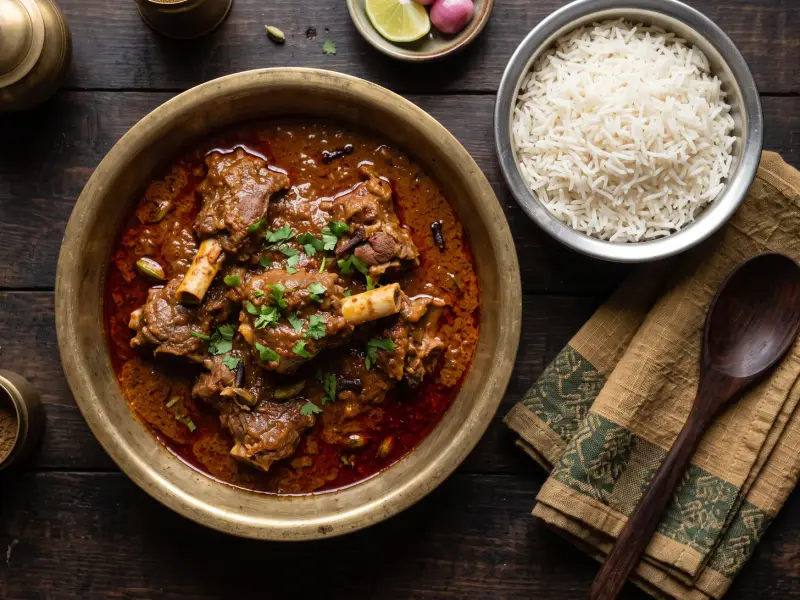 Lamb Rogan Josh
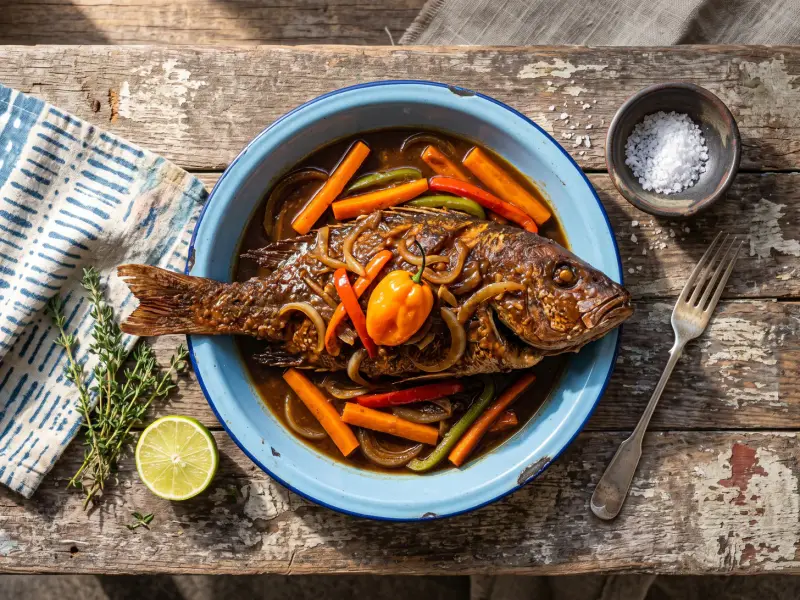 Brown Stew Fish
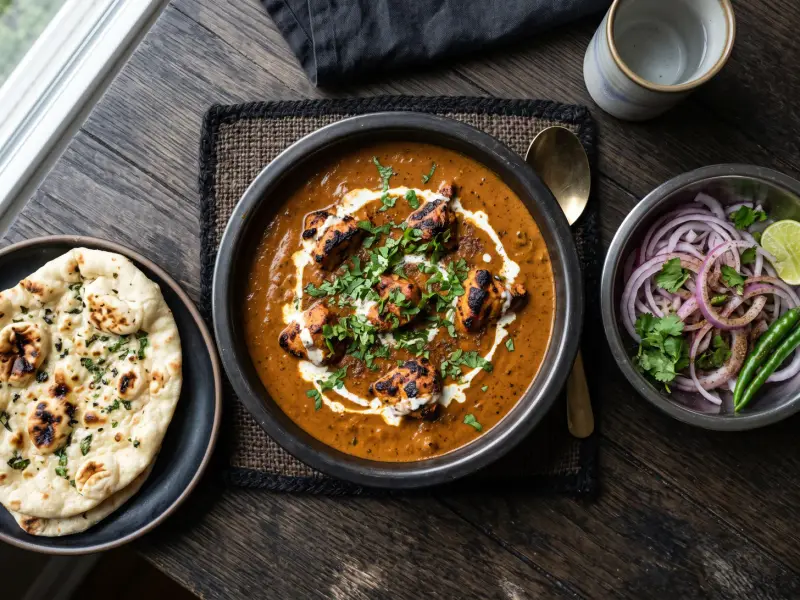 Chicken Tikka Masala
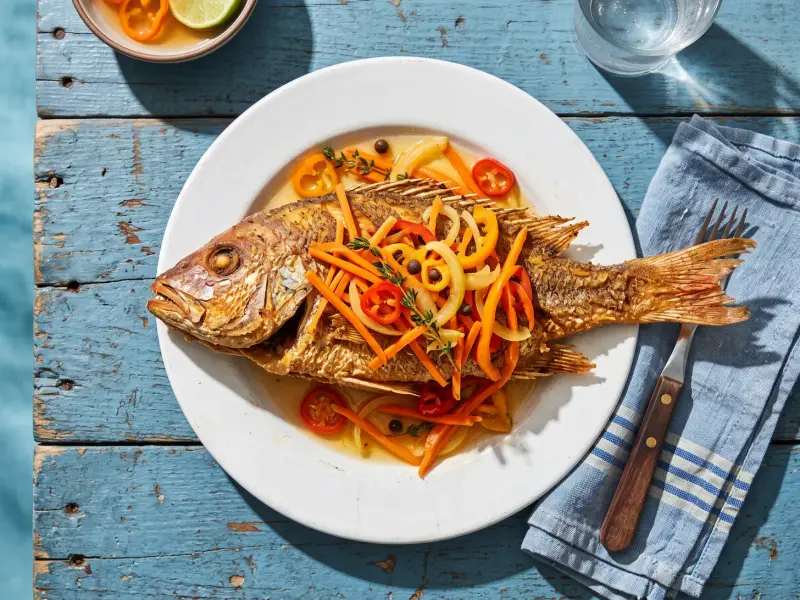 Escovitch Fish
 Goan Fish Curry
 Jerk Chicken