Chicken Congee
雞粥
Jī zhōu
Rice simmered in eight times its weight of stock until the grains collapse, into a savoury porridge finished in the bowl.
- Prep
- 15 min
- Cook
- 1 hr 35 min
- Total
- 1 hr 50 min
- Serves
- 4
- Revisions
- 5
Allergens
- Celery (via Chicken Stock)
- Sesame
- Soya
Named from the ingredients as written, including those carried in from sub-recipes. This is not a guarantee — check the labels on what you actually buy, and note that a product’s recipe can change.
Ingredients
Serves
Method
Put the rice into a heavy pan with the stock, the ginger coins and the chicken thighs.
Do not rinse the rice. Everything the steamed basmati rice in this collection washes down the sink is what thickens a congee, and rinsed grains give you chicken soup with rice in it.
Bring it to a boil over medium-high heat.
Skim off any foam that gathers in the first few minutes.
Turn the heat down until one bubble breaks the surface every second or two.
Simmer uncovered, or with the lid propped ajar, for 60-90 minutes.
Stir every 10 minutes with a wooden spoon, working it right across the base of the pan.
Do not leave it to itself. Rice sinks and welds to the base within minutes, and once a congee has scorched the burnt taste runs through the whole pot and cannot be lifted back out.
Lift the chicken thighs out after 25 minutes, once the meat pulls away from the bone.
Shred the meat with two forks and set it aside.
Discard the bones.
Carry on simmering until the grains have burst and lost their shape entirely and the congee falls off the spoon in a thick, even stream.
Fish out the ginger coins.
Stir the shredded chicken back in and warm it through for 2-3 minutes.
Season the pot with the 4g of fine salt and the soy sauce.
Take it off the heat while it is looser than you want to eat it. Congee thickens in the pan as it stands and again in the bowl, and a pot cooked to the right consistency on the hob sets to a solid mass by the time it reaches the table.
Loosen it with a splash of hot stock if it has already gone past that.
Ladle it into deep warm bowls.
Trickle the sesame oil over.
Season with the ground white peppercorns.
Scatter over the spring onions and coriander.
Put the chilli oil on the table for people to add themselves.
Remember the ratio rather than the numbers: eight parts liquid to one part rice by weight, which here is 200g of rice to 1.6 litres, and it holds at any quantity.
Nobody has rated this recipe yet.
Sign in to rate this recipe. One rating per person, and you can change it.
What to expect
- Taste
Deeply savoury and comforting, carrying the flavour of the chicken and stock right through the collapsed rice, with ginger's warmth running through the whole pot and each diner's own additions — sesame oil, chilli oil, white pepper — layering further flavour on top at the table.
- Aroma
A gentle, savoury steam throughout the long simmer, ginger's warmth rising through it, and a final nutty lift from the sesame oil once it is finished in the bowl.
- Texture
Silky and thick with no individual grain texture, loosened at the table to whatever consistency the diner prefers.
- Sound
A slow, occasional bubble through the long simmer, and the quiet scrape of a wooden spoon working across the base of the pan.
- How the flavour moves
Warm, savoury chicken and stock flavour fills the whole mouthful evenly rather than progressing through distinct stages, with ginger's warmth and whatever is added at the table — sesame oil, chilli, white pepper — layering on top as the last things tasted.
- Serve it
Served very hot, traditionally eaten as a comforting food for the sick and for small children as much as for anyone else.
- Goes with
Chilli oil, extra soy sauce, pickled vegetables or youtiao, deep-fried dough sticks, are all common table additions in the wider tradition.
Cook's notes
- Difficulty
Easy, though it needs regular stirring and real patience over the long simmer.
- Cost
Cheap — rice, chicken thighs and pantry seasonings.
- Equipment
A heavy pan, since the rice sinks and can scorch on a thinner one.
- When to make it
Breakfast traditionally, though suitable at any time of day, especially when feeling under the weather.
- Best season
None; every ingredient is shelf-stable or standard fresh produce available year round.
- You know it is done when
The grains should have completely burst and lost their individual shape, with the congee falling off a spoon in a thick, even stream rather than sitting in separate grains in liquid.
- And it feels like
Silky and thick, with no individual grain texture remaining, loosening again the moment hot stock or water is stirred through.
- Food safety
The chicken thighs are fully cooked through by the poaching time in the pot; check the meat pulls cleanly from the bone as the indicator rather than relying on time alone.
- Where it goes wrong
- Rinsing the rice before cooking, which washes away the surface starch the whole dish depends on for its texture.
- Leaving the pot unstirred for long stretches, risking the rice sinking and scorching on the base.
- Cooking it to the final eating consistency in the pan, without accounting for how much further it thickens as it stands.
- Overcooking the chicken by leaving it in the pot for the full simmering time rather than lifting it out once tender.
- If it does go wrong
Thin, soupy texture rather than a proper collapse: it needs more time, or was not simmered at a strong enough bubble. Scorched flavour: the rice was left unstirred for too long at some point and caught on the base. Overly thick, stiff congee: it was taken off the heat too late; loosen it with a splash of hot stock and remember it thickens further as it stands.
- Making it ahead
Keeps well for a few days and is a genuinely practical make-ahead dish, since reheating with extra liquid restores its texture easily.
- Keeping it
Keeps for up to three days refrigerated, though it thickens considerably and needs loosening with stock or water on reheating.
- Reheating
Reheat gently on the hob with a generous splash of hot stock or water, stirring, since it sets to a much thicker consistency once cold.
- Freezing
Freezes reasonably well, though the texture needs a good stir and extra liquid on thawing to restore its original consistency.
- Leftovers
Very good reheated, since it is a dish traditionally eaten at any time of day and improves in convenience the more it has been loosened with fresh stock.
- Scaling it
Scales up cleanly by keeping the eight-to-one ratio of liquid to rice by weight, adjusting simmering time slightly for a larger pot.
- Substitutions
Jasmine rice is standard, though any long-grain white rice works; short-grain or pudding rice gives a stickier, less traditional result.
- Dietary swaps
Contains sesame and soya. Naturally free of gluten, milk, egg and nut allergens as written, though check any stock used for other allergens.
- Shopping for it
Standard jasmine or long-grain rice from any supermarket; nothing specialist is needed.
- Keeping the cost down
A very cheap dish overall, since a modest amount of rice and two chicken thighs stretch across a large, filling pot.
- Sustainability
A low-cost, efficient way of stretching a small amount of chicken across a substantial, filling meal.
- Nutrition
A gentle, easily digestible source of carbohydrate and protein, particularly suited to anyone feeling unwell.
- Worth it?
A dish whose whole method is really one ratio worth memorising, after which it can be made confidently at any scale without consulting a recipe again.
Where it comes from
- Origin
China, with the English word arriving by a different route entirely.
- Also called
Zhou (粥), or jai depending on regional pronunciation.
- Said out loud
CON-jee.
- What the name means
The English word congee derives from Tamil kanji, meaning a rice gruel, carried into English by Portuguese traders operating in southern India from the 16th and 17th centuries — an unusual etymological route for a dish so associated with China today.
- History
Rice cooked down in liquid until it collapses is among the oldest recorded ways of preparing it in China, appearing in early Chinese texts with no traceable origin date. The dish's English name reflects a completely separate linguistic history, having entered the language via Tamil and Portuguese contact in southern India rather than through direct contact with China.
- Why it matters
A breakfast staple across China, Hong Kong and Taiwan, sold from street stalls and made at home, and specifically the food given to the sick and to small children across every culture where it is eaten.
- When it is eaten
Breakfast, and specifically food for anyone unwell or very young, given how gentle and easy to digest it is.
- The traditional way
Simmering raw rice, unrinsed, in a large volume of liquid for a long time until it fully collapses, seasoned lightly in the pot and finished individually at the table.
- How it changed
Little about the core technique has changed; variation is mostly in what protein and toppings are used, and in how thick or thin the final ratio of liquid to rice is made.
- Regional variations
Close relatives are everyday food across Asia: okayu in Japan, juk in Korea, chao in Vietnam and lugaw in the Philippines, each with its own typical toppings and seasoning traditions.
- Sources and credit
No individual is credited with the dish; it belongs to Chinese home and street cooking generally, with equally undocumented parallel traditions across much of Asia.
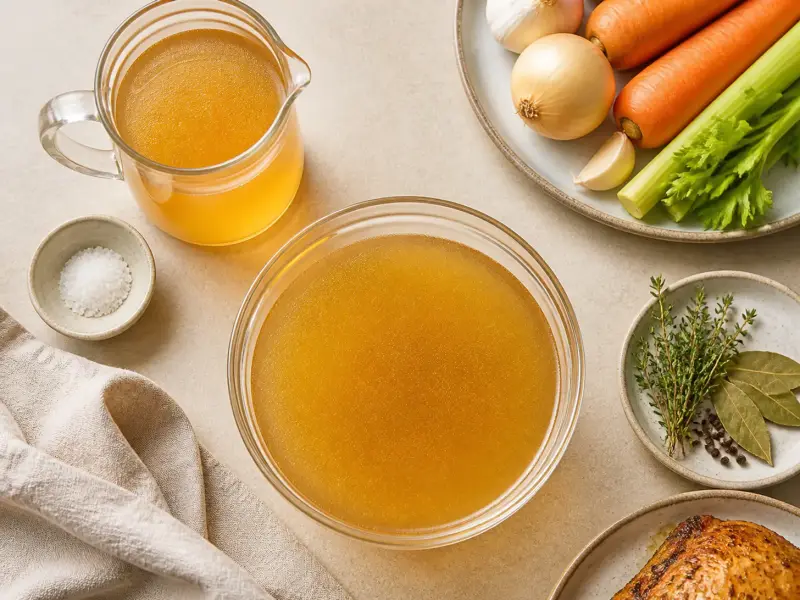 Chicken Stock
 Kung Pao Chicken