Chicken Noodle Soup
Poached chicken and vegetables in a clear stock, with the noodles cooked apart so the broth stays clean rather than thick and starchy.
- Prep
- 20 min
- Cook
- 35 min
- Resting
- 5 min
- Total
- 1 hr
- Serves
- 4
- Revisions
- 5
Allergens
- Celery
- Cereals containing gluten
- Eggs
Named from the ingredients as written, including those carried in from sub-recipes. This is not a guarantee — check the labels on what you actually buy, and note that a product’s recipe can change.
Ingredients
Serves
Method
Melt the butter in a large heavy pan over medium-low heat.
Cook the onion, carrots and celery for 8-10 minutes, stirring now and then, until they have softened without taking any colour. Colour here would muddy a broth that is meant to stay pale and clear.
Pour in the stock and add the bay leaves and thyme.
Bring to a gentle simmer and cook for 10 minutes, until a knife tip goes through a carrot coin with no resistance.
Slide the chicken thighs in and push them under the surface.
Poach at a bare simmer for 12-15 minutes, where a bubble breaks somewhere every second or two.
Never let it boil with the chicken in it. A hard boil squeezes the thighs into dry strings, and it churns fat and protein into the liquid so the broth turns cloudy — which, unlike almost everything else in this recipe, cannot be undone.
Check the thickest thigh with a thermometer if you have one: 74C/165F. Without one, cut into the thickest part and look for meat that is opaque right through with the juices running clear.
Lift the thighs onto a board and rest them for 5 minutes.
Bring the 1.5 litres of water to the boil in a separate pan and stir in the 8g of fine salt.
Cook the noodles for a minute less than the packet says, until they are just tender.
Cook them in their own water and never in the broth. They shed enough starch to turn a clear soup cloudy and faintly gluey, and noodles left standing in stock keep drinking — a pan put away tonight is a pan of swollen noodles with no broth around them tomorrow.
Drain the noodles well.
Shred the rested chicken with two forks, pulling it along the grain into pieces that will sit on a spoon.
Return the chicken to the broth and warm it through for a minute off the boil.
Fish out the bay leaves and the thyme stalks.
Season with the ground peppercorns, then with fine salt, tasting as you go — how much depends entirely on whether the stock was seasoned at all.
Stir in the lemon juice off the heat. It is a small amount and it does more for a pale broth than any further salt would.
Divide the noodles between four warm bowls.
Ladle the broth and chicken over them.
Scatter the dill over.
Keep the broth and the noodles in separate containers if any is left.
Cool the broth in a shallow container rather than the pan, refrigerate within two hours and eat it within three days.
Reheat the broth to a full simmer and pour it over the cold noodles, which is enough to warm them through.
Nobody has rated this recipe yet.
Sign in to rate this recipe. One rating per person, and you can change it.
What to expect
- Taste
A clean, savoury chicken flavour throughout, gently sweetened by the softened vegetables, with a small but noticeable lift of acidity from the lemon juice stirred in at the very end.
- Aroma
Gentle, savoury chicken and vegetable steam, thyme and bay in the background, and a fresh, bright note from the dill and lemon as the bowl is finished.
- Texture
Tender shredded chicken, soft but not mushy vegetables, and tender noodles, all held in a broth with a light, clean body rather than any thickness.
- Sound
A quiet, gentle simmer throughout, never a hard, rolling boil.
- How the flavour moves
The clean, savoury chicken and vegetable flavour of the broth arrives first and fills most of the mouthful, and the lemon's brightness is what registers last, lifting what would otherwise be a purely comforting, one-note broth.
- Serve it
Served very hot, in warmed bowls, since it is traditionally the first thing offered to anyone unwell and its comfort depends partly on being genuinely hot.
- Goes with
Traditionally eaten on its own, sometimes with crackers or bread alongside, rather than paired with any other dish.
Cook's notes
- Difficulty
Easy, though keeping the pan below a boil while the chicken poaches takes some attention.
- Cost
Cheap — chicken thighs, a few vegetables and noodles.
- Equipment
A large heavy pan, and a separate pan for the noodles.
- When to make it
Any time, and specifically the traditional first offering to anyone feeling under the weather.
- Best season
None; every ingredient is shelf-stable or standard fresh produce available year round.
- You know it is done when
The broth should stay visibly clear and pale throughout cooking, never cloudy, and the chicken should be opaque right through with clear juices when cut into.
- And it feels like
Tender, moist chicken shredded along the grain, tender-but-not-mushy noodles, and vegetables softened through without any bite lost entirely.
- Food safety
Check the thickest part of a thigh reaches 74C/165F with a thermometer if unsure, or confirm the meat is opaque throughout with clear running juices.
- Where it goes wrong
- Letting the pan reach a full boil while the chicken poaches, which both toughens the meat and clouds the broth permanently.
- Cooking the noodles directly in the broth rather than in their own separate pan, which turns it cloudy and starchy.
- Storing cooked noodles combined with the broth, leaving them bloated and the broth thin by the next day.
- Using chicken breast rather than thigh, which dries out more readily at the gentle poaching temperature this recipe depends on.
- If it does go wrong
Cloudy broth: the pan boiled hard at some point rather than staying at a bare simmer — this cannot be fixed once it has happened. Gluey, starchy broth: the noodles were cooked directly in it rather than separately. Bloated noodles the next day: they were stored combined with the broth rather than kept apart.
- Making it ahead
The broth keeps and reheats very well on its own; noodles are best cooked fresh or stored and reheated separately.
- Keeping it
Keep the broth and noodles in separate containers if storing — combined, the noodles continue swelling and drinking the broth, leaving little liquid behind by the next day.
- Reheating
Reheat the broth to a full simmer and pour it over the cold, separately stored noodles, which is enough to warm them through without further cooking them.
- Freezing
The broth freezes well on its own; freeze the noodles separately or cook a fresh batch when reheating from frozen.
- Leftovers
Best kept as broth and noodles apart, combined only at the point of reheating and serving.
- Scaling it
Scales up easily by keeping the same ratios, cooking the noodles in a correspondingly larger pan of their own water.
- Substitutions
Chicken thigh stays succulent at a temperature where breast has already dried out, making it the better cut here for the gentle poaching this recipe depends on.
- Dietary swaps
Contains celery, cereals containing gluten and eggs. A gluten-free noodle can replace the egg noodles for a version suitable for that allergy, though check the stock for celery if that is a concern.
- Shopping for it
A good homemade chicken stock, such as the one elsewhere in this collection, gives a considerably better result than a bought stock cube or carton.
- Keeping the cost down
A very cheap dish given a modest quantity of chicken thigh and basic vegetables make a substantial pot.
- Nutrition
A light, easily digestible source of protein and vegetables, traditionally valued as gentle food for anyone unwell.
- Worth it?
A dish where a single piece of restraint — never letting the pan boil — makes the entire difference between a clear, proper broth and a cloudy, ordinary one.
Where it comes from
- Origin
Ashkenazi Jewish home cooking, with the broader belief in chicken broth's restorative power considerably older still.
- Also called
Chicken soup, sometimes referred to affectionately as Jewish penicillin.
- Said out loud
Not applicable.
- What the name means
A literal, descriptive name.
- History
The physician Maimonides recommended chicken broth specifically for respiratory illness in his 12th-century medical writings, reflecting a belief in its restorative properties that predates even that written record. Chicken soup with noodles as a specific dish is Ashkenazi Jewish home cooking with no traceable origin date, carried to the United States through migration in the late 19th century, and became a mainstream American food once Campbell's began selling a tinned version in the 1930s.
- Why it matters
A Friday night and festival dish in many Jewish households, and, well beyond that community, the first thing offered to anyone unwell across much of Europe and North America.
- When it is eaten
Friday night and festival meals in Jewish tradition, and an everyday comfort food and remedy for illness far more broadly.
- The traditional way
Poaching the chicken gently rather than boiling it, and keeping the broth clear through careful temperature control rather than relying on straining to fix a clouded pot.
- How it changed
The tinned version Campbell's introduced in the 1930s made the dish accessible to a much wider American audience, though it is a considerably simplified version compared with a proper home-made broth.
- Regional variations
Matzo balls are a traditional alternative to noodles specifically within Jewish households, particularly for Passover and other occasions when leavened noodles would not be eaten.
- Sources and credit
No individual is credited with the dish; it belongs to Ashkenazi Jewish home cooking generally, later adopted very widely across American and British households.
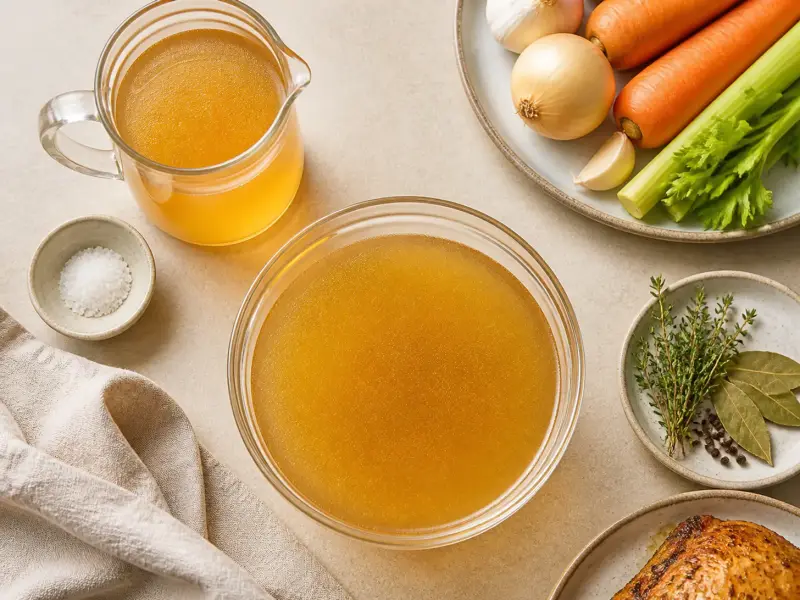 Chicken Stock
 Chicken à la King
 Sweetcorn Chowder