French Onion Soup
Soupe à l'oignon gratinée
Onions cooked down for an hour until they are jammy and dark, then finished under the grill with a raft of bread and melted cheese.
- Prep
- 20 min
- Cook
- 1 hr 20 min
- Total
- 1 hr 40 min
- Serves
- 4
- Revisions
- 5
Allergens
- Celery (via Chicken Stock)
- Cereals containing gluten
- Milk
- Sulphites
Named from the ingredients as written, including those carried in from sub-recipes. This is not a guarantee — check the labels on what you actually buy, and note that a product’s recipe can change.
Ingredients
Serves
Method
Melt the butter with the olive oil in a wide heavy pan over medium heat. Width matters more than depth here, because the water coming out of the onions has to evaporate rather than pool.
Add the onions, which will fill the pan almost to the rim.
Stir in the 5g of fine salt, which draws the water out and gets things moving.
Cook uncovered over medium-low heat for 45-60 minutes, stirring every 5 minutes and more often towards the end.
Keep the heat low enough that the onions never sizzle hard. This is the step that cannot be hurried and there is no honest shortcut — high heat scorches the sugars before the water has cooked out, and burnt onion is bitter in a way no amount of stock covers up. Fifty minutes is the real number.
Watch the colour go from pale to straw to deep mahogany, and the volume drop to roughly a quarter of what went into the pan. That collapse is the doneness cue, not the clock.
Scrape the brown film off the base back into the onions each time it builds up, adding a tablespoon of the wine if it starts to catch.
Pour in the wine.
Scrape the base of the pan clean with a wooden spoon while the wine bubbles. Everything stuck down there is the flavour you spent an hour making, and this is your one chance to get it back into the soup.
Simmer for 3-4 minutes, until the raw alcohol smell has gone.
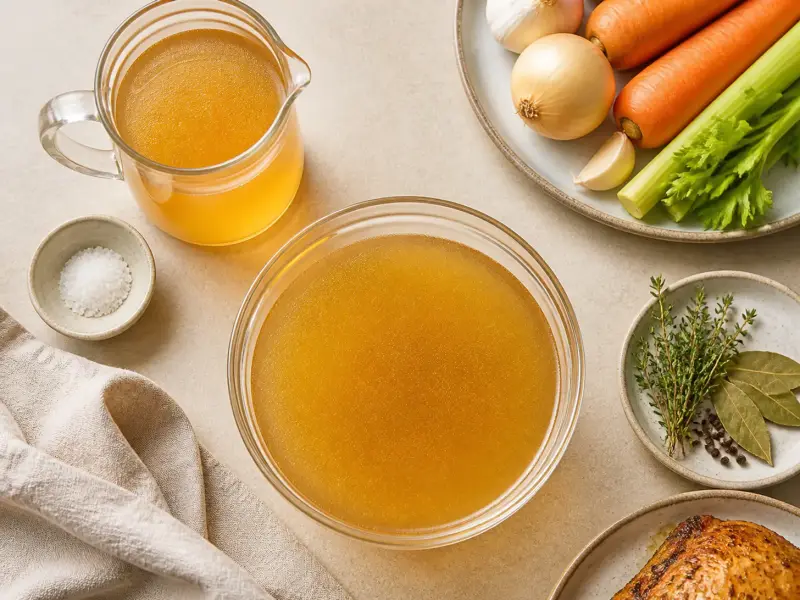
Add the warmed stock, the bay leaves and the thyme. A batch of the chicken stock in this collection covers this pan with some to spare.
Simmer gently and uncovered for 20-25 minutes, until the broth has darkened and tastes of more than stock.
Fish out the bay leaves and thyme stalks.
Taste and add salt if it needs it, which depends entirely on how the stock was seasoned.
Heat the grill to high.
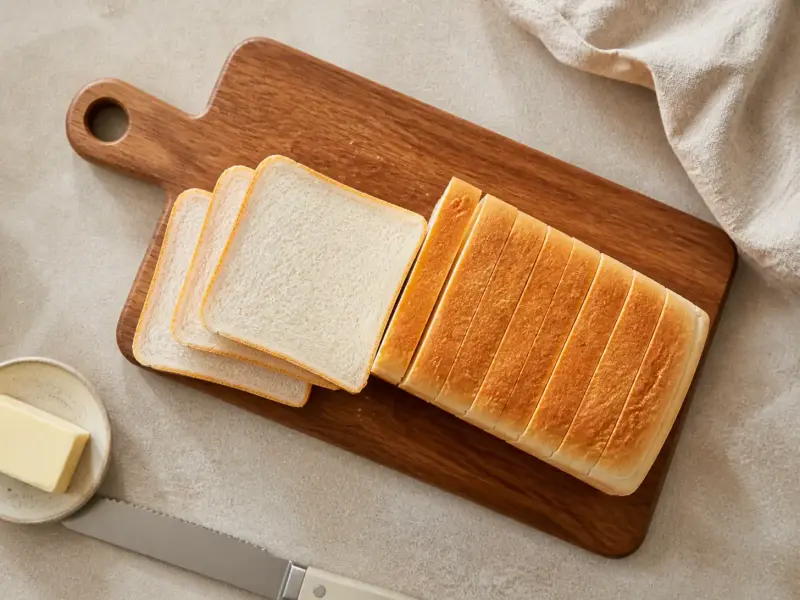
Toast the bread on both sides until it is dry and firm right through. Soft bread sinks and dissolves into the soup within a minute, and you lose the raft that holds the cheese.
Rub one side of each toast with the cut garlic clove.
Ladle the soup into four heatproof bowls.
Float a toast on each, garlic side up.
Pile the Gruyere over the toast and right out to the rim of the bowl, so it seals the surface.
Grill for 2-3 minutes, until the cheese is molten and blistered brown in patches.
Stand the bowls for 2 minutes before serving. Cheese straight from the grill is hot enough to burn.
Nobody has rated this recipe yet.
Sign in to rate this recipe. One rating per person, and you can change it.
What to expect
- Taste
Sweet, and much sweeter than most people expect a savoury soup to be — that is an hour of onion sugars with the water driven off, not sugar added. Under it is a plain savoury depth from the stock, and cutting across both is a thin line of acidity from the wine. The salt in the bowl arrives almost entirely from the Gruyère, which is worth knowing because there is no pepper and no chilli anywhere in the recipe: nothing here is sharp or hot, and the only things standing against the sweetness are the wine's acid and the cheese's salt.
- Aroma
For most of the hour it is butter and onions turning sweet, which fills a kitchen more thoroughly than almost anything else in this collection. Thyme and bay come through in the simmer. The last smell is the one at the table — grilled cheese, nutty where it has melted and faintly bitter at the blistered patches, over the sweet steam coming up through the break in the lid.
- Texture
Three things at once. Onions gone to soft threads with no resistance left in them. A raft of toast that is dry and firm on top and quietly going soft underneath. And a lid of cheese that pulls into long threads when the spoon goes through it and turns chewy at the rim where it has caught on the hot bowl.
- Sound
The long cook is nearly silent, and that is the instruction — if it is sizzling hard, the heat is wrong. What there is is the scrape of a wooden spoon on the base every few minutes. The bowl itself makes one sound worth waiting for: the soft give as the back of a spoon presses through the browned cheese lid until it breaks.
- How the flavour moves
Sweetness first, and it arrives immediately and dominates the front of the mouthful. The savoury broth comes in behind it. What lingers is salt and toasted cheese rather than anything sharp, with the wine's acidity registering only as the thing keeping the sweetness from being cloying. Every spoonful after the first also carries a little of the soaked bread, so the bowl gets softer and rounder as it goes down.
- Serve it
Very hot, and it stays that way. The cheese lid seals the surface so the broth underneath holds its heat far longer than an open bowl of soup does, which is exactly why the first mouthful needs to wait two minutes.
- Goes with
It is a meal rather than a first course when built this way. A sharply dressed green salad afterwards does more for it than anything served alongside, and the wine deglazing the pan is the obvious one to drink.
Cook's notes
- Difficulty
Technically easy and genuinely demanding of patience — nothing in it is hard to do and the one step that decides the result takes the better part of an hour of stirring.
- Cost
Cheap. A kilogram of onions is the bulk of the dish; the Gruyère is the only real expense and the wine the second.
- Equipment
A wide heavy pan — width matters more than depth, because the water coming out of the onions has to evaporate rather than pool — four heatproof bowls, and a grill.
- When to make it
Cold weather, and an evening where an hour at the hob stirring every five minutes is a pleasant way to spend the time rather than a problem.
- Best season
Autumn and winter, when onions are at their best out of store and the soup is what the weather wants.
- You know it is done when
The onions go pale, then straw, then deep mahogany, and the volume drops to roughly a quarter of what went into the pan. That collapse is the doneness cue, not the clock. The finished lid should be molten right across and blistered brown in patches, welded to the rim of the bowl.
- And it feels like
No bite left in the onions at all — they should be soft threads that give completely under a spoon. The toast should still be firm enough to hold the cheese rather than dissolved into the broth beneath it.
- Food safety
Cheese straight from the grill holds far more heat than it looks like it does, and the bowls themselves come out grill-hot. Stand them two minutes and carry them on a plate.
- Where it goes wrong
- Cooking the onions too hot to save time, which scorches the sugars before the water is out and leaves a bitterness that nothing later covers.
- Using a pan that is too narrow, so the onions' water pools and they stew rather than reduce.
- Under-toasting the bread, so the raft sinks and dissolves within a minute and the cheese goes with it.
- Piling the cheese only in the middle rather than out to the rim, so it slides off the toast instead of sealing the bowl.
- Serving straight from the grill, which is genuinely hot enough to burn a mouth.
- If it does go wrong
Bitter: the onions caught at some point, and it cannot be fixed after the event. Thin and stock-tasting: the onions were not taken far enough — mahogany and a quarter of the starting volume are the two cues. Bland: taste for salt after the simmer, since how much it needs depends entirely on whether the stock was seasoned. Soggy collapsed toast: it was not dried right through before it went on.
- Making it ahead
The base is a genuinely good make-ahead — better on day two — and the toasting, topping and grilling take five minutes from cold.
- Keeping it
The soup base keeps 3 days refrigerated and improves on the second day. Toast and cheese the bowls fresh each time rather than storing them assembled.
- Reheating
Bring the base back to a simmer, then toast, top and grill from there.
- Freezing
The base freezes well for up to 3 months. The bread and cheese do not and are not meant to.
- Leftovers
The base is a good braising liquid for beef or a bed for sausages if there is not enough left for a full bowl.
- Scaling it
Doubles cleanly provided the pan is wide enough to keep the onions in a shallow layer. Two pans beat one deep one.
- Substitutions
Gruyère is the standard, and Comté or Emmental are the usual French alternatives; any firm alpine-style cheese that melts to a thread rather than to oil will do the job. The bread wants to be a day old and firm — the everyday white tin loaf in this collection is what it was written for. Beef stock gives the darker, heavier bowl; chicken stock gives a cleaner one, and the batch of chicken stock in this collection covers this pan with some to spare.
- Dietary swaps
Contains cereals containing gluten from the bread, milk from the butter and cheese, and sulphites from the wine. Not vegetarian as written — a good vegetable stock makes it so, though it gives a lighter soup that leans more heavily on the onions and the cheese for depth. Gluten-free bread works for the raft provided it is toasted hard enough to stay afloat.
- Shopping for it
Ordinary brown onions, not sweet varieties — the sweetness is made in the pan and a sweet onion tips it over. Day-old bread rather than fresh, and a cheese that melts to a thread rather than to a pool of oil.
- Keeping the cost down
The onions are the cheapest part and there is a kilogram of them. Buy the Gruyère as a piece and grate it rather than buying it grated, and use the stale end of a loaf for the toast, which is what it is for.
- Sustainability
One of the cheapest, lowest-impact bowls in this collection if it is built on vegetable stock; the beef stock version is where its footprint sits.
- Nutrition
Mostly vegetable and stock; the fat and the salt are concentrated in the butter and the cheese lid.
- Worth it?
Worth it for the hour, and only for the hour. A shortcut version of this is a different and much less interesting soup wearing the same cheese lid.
Where it comes from
- Origin
France, and the gratinéed form is associated above all with Paris.
- Also called
Soupe à l'oignon gratinée.
- Said out loud
soup ah lon-YON grah-tee-NAY, roughly.
- What the name means
Onion soup, gratinéed — gratinée meaning browned under heat, which is the bread-and-cheese lid rather than the soup.
- History
Onion soup has no origin date and no author. Onions store through a winter and cost almost nothing, and soups built on them were poor-kitchen and market food across France for centuries before the version with the cheese lid became famous. The gratinée is tied in popular telling to Les Halles, the Paris central market, where it was eaten by porters early and by late-night crowds afterwards — a well-attested association with a place and a time of night rather than a documented invention. The story crediting Louis XV, sometimes Stanislas Leszczyński, with improvising it from the only ingredients in a hunting lodge is undated folklore repeated in a great many places and traceable to none of them.
- Why it matters
One of the handful of dishes that stands for French bistro and brasserie cooking abroad, and a fixture of the late menu in Paris rather than a formal restaurant dish.
- When it is eaten
Cold weather and late nights. It is not a dish attached to a festival or a season beyond winter.
- The traditional way
The long, low cook of the onions, and the gratinée: bread floated on the surface and cheese piled right out to the rim so it seals the bowl and browns against the edge as well as on top.
- How it changed
The main modern drift is speed. Recipes offering caramelised onions in fifteen or twenty minutes are producing softened onions with some colour, which is a different and much flatter thing — the sweetness this soup runs on is a function of time and evaporation.
- Regional variations
Gruyère, Comté and Emmental are all used, and the choice between beef and chicken stock changes the weight of the bowl considerably. Some versions add a splash of brandy or sherry with the wine.
- Sources and credit
No individual is credited, and the two most repeated origin stories — Les Halles and Louis XV — are respectively an association and a legend rather than an attribution.
Related recipes
This recipe uses
Made from scratch here, or buy it — either works.
 Chicken Stock
 Everyday White Tin Loaf