Everyday White Tin Loaf
A straight-dough sandwich loaf made with commercial yeast and no starter, baked in a tin so it slices square for toast.
- Prep
- 20 min
- Cook
- 35 min
- Resting
- 1 hr 55 min
- Total
- 2 hr 50 min
- Serves
- 12
- Revisions
- 5
Allergens
- Cereals containing gluten
- Milk
Named from the ingredients as written, including those carried in from sub-recipes. This is not a guarantee — check the labels on what you actually buy, and note that a product’s recipe can change.
Ingredients
Serves
Method
Whisk the flour, yeast and fine salt together in a large bowl.
Pour in the lukewarm water and mix to a shaggy dough with no dry flour left in the bowl.
Rest the dough for 10 minutes so the flour hydrates and the kneading goes faster.
Squeeze in the softened butter, working it through until the dough stops looking greasy.
Knead for 8-10 minutes, until the dough is smooth and a stretched corner goes thin enough to see light through before it tears.
Cover and prove at room temperature for 1-1.5 hours, until doubled and domed.
Oil a 900g loaf tin, corners included.
Tip the dough onto a lightly floured worktop and press it out to a rectangle of roughly 20x30cm, knocking the big bubbles out as you go.
Fold the two long sides in to the middle, so the strip sits a little shorter than the tin.
Roll the strip up tightly from one short end, pressing down at each turn to keep it snug.
Pinch the final seam closed.
Set the loaf seam-side down in the tin. A slack roll slumps sideways in the oven; the tight skin you build here is what forces the rise upwards instead of outwards.
Cover and prove a second time for 45-60 minutes, until the dough crowns about 2cm over the rim and a floured fingertip leaves a dent that fills back slowly.
Heat the oven to 220C/425F once the second prove is halfway through.
Bake for 30-35 minutes, until the top is deep brown and firm.
Turn the loaf out and tap the base — a hollow, drum-like sound means it is done, and a dull thud means another 5 minutes in the oven, out of the tin.
Cool on a rack for at least an hour. Cutting into a warm loaf drags the crumb into a gummy paste that never recovers.
The soft milk rolls in this collection are this same dough enriched with milk, butter and egg, while the seeded rye loaf swaps most of the wheat for a flour that forms almost no gluten at all.
Cut the cooled loaf thick for the mushrooms on toast in this collection, which wants a slice firm enough to take the weight without going soft.
Nobody has rated this recipe yet.
Sign in to rate this recipe. One rating per person, and you can change it.
What to expect
- Taste
Plain and clean — this is a bread built to carry other flavours rather than assert its own, with a mild wheaty sweetness from the flour and a faint milky richness from the butter worked through the crumb. There is none of the tang a longer or sourdough-adjacent ferment would bring; this is a short, straightforward rise and it tastes like one, in the best sense of the word.
- Aroma
Warm, yeasty and faintly buttery straight from the oven — the classic smell most people mean when they say something 'smells like fresh bread'. It fades within a day or two to something much fainter and closer to plain flour.
- Texture
Soft and slightly springy, with a thin, tender crust rather than a thick chewy one. The crumb compresses easily under a thumb and returns most of the way back, a sign of a well-developed gluten structure and a properly timed second prove.
- Sound
A soft crackle as the crust is sliced, and the specific hollow knock of the finished base being tested — one of the few sounds in bread baking that is functional rather than incidental.
- How the flavour moves
A brief moment of crust flavour — slightly toasted, faintly bitter from the Maillard browning — gives way immediately to the soft, mild, faintly sweet crumb, which is really the whole point: nothing about this loaf should linger or compete with what goes on top of it.
- Serve it
Best slightly warm or at room temperature; toasting brings back some of the crust character lost to staling.
- Goes with
Butter and jam plainly, or as the base for almost anything savoury — this is the loaf behind French onion soup's crouton, alongside roast tomato soup, and under mushrooms on toast, exactly the uses the recipe's own steps point to.
Cook's notes
- Difficulty
Easy. This is closer to a foundation bread than a technical one — the shaping fold is the only step that takes any real attention.
- Cost
Very cheap — flour, yeast, salt, butter and water, the most basic ingredient list of any bread in the collection.
- Equipment
A 900g loaf tin, a mixing bowl, and hands. No mixer is required, though one speeds the kneading.
- When to make it
Any day — this is the loaf to bake on a weekend for the week's sandwiches and toast.
- Best season
None.
- You know it is done when
A deep, even brown crust, domed well above the rim of the tin.
- And it feels like
A hollow, drum-like sound when the base is knocked; a dull thud means it needs another five minutes out of the tin.
- Food safety
Nothing perishable beyond the butter and yeast, both shelf-stable in the finished loaf. No particular hazard.
- Where it goes wrong
- A slack, loosely rolled shaping fold, which lets the dough slump sideways in the oven instead of rising straight up.
- Cutting into it while warm, which drags the crumb into a gummy paste that never fully recovers.
- Under-proving the second rise, which gives a dense, tight crumb and a loaf that tears rather than domes in the oven.
- A cold oven that has not fully come up to temperature, which blunts the initial oven spring.
- If it does go wrong
Dense crumb: check the yeast is active and the second prove was given long enough. Loaf slumped to one side: the shaping roll was not tight enough or the seam was not properly pinched. Pale crust: oven not hot enough or the loaf needed longer.
- Making it ahead
The dough can be retarded in the fridge overnight after shaping, for a slower rise and slightly more developed flavour, then brought back to room temperature before baking.
- Keeping it
Two to three days at room temperature in a bag, going stale progressively — toast rescues it well past the point where it's good plain.
- Reheating
A few minutes in a low oven or the toaster restores the crust; the crumb itself does not really recover once stale.
- Freezing
Freezes very well, whole or pre-sliced so individual slices can go straight into the toaster from frozen.
- Leftovers
Excellent for toast, breadcrumbs, bread pudding and croutons once past its best for eating plain.
- Scaling it
Scales cleanly by weight; a larger batch needs a bigger tin or splitting between two, since an oversized tin loaf risks a raw centre before the crust is done.
- Substitutions
Butter can be left out entirely for a leaner, slightly chewier crumb closer to a classic French-style white loaf; a neutral oil in its place works too and gives a softer crumb than no fat at all. Instant yeast can be swapped for active dry yeast at the same weight, dissolved in the water first rather than mixed into the dry flour.
- Dietary swaps
Vegan with oil in place of butter — nothing else in the recipe carries dairy or egg. Not naturally gluten-free; strong bread flour's gluten content is what gives this loaf its structure and there is no direct substitute that behaves the same way.
- Shopping for it
A strong white bread flour with a genuinely high protein content makes a real difference to the rise and the crumb; a plain all-purpose flour will not develop the same structure.
- Keeping the cost down
About as cheap as bread gets — flour, yeast and salt are the only real cost, and a home-baked loaf costs a fraction of a shop-bought artisan one.
- Sustainability
A straightforward, low-additive loaf with a modest energy cost relative to commercial baking's industrial mixers and additive supply chains.
- Nutrition
A plain enriched white loaf, moderate in fat from the small amount of butter, with no added sugar beyond what naturally supports the yeast.
- Worth it?
The most useful bread to learn in the whole collection — get this dough right and the same skills carry directly into the enriched rolls and almost everything else in the bread section.
Where it comes from
- Origin
British commercial baking, standardised through the 19th century and radically sped up by the Chorleywood Bread Process in 1961.
- Also called
A tin loaf, or a sandwich loaf.
- Said out loud
Plain English.
- What the name means
Named for the tin it is baked in, which is what gives it its characteristic square-sided shape and even slices.
- History
The 900g tin became the standard British loaf size and the same tin size doubles as the mould for loaf cakes, which is why home bakers often own only one shape of tin for both. The Chorleywood Bread Process, developed at the British Baking Industries Research Association in Hertfordshire in 1961, let bakeries use lower-protein, cheaper wheat and turn it into an acceptable loaf through mechanical energy and additives rather than time — a genuine industrial breakthrough that also changed, for many people, what 'bread' tastes like by default.
- Why it matters
It is the least remarkable bread in the collection by design, and that is exactly its cultural role: the default toast, the default sandwich bread, the loaf assumed rather than chosen in most British households.
- When it is eaten
Every day, for every meal that wants bread and no particular character from it.
- The traditional way
A straight dough — flour, water, yeast, salt and a little fat, mixed, kneaded, proved twice and baked in a tin — as opposed to a pre-ferment or a long cold retard.
- How it changed
The Chorleywood Bread Process is the major 20th-century shift: intense mechanical mixing plus additives replaces the traditional long, slow bulk fermentation, cutting total production time from many hours to under four and changing the crumb and flavour of most commercially available sliced bread as a result.
- Regional variations
The same basic dough, enriched, becomes the soft milk rolls in this collection; left largely unworked because it has almost no gluten to develop, the same family idea produces the seeded rye loaf instead. The plain tin loaf itself varies mainly in flour type and enrichment level rather than in any regional named variant.
- How this version differs
This is a traditionally fermented straight dough rather than a Chorleywood-process one — no additives, no high-speed industrial mixer, a full first prove of an hour to ninety minutes rather than the few minutes an industrial process substitutes for it.
- Sources and credit
No single inventor. The tin-baked shape is a commercial-bakery convention that spread broadly through the 19th century; the Chorleywood Bread Process is credited to the British Baking Industries Research Association as an institution rather than to one named person.
Related recipes
Used in 4 recipes
Where this turns up as an ingredient.
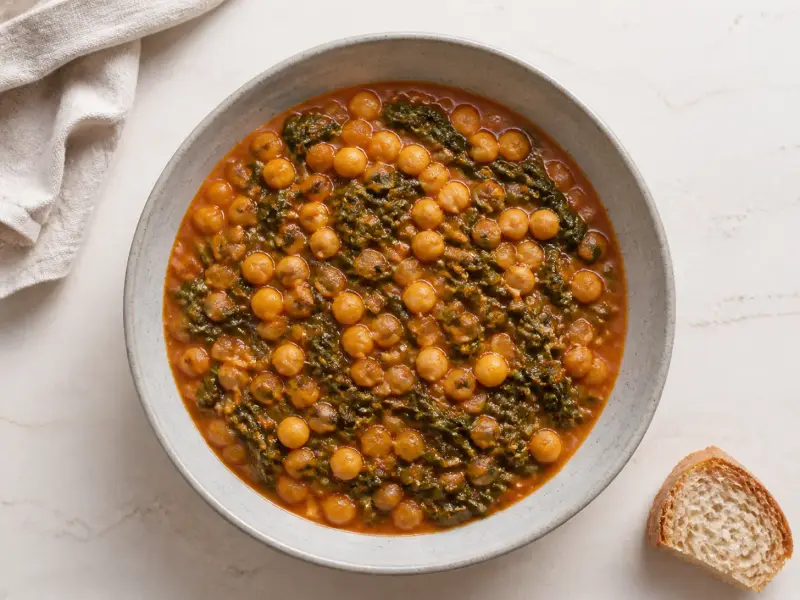 Chickpea and Spinach Stew
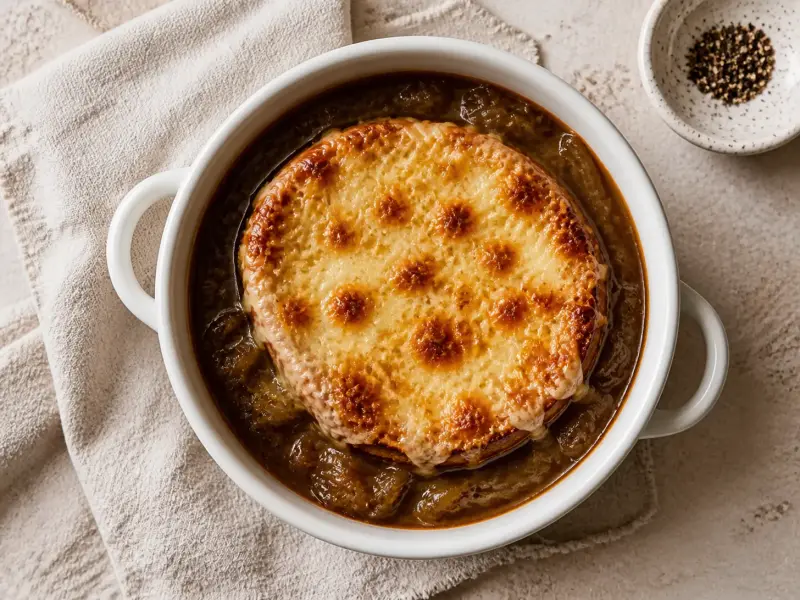 French Onion Soup
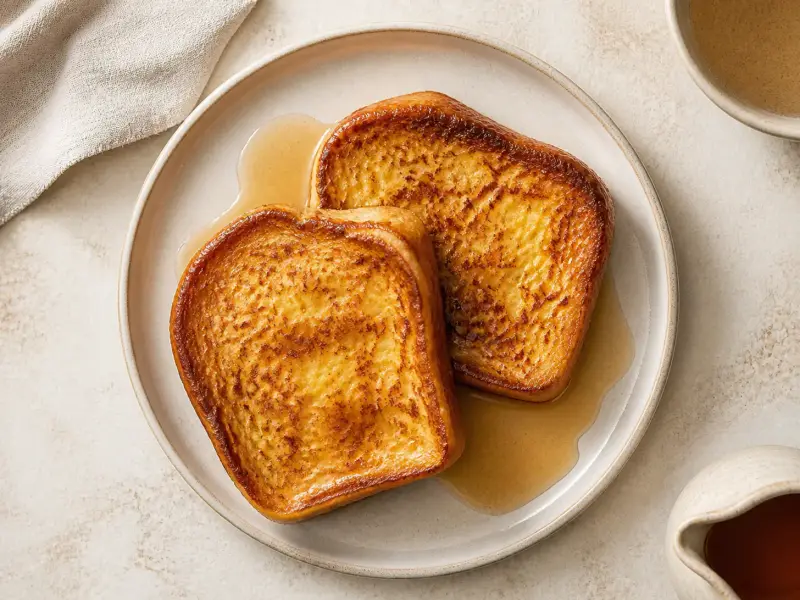 French Toast
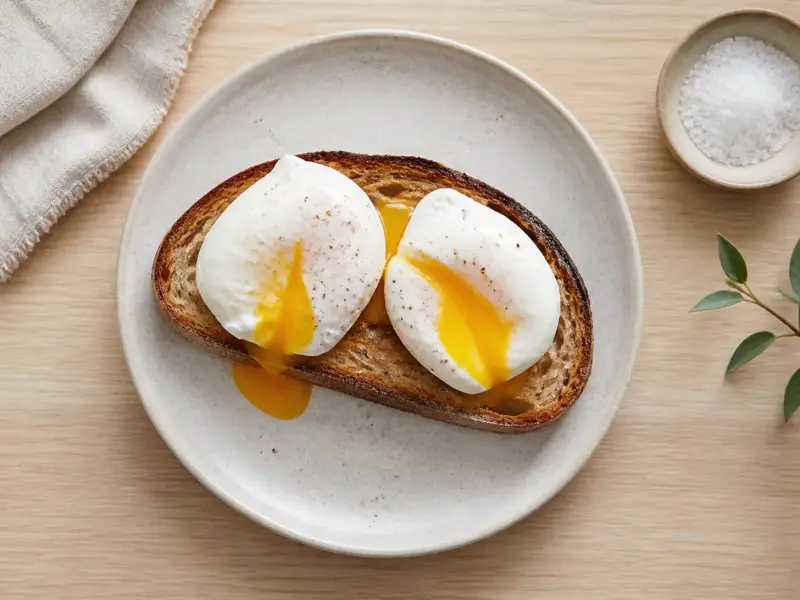 Poached Eggs
 Apple and Blackberry Crumble
 Buttermilk Soda Bread
 Crumpets
 Lemon Drizzle Loaf Cake
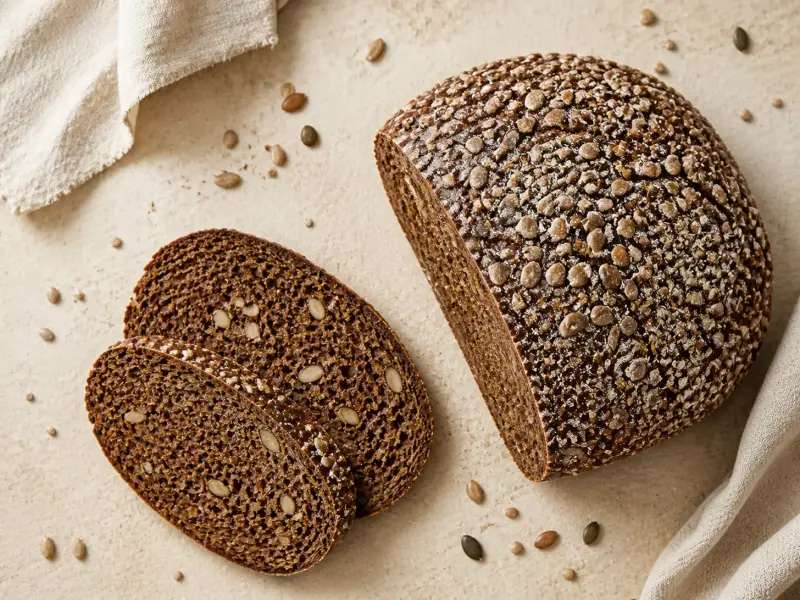 Seeded Rye Loaf
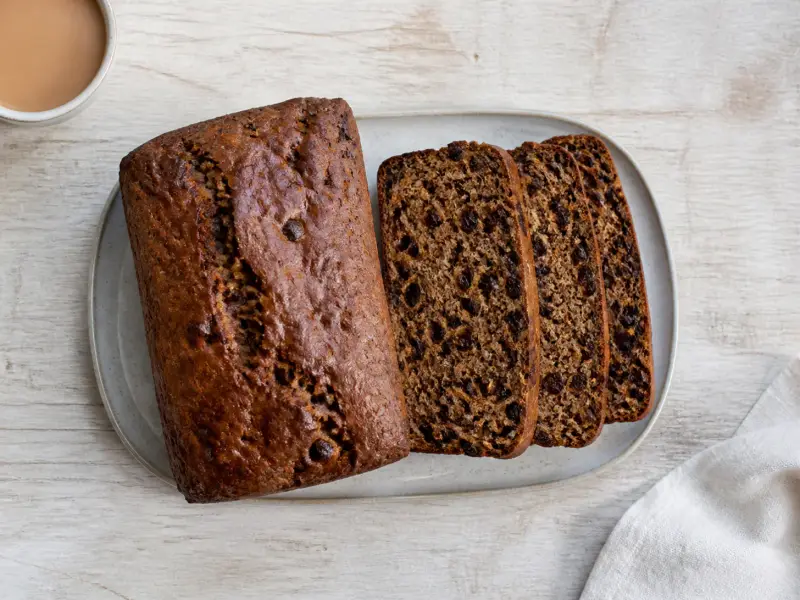 Spiced Fruit Tea Loaf