Apple and Blackberry Crumble
Tart Bramley apples and blackberries under a rubbed-in oat crumble, mixed by hand in one bowl with no mixer needed.
- Prep
- 25 min
- Cook
- 45 min
- Resting
- 15 min
- Total
- 1 hr 25 min
- Serves
- 6
- Revisions
- 5
Allergens
- Cereals containing gluten
- Eggs (via Vanilla Custard)
- Milk
Named from the ingredients as written, including those carried in from sub-recipes. This is not a guarantee — check the labels on what you actually buy, and note that a product’s recipe can change.
Ingredients
Serves
Method
Heat the oven to 190C/375F.
Taste a raw piece of apple before you commit to it. It should be sharp enough to make you wince, because the topping carries 80g of sugar and a sweet eating apple underneath bakes out flat and cloying. With a milder apple, drop the fruit sugar to 40g.
Toss the apple chunks with the lemon juice, caster sugar, cinnamon and cornflour until every piece is coated.
Fold the blackberries through with two or three turns only, so they stay whole instead of bleeding the dish purple.
Tip the fruit into a 1.5-litre baking dish.
Level it out without pressing it down.
Rub the cold butter cubes into the plain flour with your fingertips, lifting the mixture high out of the bowl and letting it fall back so it stays cool.
Stop while it is coarse rubble with butter pieces still the size of small peas — not fine breadcrumbs, and not a paste. Butter worked too far, or a kitchen too warm, gives a sandy dough that melts into a solid lid over the fruit instead of a crumble with texture.
Put the bowl in the fridge for 10 minutes if the mixture starts to feel greasy or claggy on your fingers, and carry on once it is cold again.
Stir in the demerara sugar, oats and fine salt. This rubble is a close relative of the toasted honey granola in this collection, which is the same oats and sugar baked on their own until they clump.
Scatter the topping over the fruit in loose clumps rather than an even sheet, and leave it unpressed. Packed crumble steams from underneath and never crisps.
Set the dish on a baking tray to catch whatever boils over.
Bake for 40-45 minutes, until the topping is deep gold and the juices are bubbling up thick and syrupy at the edges rather than running thin.
Rest for 15 minutes before serving, so the fruit stops being molten and the juices set enough to spoon.
Serve warm, with cream or the vanilla custard in this collection, which is the partner this dish is built around.
Nobody has rated this recipe yet.
Sign in to rate this recipe. One rating per person, and you can change it.
What to expect
- Taste
Sharp, tart apple leads under the sugar rather than being overwhelmed by it, since the fruit itself is chosen specifically to still taste of something once baked; blackberries add a deep, slightly winey sweetness and a gentle sourness of their own. The demerara-and-oat topping is nutty and only lightly sweet, in genuine contrast to the fruit's sharper character underneath.
- Aroma
Warm baked apple and cinnamon lead, with a rich, slightly caramelised sugar note from the topping and a deep, faintly winey smell from the blackberries as their juices bubble up at the edges.
- Texture
A crumbly, craggy topping with distinct pieces of butter and oat giving real bite, over soft, collapsed apple and blackberries that mostly hold their shape rather than turning to complete mush.
- Sound
A quiet bubbling from the oven as the fruit juices thicken, and a soft, granular crunch when a spoon breaks through the topping.
- How the flavour moves
The topping's nutty sweetness and light crunch arrive first, the tart apple follows underneath and dominates the middle of the bite, and the blackberries' deeper, slightly winey sweetness lingers at the finish, especially where they have bled a little juice into the surrounding fruit.
- Serve it
Served warm rather than hot, after the 15-minute rest that lets the molten fruit set enough to hold its shape on a spoon.
- Goes with
Cream or the vanilla custard elsewhere in this collection, which this dish is specifically built around — the hot fruit and cold cream, or the pouring custard, are as much a part of the dish as the crumble itself.
Cook's notes
- Difficulty
Easy. The only real judgement is stopping the rubbed-in topping at the right stage and choosing sharp enough apples.
- Cost
Low. Apples, a modest amount of blackberries, and pantry baking staples.
- Equipment
A 1.5-litre baking dish and a baking tray underneath it to catch any boiling-over juice; nothing else specialised.
- When to make it
Autumn, when blackberries are in season, and any cold-weather meal wanting a warm, comforting pudding.
- Best season
Blackberries are picked wild across Britain in late summer into early autumn, which is why the pairing with apple, itself an autumn fruit, is genuinely seasonal rather than an arbitrary combination.
- You know it is done when
The topping should be deep gold rather than pale, and the fruit juices should be bubbling up thickly and syrupy at the edges of the dish rather than thin and watery.
- And it feels like
A crumbly, craggy topping with real texture from the visible butter and oats, sitting over fruit that has softened but the blackberries have mostly held their shape.
- Food safety
No particular hazard; standard care rubbing in cold butter and handling a hot dish straight from the oven.
- Where it goes wrong
- Using a sweet eating apple without reducing the fruit sugar, which bakes out flat and cloying under the sugared topping.
- Over-rubbing the butter into the flour until it resembles fine breadcrumbs, which bakes into a solid, sandy lid rather than a crumbly topping.
- Pressing the topping down onto the fruit, which steams it from underneath and stops it crisping.
- Serving straight from the oven without resting, so the filling is too molten to hold its shape on a spoon.
- If it does go wrong
Topping bakes into a solid crust: the butter was rubbed in too far, or it was pressed down onto the fruit instead of scattered loosely. Filling too runny: the cornflour amount was reduced, or the dish was not rested the full 15 minutes before serving. Dish overly sweet or flat-tasting: a sweeter eating apple was used without cutting back the added fruit sugar accordingly.
- Making it ahead
The unbaked assembled dish can be refrigerated for a day, or frozen, and baked directly from cold with a little extra time added.
- Keeping it
Keeps 2-3 days refrigerated, covered.
- Reheating
A moderate oven for 15-20 minutes restores the topping's crispness better than a microwave, which leaves it soft throughout.
- Freezing
Freezes well, either unbaked (assembled but not cooked) or baked; bake from frozen with extra time, or reheat a baked one from frozen in a moderate oven.
- Leftovers
Good cold for breakfast the next day, or reheated with a fresh spoonful of custard.
- Scaling it
Scales up cleanly in a larger dish; keep the topping loose and unpressed regardless of the size of the batch.
- Substitutions
Any tart cooking apple can replace Bramley, though a milder eating apple needs the fruit sugar reduced from 60g to about 40g to avoid the dish turning flat and cloying. Frozen blackberries work in place of fresh, added straight from frozen without thawing first.
- Dietary swaps
Vegetarian as written. Contains gluten and milk. A dairy-free block butter substitute works in the rubbed-in topping reasonably well; a gluten-free flour blend changes the topping's texture but is workable.
- Shopping for it
Bramley apples specifically for their high acidity and water content, which is what lets them collapse to a soft, well-balanced filling rather than holding their shape like an eating apple would.
- Keeping the cost down
Blackberries picked wild, where legally and safely possible, cost nothing at all; frozen blackberries out of season are a reliable and inexpensive alternative to fresh.
- Sustainability
Wild-foraged blackberries, where available, are about as low-impact an ingredient as exists in this whole collection.
- Nutrition
A moderately indulgent pudding, with real fibre and vitamin C from the fruit offsetting the sugar and butter in the topping.
- Worth it?
One of the most forgiving and reliably comforting puddings in British home cooking, and a good first step for anyone intimidated by pastry.
Where it comes from
- Origin
Britain.
- Also called
Crumble.
- What the name means
Named plainly for the texture of its topping.
- History
Crumble emerged specifically as a wartime dish in the 1940s, when rationing limited both fat and a cook's available time; a rubbed-in topping needed neither the extra fat nor the rolling and lining work a full pastry crust demands, making it a genuinely practical wartime adaptation rather than a dish invented for its own sake.
- Why it matters
A standard pudding across Britain, Ireland, Australia and New Zealand, closely tied to home baking and comfort food rather than restaurant cooking, and one of the most commonly made British puddings even now, decades after the rationing that produced it ended.
- When it is eaten
A standard family pudding, particularly in autumn when blackberries are foraged and apples are freshly harvested.
- The traditional way
Butter rubbed into flour by hand to a coarse, uneven rubble rather than a smooth paste or fine breadcrumbs, and scattered loosely over the fruit rather than pressed down, both of which are what keep the topping crumbly rather than forming a solid, steamed lid.
- How it changed
The American crisp, generally with oats and nuts, developed independently along the same underlying logic, and the two are now often used somewhat interchangeably despite their separate development.
- Regional variations
Rhubarb, plum and gooseberry are all common alternative or additional fruits depending on season and region; some versions add ground almonds or additional spices to the topping.
- Sources and credit
No individual is credited with the dish; it developed broadly across British home cooking during wartime rationing rather than through a single named recipe.
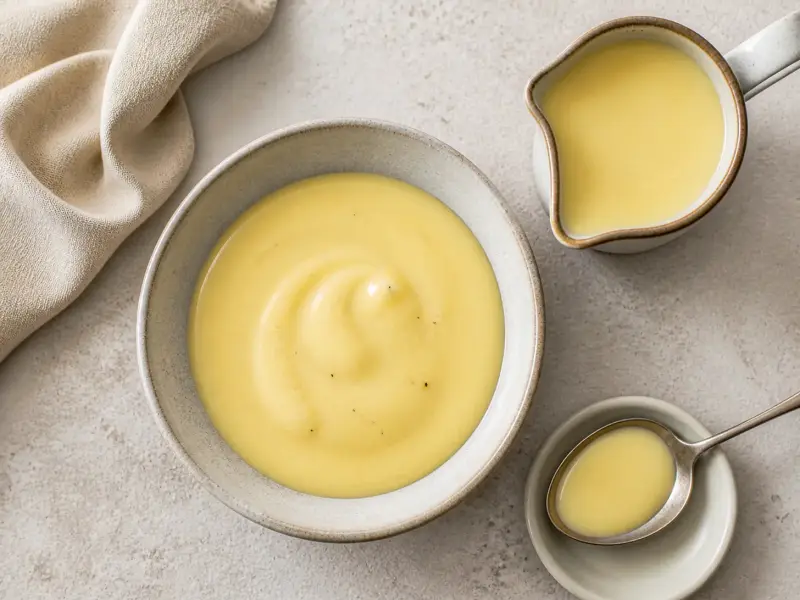 Vanilla Custard
 Lemon Drizzle Loaf Cake
 Baked Rice Pudding
 Brown Butter Chocolate Chip Cookies
 Classic Scones
 Dark Chocolate Brownies
 Sticky Toffee Pudding