Seeded Rye Loaf
Roggenbrot
A dense oval of dark rye and seeds, mixed rather than kneaded because rye forms almost no gluten to work with.
- Prep
- 20 min
- Cook
- 50 min
- Resting
- 6 hr 15 min
- Total
- 7 hr 25 min
- Serves
- 12
- Revisions
- 5
Allergens
- Cereals containing gluten
Named from the ingredients as written, including those carried in from sub-recipes. This is not a guarantee — check the labels on what you actually buy, and note that a product’s recipe can change.
Ingredients
Serves
Method
Whisk the rye flour, white flour, yeast and fine salt together in a large bowl.
Stir the treacle into the lukewarm water until it has dissolved.
Pour the liquid into the flours and mix with a wooden spoon until no dry flour is left.
Expect a sticky, heavy dough closer to a thick paste than to a bread dough. Rye holds far more water than wheat, and the stickiness is not a sign that it wants more flour.
Stir in the 60g of mixed seeds and the crushed caraway with about ten turns of the spoon.
Stop there. Rye carries very little of the protein that forms gluten, so this dough will never turn smooth and elastic and it will never pass the windowpane test a wheat dough is judged on, where a stretched corner goes thin enough to see light through before it tears.
Do not knead it the way the everyday white tin loaf in this collection is kneaded. There is no gluten network to build here, and prolonged handling only breaks down what structure the dough does have, which gives a flat loaf that spreads sideways on the tray.
Note that the no-knead sourdough focaccia in this collection is also left largely unworked, though for the opposite reason: there the folds build a gluten network slowly, where rye has almost none to build.
Cover the bowl and prove at room temperature for about 1.5 hours, until the dough has risen by half and the surface is pitted with bubbles. Rye does not double.
Scrape the dough onto a well-floured worktop.
Shape it into an oval about 25cm long with floured hands, using four or five movements and no more.
Lift it onto a lined baking tray.
Brush the top and sides with the tablespoon of water.
Scatter over the 20g of seeds for the crust and press them lightly into the surface.
Cover and prove for 45-60 minutes, until fine cracks have opened across the surface. That crazing is the cue rye gives that it is ready, in place of the slowly filling dent of a wheat dough.
Heat the oven to 220C/425F once the second prove is halfway through.
Bake for 15 minutes.
Turn the oven down to 190C/375F.
Bake for a further 30-35 minutes, until the crust is dark and hard and the base sounds hollow when you knock it.
Check the centre with a thermometer if you have one: 95C/203F, a few degrees higher than a wheat loaf needs.
Cool on a rack for at least 4 hours, and overnight if you can leave it.
Do not cut into it warm. Rye starch sets far more slowly as it cools than wheat starch does, and a loaf opened while the crumb is still warm smears into a gummy paste under the knife and stays that way.
Cut thin slices with a serrated knife, sawing rather than pressing.
Store it cut-side down on a board for up to five days. The flavour is rounder on the second day than on the first.
Nobody has rated this recipe yet.
Sign in to rate this recipe. One rating per person, and you can change it.
What to expect
- Taste
Deep, sour-edged and faintly bitter compared with a wheat loaf, with the treacle contributing a low, dark sweetness that never becomes cloying and the caraway adding a warm, faintly aniseed note running through the chew. It is a much more assertive-tasting bread than the everyday white tin loaf in this collection — this one is meant to carry its own flavour rather than disappear under a topping.
- Aroma
Earthy and slightly sour, with the caraway's aniseed note noticeable even before the loaf is cut, and a faint molasses sweetness from the treacle underneath.
- Texture
Dense, moist and close, entirely unlike the open, airy crumb of a wheat loaf — this is closer in mouthfeel to a firm cake than to standard bread, holding together in a solid, chewy slice rather than tearing into soft strands.
- Sound
A firm crack through the hard crust when it's sliced, and a dull but genuine knock from the dense base — less resonant than a wheat loaf's hollow sound, reflecting how much heavier the crumb is.
- How the flavour moves
The crust arrives first, dark and slightly bitter from deep colour; the crumb underneath is sourer and denser, with the caraway's aniseed note building through the chew and the treacle's sweetness only really registering as an aftertaste once the initial sourness has faded.
- Serve it
Served at room temperature rather than warm — this loaf is not really improved by heat the way a lighter bread is, and its flavour is arguably at its best a day after baking, once fully cooled and rested.
- Goes with
Cured and smoked fish, strong cheese, pickles, butter alone — this is the bread of the Scandinavian open sandwich, and it stands up to strongly flavoured toppings in a way a plainer loaf cannot.
Cook's notes
- Difficulty
Easy in terms of active effort, but it asks for patience most wheat bakers have not had to learn: no kneading, no windowpane test, and a long cool before cutting that cannot be rushed.
- Cost
Cheap. Rye and white bread flour, yeast, treacle and a modest amount of mixed seeds.
- Equipment
A large bowl and a wooden spoon rather than a stand mixer's dough hook, since there is no kneading to mechanise. A baking tray, no tin.
- When to make it
Any time, though its long cooling period makes it a bread to plan a day ahead of rather than bake and eat the same afternoon.
- Best season
None.
- You know it is done when
Fine cracks opening across the surface during the second prove are rye's version of the finger-dent test a wheat dough gives; in the oven, a dark, hard, deeply coloured crust is the target.
- And it feels like
The base should sound hollow when knocked, though a few degrees hotter than a wheat loaf's benchmark, since rye starch sets more slowly.
- Food safety
Nothing perishable. No particular hazard beyond ordinary hygiene.
- Where it goes wrong
- Kneading the dough the way a wheat loaf is kneaded, which achieves nothing and only tires the baker, since there is no gluten network here to build.
- Adding extra flour because the dough looks too sticky. That stickiness is rye's pentosans holding water, not a sign of an under-measured recipe.
- Cutting into the loaf before it has fully cooled, which smears the crumb into a gummy paste that never sets properly, since rye starch sets far more slowly as it cools than wheat starch does.
- Not giving the crust enough seeds or pressing them in only lightly, so they fall away when the loaf is sliced.
- If it does go wrong
Gummy or wet crumb: it was cut too soon — rye genuinely needs the long cool, not just a shorter rest like a wheat loaf. Flat, spread loaf: over-handled during shaping, or the dough was shaped with too many movements. Pale or soft crust: needs the full second-stage bake time at 190C/375F, or the internal temperature was not checked.
- Making it ahead
The finished loaf keeps and arguably improves over its first two days, so baking a day ahead of when it's needed is a genuine advantage rather than a compromise.
- Keeping it
Up to five days stored cut-side down, and the flavour is widely held to improve on the second day as the crumb settles.
- Reheating
Not really applicable — this bread is not meant to be warmed through, and its dense crumb does not respond to reheating the way a lighter loaf does.
- Freezing
Freezes well, sliced or whole, for a few months.
- Leftovers
Excellent thin, as a base for open sandwiches in the Scandinavian style — cured fish, pickles, cheese — rather than for toast or standard sandwiches.
- Scaling it
Doubling is straightforward by weight, though a much larger loaf will need a longer bake and an even longer cool to set through the middle.
- Substitutions
White bread flour makes up two fifths of the mix here to give the loaf a little more structure than an all-rye dough would have; a fully wholegrain rye version is possible but denser and stickier still, and needs more confidence not to add flour to compensate. Black treacle can be swapped for dark muscovado sugar dissolved in the water, or left out for a plainer, less sweet crumb.
- Dietary swaps
Naturally vegan and dairy-free as written. Not remotely suitable for a gluten-free diet — rye contains its own gluten proteins, distinct from wheat's but still a problem for coeliacs, and there is no direct substitute that reproduces rye's specific water-holding starches.
- Shopping for it
A genuinely dark rye flour, rather than a light rye blend, gives the correct depth of colour and flavour; German-style flour-type numbering, where available, is a useful guide to how wholegrain a rye flour is.
- Keeping the cost down
Rye flour and treacle are both inexpensive pantry items; the seeds are the priciest ingredient by weight and can be reduced or varied to what's cheapest locally.
- Sustainability
Rye is a hardy, low-input crop that grows on poorer land than wheat needs, which historically made it the more sustainable choice in the regions that depended on it.
- Nutrition
High in fibre relative to a white wheat loaf, owing to rye's own dense, less-refined character even when the flour is not wholegrain rye.
- Worth it?
A genuinely different bread from everything else in the bread section, and worth making at least once for the lesson in how differently a grain with almost no gluten behaves.
Where it comes from
- Origin
Northern and eastern Europe broadly, wherever rye rather than wheat was the reliable local grain.
- Also called
Roggenbrot in German.
- Said out loud
German: ROG-en-broht.
- What the name means
Simply 'rye bread' — a descriptive rather than a poetic name.
- History
Rye tolerates cold and poor soil far better than wheat, which made it the dependable grain across much of northern and eastern Europe for centuries before modern agriculture and trade widened wheat's reach. Dense rye loaves of this kind carry no attributable origin date or inventor; they are the product of what a region's soil and climate could grow, repeated across generations of households.
- Why it matters
Daily bread across Germany, Poland, the Baltic states, Russia and Scandinavia, where Danish rugbrød in particular is the base of the open sandwich, smørrebrød. Outside those regions it is now more often a speciality or artisan choice than an everyday one.
- When it is eaten
An everyday bread wherever it remains a staple; elsewhere, a deliberate choice for open sandwiches or alongside strongly flavoured food such as smoked fish and pickles.
- The traditional way
Mixed rather than kneaded, since rye has almost no gluten-forming protein to develop, and given a long, slow cooling period after baking that wheat bread does not need, because rye starch takes considerably longer to set as it cools.
- How it changed
Wheat displaced rye as the everyday grain across much of Western Europe through the 19th and 20th centuries as milling and transport improved, moving rye bread from staple to speciality; it has returned to Western bakeries as an artisan choice from the 1990s onward.
- Regional variations
German rye breads are graded by a flour type number, running from light 815 through to near-wholemeal 1800, reflecting how much of the grain's bran and germ remain in the flour. Danish rugbrød is typically denser still and often includes whole rye berries or cracked grain rather than only flour.
- How this version differs
This version keeps two-fifths white bread flour in the mix for a slightly more workable dough and a marginally lighter crumb than a fully wholegrain rye loaf, while keeping the mixing-not-kneading method that is rye's real defining technique.
- Sources and credit
No inventor can be credited to a bread this old and this geographically widespread; it is a regional staple rather than a composed dish.
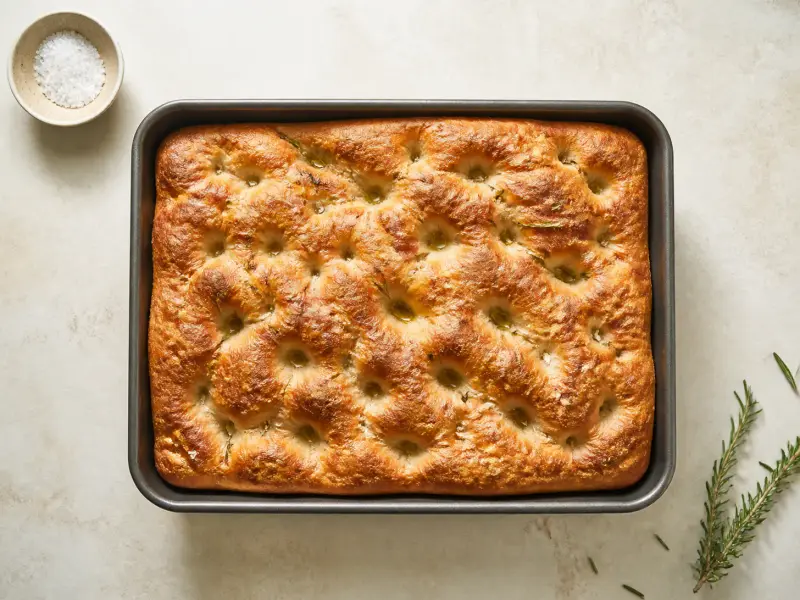 No-Knead Sourdough Focaccia
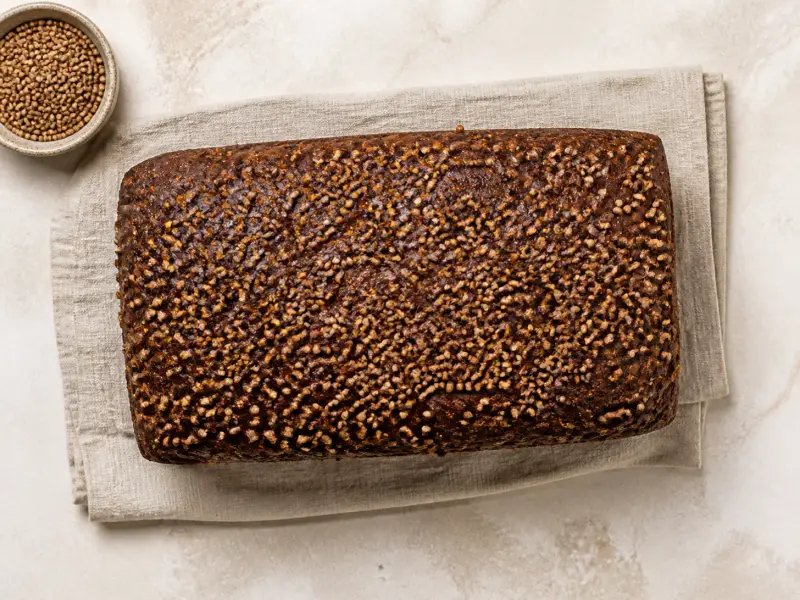 Borodinsky Rye Bread
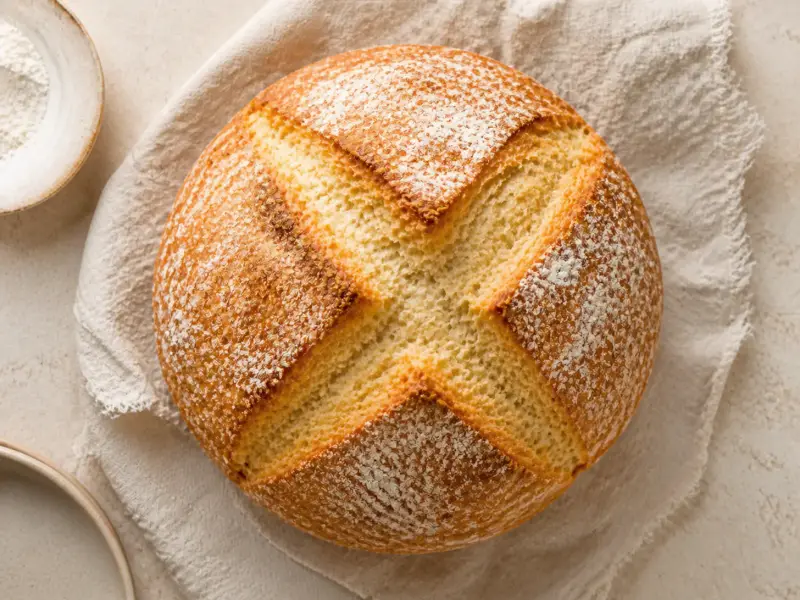 Buttermilk Soda Bread
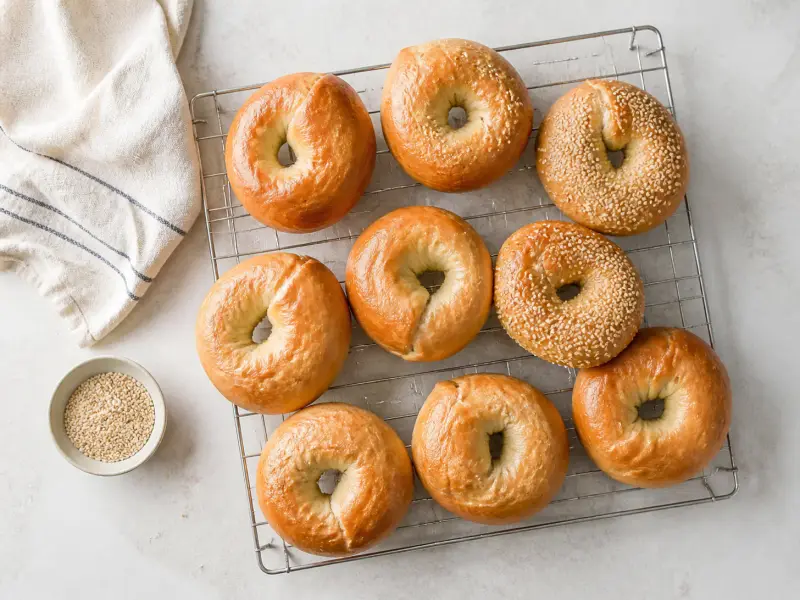 Hand-Rolled Bagels
 Sourdough Boule
 Soft Milk Rolls