Pirozhki
Пирожки
Пирожки — little pies.
Small yeasted buns filled with cabbage and egg, baked or fried, sized to be eaten out of the hand in two or three bites.
- Prep
- 45 min
- Cook
- 30 min
- Resting
- 1 hr 30 min
- Total
- 2 hr 45 min
- Serves
- 8
- Revisions
- 5
Allergens
- Cereals containing gluten
- Eggs
- Milk
Named from the ingredients as written, including those carried in from sub-recipes. This is not a guarantee — check the labels on what you actually buy, and note that a product’s recipe can change.
Ingredients
Serves
Method
Whisk the flour, yeast, sugar and the 8g of salt for the dough together in a large bowl.
Whisk the egg for the dough into the lukewarm milk and pour it in.
Mix to a shaggy dough with no dry flour left, then knead for 8 minutes, until smooth and elastic.
Work in the softened 60g of butter a piece at a time. The dough will come apart and look ruined partway through; keep kneading and it comes back together.
Cover and prove at around 24C/75F for 60-90 minutes, until doubled.
Meanwhile, melt the 30g of butter for the filling in a wide pan.
Cook the onion over medium-low heat for 6-8 minutes, until soft and translucent but not coloured.
Add the cabbage and the 3g of salt for the filling.
Cook for 20-25 minutes over medium heat, stirring often, until the cabbage has collapsed to about a third of its volume, tastes sweet rather than raw, and no liquid pools when you push it to one side of the pan.
That dry pan is the point of the long cooking. Any free liquid left in the filling turns to steam in the oven and splits the seam open.
Cool the cabbage completely, then fold through the chopped hard-boiled eggs, the dill and the pepper.
Knock the dough back and divide it into 16 pieces of about 55g.
Press or roll each piece into an oval about 12cm long, leaving the middle slightly thicker than the edges.
Put a heaped tablespoon of filling, about 25g, along the centre of each.
Do not go past 30g. An overfilled pirozhok cannot be sealed and will open along the seam wherever it is thinnest.
Bring the two long edges up to meet and pinch the seam firmly along its whole length, then pinch the two ends closed.
Wipe any filling off the seam with a fingertip before pinching. Fat or moisture on the dough stops it sticking to itself.
Set them seam-side down on a lined tray, 4cm apart.
Prove for 30-40 minutes, until visibly puffed and slow to spring back when pressed.
Heat the oven to 190C/375F.
Brush the tops with the beaten egg and milk.
Bake for 18-22 minutes, until deep gold on top and firm underneath when lifted.
To fry them instead, heat the oil to 175C/350F in a deep pan filled no more than a third of the way up, and fry them seam-side down for 2-3 minutes a side, until dark gold. Drain on a rack rather than on paper, which steams the base soft.
Cool for 10 minutes before eating. The filling holds heat far longer than the crumb around it.
Nobody has rated this recipe yet.
Sign in to rate this recipe. One rating per person, and you can change it.
What to expect
- Taste
A mild, slightly sweet enriched bread dough wrapped around a filling that's sweet-savoury from the long-cooked cabbage — cabbage cooked this far past raw develops a genuine sweetness rather than any of its raw sulphurous sharpness — with the chopped hard-boiled egg adding a mineral, slightly sulphurous richness and the dill contributing a fresh, faintly aniseed lift that cuts through both.
- Aroma
Warm, slightly sweet baked dough first, with the cabbage's sweet, faintly buttery smell coming through once one is broken open, and dill's bright, grassy top note over all of it.
- Texture
A soft, slightly chewy enriched crumb giving way to a moist, tender filling — the cabbage should still have the faintest bite left rather than being cooked to total collapse, and the chopped egg adds small, soft, slightly grainy pockets through the mixture.
- Sound
A soft tear as it's broken open by hand, releasing a little visible steam if eaten warm.
- How the flavour moves
Mild sweet dough first, then the savoury, sweet-cooked cabbage filling, with the egg's richness and the dill's freshness arriving together partway through and the whole thing finishing cleanly rather than lingering.
- Serve it
Best served warm rather than hot straight from the oven — the filling holds heat considerably longer than the dough around it, so a pirozhok that looks cool on the outside can still be scalding in the centre for several minutes after baking.
- Goes with
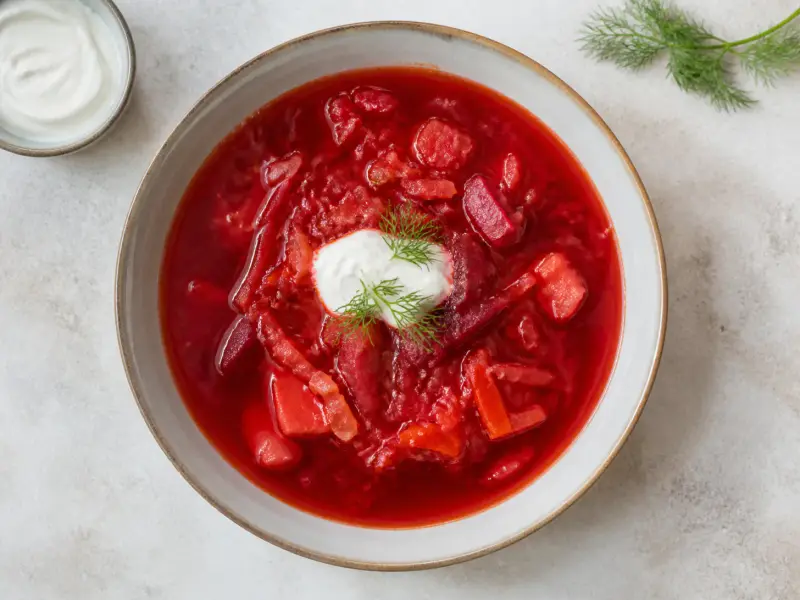
A bowl of borscht or shchi, exactly as the recipe's own history notes — a pirozhok on the side of a bowl of soup is one of the most standard pairings in the whole tradition.
Cook's notes
- Difficulty
Moderate. The dough is a straightforward enriched yeasted dough, but sealing sixteen small parcels without a burst seam takes a little practice, and the filling has to be properly dried out first.
- Cost
Cheap — cabbage, eggs and a basic enriched dough.
- Equipment
A large bowl, a rolling pin or your hands for shaping, and either a baking tray or a deep pan for frying, depending on which version you're making.
- When to make it
Any time as a snack or a soup side; traditionally also travel food, made in batches to take on a journey.
- Best season
White cabbage is available year-round, though traditionally at its cheapest in the colder months.
- You know it is done when
Deep gold on top and firm underneath when lifted, for the baked version; dark gold all over for the fried version.
- And it feels like
The dough should feel firm and set right through, not soft or doughy at the seam, which is usually the last part to fully cook.
- Food safety
The eggs are already hard-boiled before they go in, so there is no undercooked-egg risk; the main hazard is an underfilled bake that leaves the dough raw at a thick seam, which is a texture problem rather than a safety one at this scale.
- Where it goes wrong
- An undercooked, still-wet cabbage filling, which turns to steam in the oven and splits every seam it's packed into.
- Overfilling past about 30g per bun, which leaves no dough left over to seal properly.
- Filling or fat left on the seam edge before pinching, which stops the dough sticking to itself.
- Cutting into one straight from the oven, when the filling is still far hotter than the dough around it suggests.
- If it does go wrong
Split seams: the filling was too wet, or the bun was overfilled. Doughy, undercooked seams: not enough time in the oven, or the buns were packed too closely together on the tray. Dense, heavy dough: under-proved at either stage.
- Making it ahead
The filling can be made well ahead and kept refrigerated; the dough can be made the day before and its first prove done overnight in the fridge, shaped and given its second prove the next day.
- Keeping it
Baked pirozhki keep a day at room temperature or a few days refrigerated; fried ones are best the same day, since they stale and lose their lightness within hours.
- Reheating
A few minutes in a low oven brings the baked version back close to fresh; fried ones are harder to fully restore once cooled.
- Freezing
Freeze well baked or unbaked; from frozen, bake a little longer than the fresh timing calls for.
- Leftovers
Eaten cold or reheated, exactly as they are — there's no real secondary use for a filled bun like this.
- Scaling it
Scales cleanly by dividing the dough into more or larger pieces, though the fill-and-seal step remains a per-bun task regardless of batch size.
- Substitutions
Fillings vary enormously and traditionally follow what's cheap and available: potato, minced meat, mushroom or rice are all standard alternatives to cabbage and egg, using the same dough. Baked and fried pirozhki share the identical dough; frying gives a lighter, richer result that goes stale within hours, while baking keeps for a day.
- Dietary swaps
Contains gluten, egg and milk throughout, in both the dough and the filling. A vegan version would need to rework the dough's egg and milk enrichment and drop the egg from the filling, which changes the dish considerably rather than being a simple swap.
- Shopping for it
Any firm white cabbage works; there's nothing specialist to source here.
- Keeping the cost down
Cabbage is one of the cheapest vegetables available, and the filling stretches a long way relative to its cost — this is fundamentally a frugal, resourceful dish.
- Sustainability
A low-cost, plant-forward filling with only a modest amount of egg, making it a relatively low-impact snack by the standards of the meat-filled versions of the same dough.
- Nutrition
A filling snack rather than a light one — enriched dough plus egg and a little butter both in the dough and the filling.
- Worth it?
A genuinely useful hand-held snack, and the standard companion to a bowl of borscht rather than an afterthought beside it.
Where it comes from
- Origin
Russia and the wider East Slavic world, with no traceable single point of origin.
- Also called
Pirozhki (пирожки), the diminutive plural of pirog.
- Said out loud
pee-rosh-KEE, stress on the final syllable.
- What the name means
Pirog, pirozhok and pirozhki are the same underlying word at three different sizes — a pirog can be a full pie large enough for a whole table, a pirozhok a single hand-sized bun, and pirozhki the plural of those small ones.
- History
Filled pastry of this general kind is old enough across the region that no invention story or date attaches to it; what has changed over time is mainly the filling, following whatever was affordable and in season in a given household or period. Fried versions became a familiar sight sold from carts and station kiosks across the Soviet Union, functioning as portable street food in a way the baked domestic version never quite did.
- Why it matters
Made at home for family meals and for taking on journeys, and sold from bakeries and kiosks across Russia, Ukraine and Belarus. A single one is eaten out of the hand as a snack; a plate of them is a standard accompaniment to soup, particularly borscht.
- When it is eaten
Everyday snacking and travel food, and a standard side to a soup course at a family table.
- The traditional way
An enriched yeasted dough, rolled, filled, pinched shut along a seam, proved once more and then either baked or fried — the same dough serves both methods.
- How it changed
Little about the technique itself has changed; what shifts is mainly the filling by era and region, and the balance between fried street food and baked domestic food as circumstances and access to frying oil or ovens have varied.
- Regional variations
Fillings run from cabbage and egg — the version made here — to potato, minced meat, mushroom, rice, or curd and fruit for a sweet version; a cabbage-only filling with no egg at all is the version made during religious fasting periods.
- How this version differs
This recipe uses the classic cabbage-and-chopped-egg filling and gives both a baking and a frying method, rather than committing to only one.
- Sources and credit
No individual inventor can be credited to a dish this old and this broadly spread across a region's home cooking.
 Borodinsky Rye Bread
 Kulich
 Vatrushka
 Borscht
 Braised Red Cabbage
 Buckwheat Kasha with Mushrooms