Daiquiri
Three ingredients and nowhere to hide: white rum, lime and sugar, shaken hard and drunk cold and straight up.
- Prep
- 5 min
- Total
- 5 min
- Serves
- 1
- Revisions
- 6
Ten seconds, if you are in a hurry
The whole dish, carried in and set down, with the one thing worth knowing about it said out loud. No method, no measuring — just what it should look like when it arrives.
Watch on YouTubeIngredients
Serves
Method
Chill a coupe glass, either in the freezer or with ice and water while you work.
Put the rum, lime juice and sugar syrup into a cocktail shaker.
Fill the shaker two thirds with ice.
Shake hard for 12-15 seconds, until the outside of the shaker is painfully cold and frosted.
Tip the ice out of the glass.
Double strain into the chilled coupe, through both the shaker strainer and a fine sieve, so no ice shards float on the surface.
Garnish with the lime wheel and drink it while it is still very cold.
Nobody has rated this recipe yet.
Sign in to rate this recipe. One rating per person, and you can change it.
What to expect
- Taste
Sharp and clean, with fresh lime doing most of the talking and the white rum sitting underneath it as a light, faintly grassy sweetness rather than announcing itself the way a darker rum would. The sugar syrup rounds the acidity without ever making the drink taste sweet outright — the whole point of the ratio is that sourness still leads.
- Aroma
Fresh lime zest and juice dominate completely, with only a faint, clean sweetness from the rum underneath it — this is one of the few classic cocktails where the base spirit is almost invisible on the nose.
- Texture
Thin and quick rather than rich — there is no fat, no cream, nothing to give it body beyond the small amount of sugar, and that leanness is deliberate.
- Sound
A hard, bright rattle through the shake, softening as the ice breaks down, then a thin, steady pour and a quiet settling into the chilled glass.
- How the flavour moves
Lime arrives first and hardest, sharp enough to make the mouth water; the sugar catches up a beat behind it and softens the edge; the rum is the last thing to register, a light warmth at the very back rather than a flavour up front. The whole arc is short and clean rather than layered.
- Serve it
Served extremely cold and drunk quickly for exactly that reason — it warms and loses its edge within ten minutes.
- Goes with
Ceviche, ropa vieja, fried plantain, or simply salted nuts — anything with acid or salt of its own, since the drink's job is to be sharper and colder than whatever it sits beside.
Cook's notes
- Difficulty
Easy to make, and unforgiving of a poor ingredient, since there is nothing else in the glass to cover for bottled lime juice or a rough rum.
- Cost
Low. A bottle of decent white rum makes many drinks, and lime and sugar syrup cost very little per glass.
- Equipment
A cocktail shaker, a jigger or accurate measure, a citrus squeezer, a fine sieve for the second strain, and a coupe glass, chilled.
- When to make it
Hot weather, and the first drink of an evening.
- Best season
None; limes and rum are both available year round.
- You know it is done when
The outside of the shaker should frost over fully; the strained drink should be pale, faintly cloudy from the fresh lime, with a thin collar of fine bubbles on top for the first minute.
- And it feels like
Listen to the shake rather than watch it — a hard, bright rattle that goes progressively duller as the ice breaks down is the tell that it is ready.
- Food safety
No particular hazard; wash the lime before cutting it, since the peel touches both the juicer and, briefly, the glass.
- Where it goes wrong
- Bottled lime juice, which tastes flat and cooked next to the freshly squeezed version this drink depends on.
- Skipping the second, fine strain, leaving ice shards in the first sip.
- Serving it in a warm glass, which undoes much of what the shake achieved.
- Treating it as the same drink as a frozen daiquiri, which is a related but genuinely different thing.
- If it does go wrong
Too sour: add sugar syrup a little at a time. Too sweet or flat: use more lime, and check the rum is a clean white style rather than something spiced or aged. Tastes weak: it was over-shaken or over-diluted, or served over the already-melting shaking ice rather than freshly strained.
- Making it ahead
The rum, lime and syrup can be combined ahead and refrigerated for same-day serving, kept cold and shaken to order; a fully pre-diluted batch can also be frozen and poured straight from the freezer.
- Keeping it
Does not keep once shaken; the rum, lime and syrup can be pre-batched without ice and refrigerated for a day, with the lime dulling noticeably by the second.
- Reheating
Not applicable.
- Freezing
A pre-diluted batch (rum, lime and syrup with a little added water to stand in for the shake) can be kept in the freezer and poured straight into a glass with no shaking required, which is a useful trick for serving several at once.
- Leftovers
None worth keeping; a half-finished daiquiri warms and dilutes further within minutes.
- Scaling it
Scales cleanly for a jug or batch, though a shaker cannot properly chill more than a few drinks' worth at once — batch the mix and shake or freeze it in smaller portions.
- Substitutions
A light Cuban-style rum is the reference spirit; an aged or heavily spiced rum changes the drink's whole character rather than just its finish. Simple syrup can replace sugar syrup one for one; agave syrup works but leaves a faint, un-Cuban vegetal note behind it.
- Dietary swaps
Dairy free, egg free, nut free and gluten free as written. A lower-sugar version can be made by reducing the syrup slightly and accepting a sharper, more purely sour drink; there is no convincing non-alcoholic version, since the rum is the drink's entire structure rather than a flavour layered on top of something else.
- Shopping for it
A clean, light white rum rather than an aged or heavily spiced one; limes that are heavy for their size with thin, slightly yielding skin, which juice more freely than hard, thick-skinned ones.
- Keeping the cost down
A mid-priced white rum is genuinely sufficient here, since the drink is built to taste clean and light rather than to showcase an aged spirit's complexity.
- Sustainability
Sugarcane, the base of rum, carries the same monoculture and water-use questions as most large-scale tropical agriculture, and distillation produces a significant volume of vinasse waste per litre of spirit — a general point about rum production rather than a claim about any specific bottle.
- Nutrition
Roughly 130-150 calories per drink, calculated from the pours, most of it from the rum and the sugar syrup; it carries about 24ml of pure alcohol, a little under two UK units.
- Worth it?
The clearest possible test of a good white rum, and one of the simplest genuinely great cocktails on any list.
Where it comes from
- Origin
Santiago de Cuba, and specifically the beach and mining town of Daiquirí nearby.
- Also called
Daiquirí.
- Said out loud
Spanish: dye-kee-REE, stress on the final syllable; commonly anglicised as DYE-kuh-ree.
- What the name means
Named directly for the place, Daiquirí, rather than for any ingredient or technique.
- History
The Jennings Cox story situates the drink's naming at the end of the Spanish-American War, when American mining engineers and soldiers were present in eastern Cuba in numbers. The underlying combination of rum, lime and sugar is considerably older and descends from British naval rum rations cut with lime juice as an anti-scurvy measure, which places the daiquiri's true ancestry in naval medicine rather than in any bar.
- Why it matters
One of the six basic drinks named in David Embury's influential 1948 cocktail writing, and permanently associated with Hemingway and El Floridita in Havana, where the sugar-free "Papa Doble" version he favoured is still served.
- When it is eaten
Warm weather, and the start of an evening — it is short, cold and sharp rather than a nightcap.
- The traditional way
Shaken hard with ice and double strained, which removes all ice fragments from a drink with nothing else in the glass to distract from one.
- How it changed
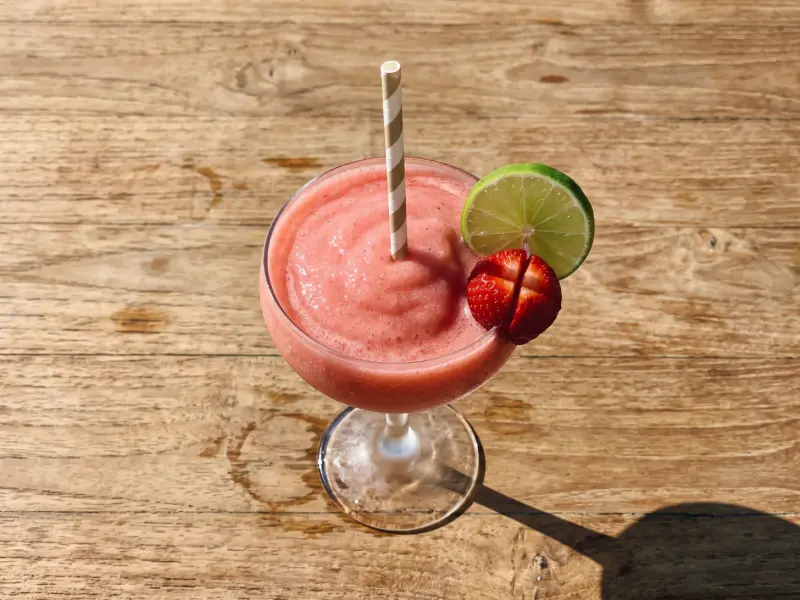
The frozen, blended daiquiri — closer to a slushy than the shaken original — became the more commonly known version in much of the world from the mid-twentieth century onward, in the same way frozen machines reshaped the margarita; the two drinks share that history closely.
- Regional variations
The Hemingway or "Papa Doble" swaps out the sugar for grapefruit juice and maraschino liqueur and is considerably more tart; frozen and fruit-blended versions (strawberry daiquiri and similar) are a separate, much sweeter branch of the same name.
- How this version differs
We keep the original shaken, unadorned form rather than the frozen version most people meet first, and we double strain it, which is a small refinement rather than a departure from the classic recipe.
- Sources and credit
Jennings Cox is the credited namer of the drink, though the story is repeated rather than documented in contemporary sources; Constantino Ribalaigua Vert's later development of the drink at El Floridita is much better documented and safe to repeat.
 Bahama Mama
 Caribbean Rum Punch
 Dark and Stormy
 Frozen Melon Colada
 Frozen Strawberry Daiquiri
 Mojito