Red-Braised Pork Belly
紅燒肉
Hóngshāo ròu
紅燒肉 — red-cooked meat, for the colour the caramel gives it.
Pork belly caramelised in sugar and braised in soy and wine until the fat turns to jelly and the sauce to lacquer.
- Prep
- 15 min
- Cook
- 1 hr 45 min
- Total
- 2 hr
- Serves
- 4
- Revisions
- 5
Allergens
- Cereals containing gluten
- Soya
Named from the ingredients as written, including those carried in from sub-recipes. This is not a guarantee — check the labels on what you actually buy, and note that a product’s recipe can change.
Ingredients
Serves
Method
Put the pork in a pan of cold water, bring to the boil, and simmer for 3 minutes.
Drain, rinse the pieces under hot water and pat them dry. Discard the water.
Heat the oil in a heavy pot over a medium-low heat and add the sugar.
Let it melt and turn amber — 3-4 minutes. Watch it: from amber to burnt is about fifteen seconds.
Add the pork immediately and turn the pieces until they are coated and glossy.
Add the ginger, spring onions, star anise and cinnamon and fry for a minute.
Pour in the Shaoxing wine and let it bubble for 30 seconds.
Add both soy sauces and the hot water, which should almost cover the meat.
Bring to a simmer, cover, and cook at the barest bubble for 70 minutes.
Uncover, add the salt, raise the heat and reduce for 20 minutes, spooning the sauce over the pork as it thickens.
It is ready when the sauce is syrupy and clings to the back of a spoon and the fat is translucent.
Nobody has rated this recipe yet.
Sign in to rate this recipe. One rating per person, and you can change it.
What to expect
- Taste
Sweet first, and much sweeter than people expect from a savoury braise — 40g of sugar in a dish for four is a real quantity and it is the point. Under it, soy brings salt and a deep fermented savouriness, and the two soys are doing different things: the light one is bright and salty, the dark one is molasses-thick and slightly bitter. The caramel contributes a third register that neither sugar nor soy has on its own — a faint burnt bitterness that keeps the whole dish from being confectionery, and it is why the sugar is caramelised rather than stirred in. Shaoxing wine adds a nutty, sherry-like depth. Star anise and cinnamon are warm and background rather than dominant. And then the pork, which after ninety minutes tastes primarily of itself and of rendered fat, sweet and rich and faintly milky.
- Aroma
Star anise is the loudest thing and it is the smell most people identify as Chinese braising. Under it, caramel and soy — a dark, sweet, slightly savoury smell like the top of a well-glazed roast — and the wine's nuttiness. It fills a kitchen for an hour and a half, which is most of the pleasure of cooking it.
- Texture
Three textures in one cube and that is the whole reason for using belly. The skin is soft and slightly sticky with collagen. The fat is not fatty in the mouth at all after ninety minutes — it is gelatinous, yielding, closer to a set custard than to anything greasy. And the lean streaks are tender and pull apart in strands. The sauce is syrupy and coats. It should never be greasy; if it is, the braise was too hot and the fat separated rather than rendering into the liquid.
- Sound
Almost nothing for ninety minutes, and that is the correct sound — a bare tremble, an occasional bubble breaking. If the pot is audibly boiling it is too hot. Before that, the caramel is silent and then the pork hits it with a violent hiss and a burst of steam. At the end, the reduction goes from a simmer to a thicker, slower, plopping sound as it concentrates, which is a genuine cue that it is nearly there.
- How the flavour moves
Star anise in the nose. Then sweetness, immediately and strongly, then salt behind it. The fat arrives in the middle and coats everything, carrying the aromatics with it. The finish is long and is where the caramel's bitterness shows — it clears the sweetness away and leaves a savoury, faintly smoky aftertaste. That final bitterness is why the dish can be this sweet and still be eaten with rice.
- Serve it
Hot, and it holds heat exceptionally well because of the fat and the sugar. It is also good at room temperature and perfectly good cold from the fridge the next day, which is not true of most braises.
- Goes with
Plain steamed rice, which is not an accompaniment but a structural requirement — the dish is far too intense to eat alone and the rice is what makes the portions work. Something green and sharp: blanched greens with a little vinegar, smashed cucumber, pickled mustard greens. A clean lager or a light oolong tea. Where it fails is with anything else sweet or rich, and with wine generally, which the sugar and the soy both fight.
Cook's notes
- Difficulty
Easy for ninety minutes and genuinely tense for four. Everything about this dish is straightforward except the caramel, which goes from correct to ruined faster than you can fetch the pork — so the pork must be beside the pan, dry and ready, before the sugar goes in.
- Cost
Low. Pork belly is one of the cheapest cuts there is, and the rest is store-cupboard. It is the most impressive cheap dish in the collection.
- Equipment
A heavy pot with a lid — cast iron or a clay pot — that holds heat evenly, because ninety minutes at a bare tremble is hard in a thin pan. A pan for the blanch. Nothing specialised.
- When to make it
Cold weather, weekends, and the day before you want to eat it.
- Best season
None. It is a winter dish by temperament.
- You know it is done when
The caramel is ready at amber — the colour of clear honey going towards maple syrup. The finished dish is right when the sauce is syrupy enough to coat the back of a spoon and the fat has gone from opaque white to translucent, almost jelly-like. That translucency is the doneness cue that matters and it is unmistakable once you have seen it.
- And it feels like
A cube should be soft enough to cut with the side of a spoon and still hold its shape. The fat should be gelatinous rather than greasy — collagen has become gelatine and the fat has rendered into the sauce.
- Food safety
Pork braised for ninety minutes is far past any safety threshold. The blanch at the start is not a safety step; it removes scum and impurities that would otherwise cloud the sauce.
- Where it goes wrong
Taking the caramel too far — from amber to acrid is about fifteen seconds and there is no recovering it, so have the pork dry and beside the pan before the sugar goes in. Skipping the blanch, which gives a cloudy, slightly muddy sauce. Boiling rather than trembling, which makes the lean parts stringy and separates the fat instead of rendering it. Cutting the pieces too small. And skipping the final uncovered reduction, which is the difference between a braise and a lacquer.
- If it does go wrong
Bitter and acrid: the caramel burnt, and the only fix is to start again — it is 40g of sugar, not a disaster. Sauce thin at the end: reduce harder and longer, uncovered, and baste. Meat tough after ninety minutes: it was boiling rather than simmering; another thirty minutes at a proper tremble will usually rescue it. Greasy rather than glossy: the same cause, and chilling it overnight and lifting the set fat off is the practical fix. Too sweet: more light soy at the reduction stage, a little at a time.
- Making it ahead
It is genuinely better made a day ahead. The flavours settle, the sauce thickens, and the fat sets on top so any excess can be lifted off. Reheat gently with a splash of water. This is the recommended way to cook it, not a compromise.
- Keeping it
Four days in the fridge, and it is better on day two — see Making it ahead. The fat sets solid on top and is easily lifted off if you want a leaner dish.
- Reheating
Very well, gently, with a splash of water to loosen the sauce. It is one of the few dishes here that genuinely improves on reheating.
- Freezing
Three months, and it survives it well. Braises freeze better than almost anything else because the structure has already broken down.
- Leftovers
Excellent. Chopped small and stirred through fried rice, or in a steamed bun with cucumber and spring onion.
- Scaling it
Doubles well in a large enough pot, with the caveat that the caramel stage does not scale — do the sugar in the same quantity of oil and add the pork in two lots.
- Substitutions
Caster sugar for rock sugar works and gives a slightly less glossy result. Dry sherry is the standard substitute for Shaoxing wine and is genuinely close; a dry white wine is not, and mirin is far too sweet. Pork shoulder can be used and gives a leaner, less luxurious dish that needs longer. There is no substitute for the pork belly if you want the texture that makes the dish.
- Dietary swaps
Not adaptable. It is a pork-fat dish. Contains soya and, through both the soy sauce and the Shaoxing wine, cereals containing gluten — tamari and a gluten-free rice wine make a version that is close, though most Shaoxing wine contains wheat.
- Shopping for it
Skin-on pork belly, from a butcher if possible, with clear layers rather than one thick band of fat. Shaoxing wine and rock sugar from a Chinese supermarket. Both light and dark soy sauce — supermarkets often sell only one, and the dish needs both.
- Keeping the cost down
Pork belly is already cheap and buying a whole piece and cutting it yourself is cheaper than buying it cubed. Rock sugar keeps forever and is inexpensive at a Chinese grocer, where the Shaoxing wine will also cost a fraction of what a supermarket charges.
- Sustainability
Belly is one of the cuts that gets under-used in Western butchery, so cooking it is a genuinely good use of the animal rather than a compromise.
- Nutrition
Around 700 calories a serving as written, and it is a fatty dish; there is no honest way to present it otherwise. A good deal of the rendered fat stays in the pot rather than on the plate, and chilling overnight and lifting it off removes a substantial amount. It is eaten in small quantities with rice for exactly this reason.
- Worth it?
Worth it, and it is the best value in the collection — a kilogram of the cheapest cut in the shop, turned into something that looks like restaurant food, with twenty-five minutes of actual work. The caramel is the only thing standing in the way and it is four minutes of paying attention. Make it the day before.
Where it comes from
- Origin
China. Hong shao is a national technique; this dish is claimed most strongly by Shanghai and by Hunan, and the two versions differ.
- Also called
Hong shao rou — 红烧肉.
- Said out loud
hong shao roh, with hong on a high level tone and shao rising. Roughly 'hong-shaow-roh'.
- What the name means
Red-braised meat. Hong is red, shao is to braise or cook, rou is meat and by default means pork in Chinese — which is itself worth knowing, since a Chinese menu saying only 'meat' means pork.
- History
Red-braising is old and widespread and there is no inventor to name. What is documented is the twentieth-century fame of this particular dish, which is tied to Mao Zedong: he was from Hunan, the dish is a Hunanese staple, and his reported fondness for it is repeated in a great many accounts. The Hunanese version is often made without soy sauce at all, taking its colour entirely from the caramel, while the Shanghainese version leans on soy and sugar and is sweeter. Both are called hong shao rou and people from each region will tell you the other is doing it wrong.
- Why it matters
It is one of a small number of dishes that function as a national comfort food across a country with enormously varied regional cuisines, and it is a standard test of a home cook. The technique of caramelising sugar before braising is used across Chinese cooking and learning it here transfers to a dozen other dishes.
- When it is eaten
Family meals, celebrations, and cold weather. It is not restaurant food so much as home food that restaurants also make.
- The traditional way
Two things. The blanch from cold water, which draws out blood and scum and gives a clean-tasting, clear sauce — skipping it is the most common shortcut and the sauce is visibly murkier for it. And the sugar caramelised in oil before the meat goes in, which is what produces the colour and the depth.
- How it changed
Rock sugar has largely replaced other sweeteners, and pressure cookers have shortened the braise in many modern kitchens, which works but loses the final reduction's concentration unless it is done separately afterwards.
- Regional variations
The Hunanese version uses little or no soy sauce and often more chilli. The Shanghainese is sweeter and darker with more soy. Some versions add hard-boiled eggs to the braise for the last half hour, which is excellent and worth doing. Tofu, chestnuts and dried bamboo shoots are all traditional additions.
- How this version differs
It is closer to the Shanghainese build, with both soys. It is unusually explicit about the caramel window and about having the pork dry and to hand before the sugar goes in, because that is where the dish is lost.
- Sources and credit
No attribution. The Mao association is widely reported and is given here as association rather than as documented preference.
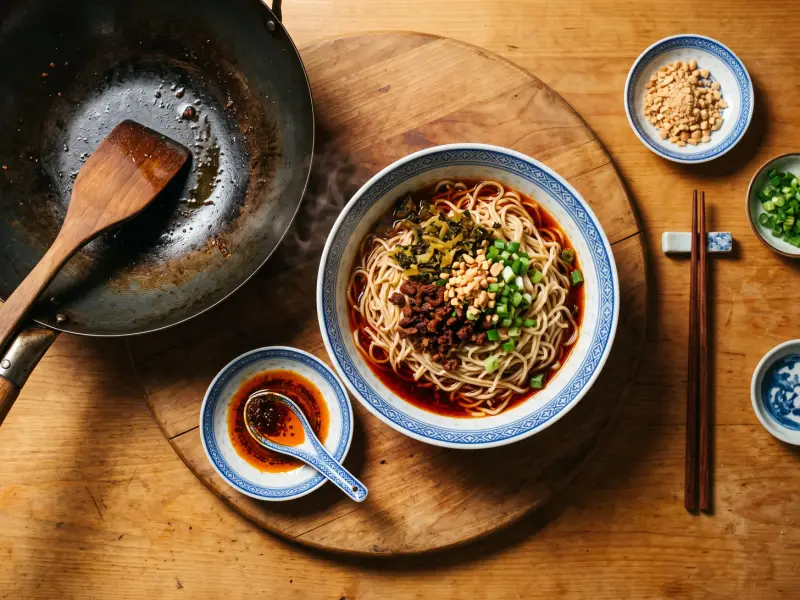 Dan Dan Noodles
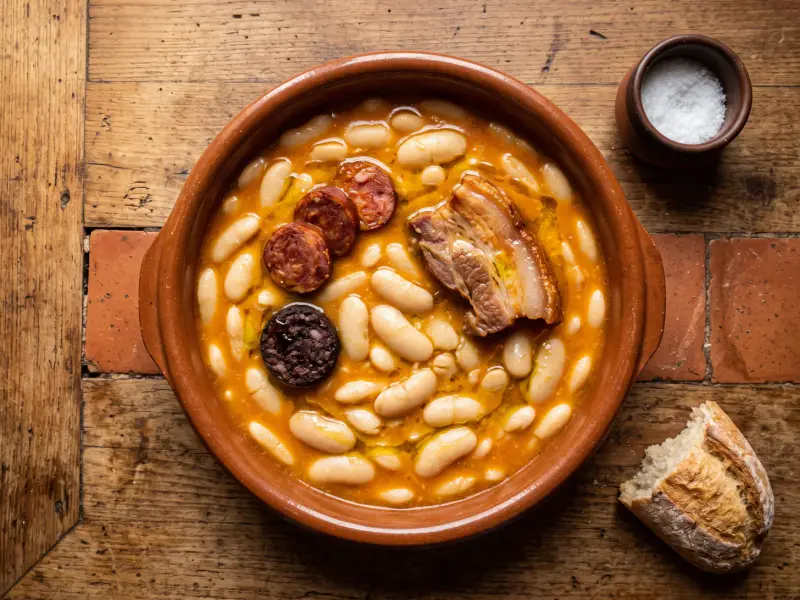 Fabada Asturiana
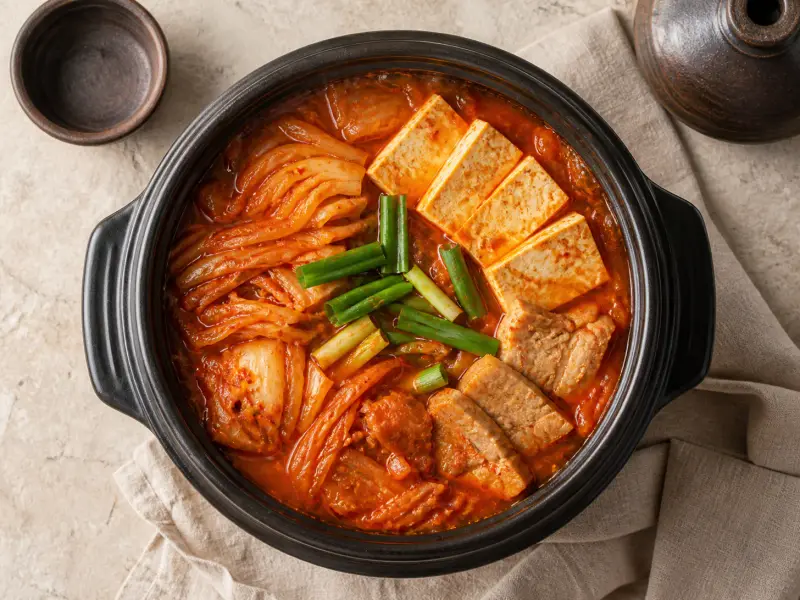 Kimchi Jjigae
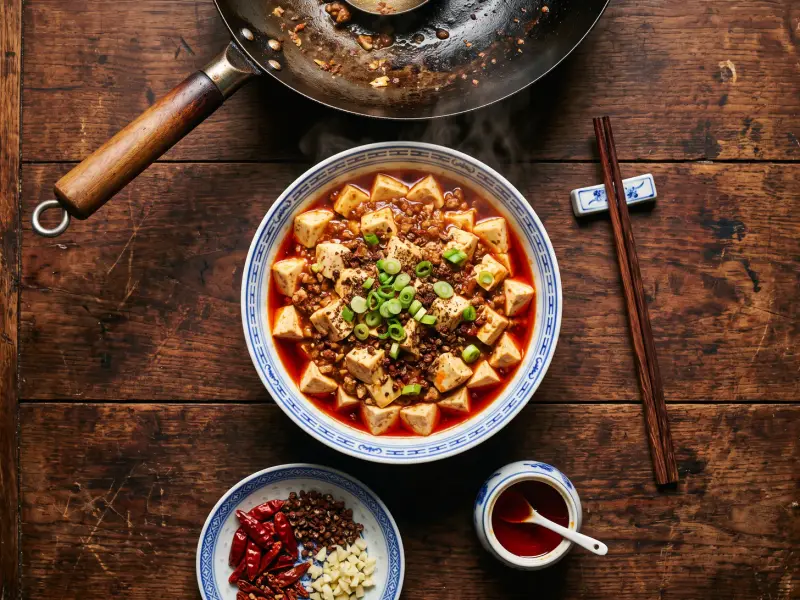 Mapo Tofu