Spaghetti Carbonara
Spaghetti alla carbonara
Guanciale, egg yolk and pecorino brought together off the heat into a glossy sauce, with no cream anywhere near the pan.
- Prep
- 10 min
- Cook
- 15 min
- Total
- 25 min
- Serves
- 2
- Revisions
- 5
Ten seconds, if you are in a hurry
The whole dish, carried in and set down, with the one thing worth knowing about it said out loud. No method, no measuring — just what it should look like when it arrives.
Watch on YouTubeAllergens
- Cereals containing gluten
- Eggs
- Milk
Named from the ingredients as written, including those carried in from sub-recipes. This is not a guarantee — check the labels on what you actually buy, and note that a product’s recipe can change.
Ingredients
Serves
Method
Bring the 2 litres of water to the boil in a pan wide enough to hold the spaghetti flat.
Stir in the 10g of fine salt.
Grate the pecorino on the finest holes you have, so it goes to a powder rather than shreds that sit in the sauce as rubbery threads.
Put the guanciale batons into a cold wide frying pan and set it over medium-low heat.
Render for 6-8 minutes, turning the pieces, until the fat has gone from opaque white to clear and the lean edges are deep gold and crisp at the corners.
Keep the heat low through all of that. Guanciale dropped into a hot pan browns and hardens on the outside while the fat inside is still solid, and that rendered fat is half the sauce.
Take the pan off the heat and leave the guanciale sitting in its own fat.
Whisk the 3 yolks, the whole egg, the pecorino and three quarters of the ground pepper together in a bowl until they form a thick, even paste with no streaks of white left.
Cook the spaghetti for 1 minute less than the packet says, until it still has a firm white core when you bite a strand.
Ladle 300ml of the cooking water into a jug before anything is drained. As in the cacio e pepe in this collection, that starchy water is an ingredient, and once it is down the sink there is no way back.
Lift the spaghetti straight into the guanciale pan with tongs, letting it drip but not draining it dry.
Set the pan over low heat and toss for 20-30 seconds, until every strand is slick with the rendered fat.
Take the pan off the heat and wait a full minute, until it has stopped sizzling and no steam is coming hard off the base.
Do not shorten that minute. Egg yolk starts setting at around 65C/149F, and a pan still hot enough to fry turns the eggs into fine yellow threads sitting in a greasy pool the second they land — a sweetish scrambled egg with pasta in it, and nothing brings it back.
Loosen the egg and cheese paste with 60ml of the reserved water, whisking until it pours off the whisk in a thick ribbon.
Pour the paste over the pasta.
Toss hard and continuously for 30-60 seconds, lifting the strands high so the sauce moves through them, until it turns glossy and clings.
Put the pan back over the lowest heat for 10-15 seconds only if the sauce still looks watery, moving the pasta the whole time and lifting it off at the first sign of thickening.
Loosen with the reserved water a splash at a time, until the sauce slides slowly off the strands rather than clinging in a paste.
Taste it. Between the salted water, the guanciale and the pecorino it should need no more salt.
Serve into warmed bowls straight away, with the remaining pepper over the top.
Eat it at once. This sauce is held together by heat and starch alone, and it stiffens and dulls within a couple of minutes on a cold plate.
Nobody has rated this recipe yet.
Sign in to rate this recipe. One rating per person, and you can change it.
What to expect
- Taste
Rich and deeply savoury from the rendered guanciale fat and the dense, salty pecorino, with the egg yolk adding a rounding creaminess that reads as silky rather than heavy — there is no dairy cream anywhere in it, and the richness comes entirely from egg fat and cheese rather than added dairy.
- Aroma
A meaty, faintly smoky smell from the rendering guanciale, with a sharp, sheep's-milk tang from the pecorino as it melts into the hot pasta and egg.
- Texture
Silky and clinging where the emulsion has held, coating every strand without pooling in the bowl; a broken sauce turns visibly stringy and grainy, unmistakably different from a properly made one.
- Sound
A steady, continuous tossing sound as the pasta and egg mixture are worked together vigorously for the final 30-60 seconds, the technique being as much about motion as heat.
- How the flavour moves
The guanciale's savoury, meaty fat registers first, the pecorino's dense saltiness follows and builds through the middle of the bite, and the black pepper's sharp heat lingers longest at the finish, cutting through the richness of the egg and fat.
- Serve it
Served hot and eaten quickly, since the sauce is held together by residual heat and starch rather than any stable fat or dairy base, and it stiffens within a couple of minutes on a cooling plate.
- Goes with
Little to nothing — this is traditionally eaten on its own as a primi course, without bread or a side dish.
Cook's notes
- Difficulty
Deceptively difficult — a short ingredient list, but the egg sauce has a narrow window between silky and scrambled, and there is no recovering it once it has gone wrong.
- Cost
Low to moderate — guanciale is a specific cured pork product and the main cost beyond the pasta and cheese.
- Equipment
A wide pan for both the guanciale and the finished pasta, and a jug for the reserved cooking water.
- When to make it
A quick but attentive weeknight dinner — quick in total time, but not a dish to multitask through.
- Best season
None; every ingredient is available year round.
- You know it is done when
The finished sauce should look glossy and cling to every strand, sliding slowly rather than sitting as a thick paste or pooling as a thin, curdled liquid with visible yellow threads in it.
- And it feels like
Smooth and coating, with no graininess; a broken sauce reads as fine scrambled-egg threads sitting in a thin, greasy liquid rather than a unified, glossy coating.
- Food safety
The egg yolks are not fully cooked to a hard set in the traditional method, since the sauce depends on retaining a runny, emulsified texture — the residual heat of the pasta and pan is generally sufficient to bring the eggs to a safe, lightly cooked state, though anyone in a vulnerable group should be aware the yolks are not cooked hard.
- Where it goes wrong
- Adding the egg mixture while the pan is still hot enough to cook it, which scrambles the eggs into stringy threads in a greasy pool.
- Substituting cream for some or all of the egg, which is not a lighter version of carbonara but a different, non-Roman dish.
- Rendering the guanciale too hot and fast, which browns and hardens the outside while the fat inside is still solid.
- Grating the pecorino coarsely rather than finely, leaving rubbery threads that never fully melt into the sauce.
- If it does go wrong
Sauce turned into scrambled egg: the pan was too hot when the egg mixture was added — there is no bringing it back, only starting the final combining step again more carefully next time and giving the pan longer to cool. Sauce too thin and greasy: not enough of the reserved starchy water was worked in, or too much guanciale fat relative to egg and cheese. Guanciale chewy rather than crisp at the edges: it was rendered too fast over too high a heat rather than slowly.
- Making it ahead
Not a make-ahead dish in any sense — the sauce must be finished and eaten within minutes of being made.
- Keeping it
Not a dish that keeps or reheats with anything like its original texture — the sauce is an emulsion held together by heat and starch, and it does not survive refrigeration and reheating.
- Reheating
Not recommended; reheating reliably breaks the emulsion into separated fat, grainy egg and dry pasta.
- Freezing
Not suitable in any form.
- Leftovers
Effectively none worth keeping — this is a cook-and-eat-immediately dish.
- Scaling it
Scales reasonably by keeping the same ratios, though the emulsion is genuinely harder to control in a very large single batch, since a bigger pan and a bigger volume of pasta cool much less predictably.
- Substitutions
Guanciale, cured pig cheek, is fattier and more strongly seasoned than pancetta and renders to a soft fat that carries the sauce in a way pancetta does not quite replicate — pancetta is the common substitute where guanciale is unavailable, but it is a substitution rather than an equivalent. There is no acceptable substitute for the eggs and pecorino with cream; adding cream produces a different, non-Roman dish regardless of how it is labelled.
- Dietary swaps
Contains gluten, eggs and milk. Not easily adapted to any of the major allergen-free categories without fundamentally changing the dish, since eggs and pecorino are both structurally central rather than optional flavourings.
- Shopping for it
Guanciale specifically, rather than pancetta or bacon, for the most authentic result — it is worth seeking out at a good Italian delicatessen where possible.
- Keeping the cost down
Pancetta is a genuinely reasonable and considerably more available substitute for guanciale where it cannot be found, though it renders differently and gives a slightly different final texture.
- Nutrition
A rich source of protein and fat from the eggs, pecorino and guanciale; a satisfying rather than a light dish by design.
- Worth it?
A dish that rewards precise technique over improvisation, and one where understanding exactly why cream has no place in it changes how the whole method is approached.
Where it comes from
- Origin
Rome, Italy, as far as the documented record goes; its deeper origin before the 1950s is genuinely unknown.
- Also called
Carbonara.
- Said out loud
car-bo-NAH-rah.
- What the name means
Possibly related to carbonari, Italian charcoal burners, though this is one contested explanation among several rather than a settled etymology.
- History
No documented recipe for carbonara exists before the 1950s, when it appears in print in both Italy and the United States, already associated with Rome. Three separate origin stories circulate, none of them resolved: that it was invented for American soldiers after 1944 using ration bacon and powdered egg; that the name derives from Roman charcoal burners who are said to have eaten a version of it; and that it was created after the war by the restaurateur Riccardo Ferrigno. None of the three has the kind of contemporary documentation that would settle the question, and all three should be treated as competing claims rather than one being favoured as correct.
- Why it matters
A Roman trattoria fixture and one of the most cooked pasta dishes in the world, frequently altered abroad with additions — cream, garlic, onion, bacon in place of guanciale — that are not part of the Roman original.
- When it is eaten
Everyday trattoria and home cooking in Rome, rather than a dish tied to a specific occasion.
- The traditional way
Rendering guanciale slowly, emulsifying egg and pecorino into the hot pasta entirely off direct heat, and never introducing cream at any stage.
- How it changed
Cream, garlic and onion are common additions made outside Italy, none of which appear in the Roman original; guanciale is also very commonly replaced with bacon or pancetta abroad, which changes both the flavour and the texture of the rendered fat the sauce depends on.
- Regional variations
It belongs to the same Roman family of dishes as cacio e pepe, gricia and amatriciana — gricia is essentially this dish without the egg, and amatriciana adds tomato in place of the egg and cheese sauce.
- Sources and credit
No individual is documented as the inventor; the American-soldiers, charcoal-burner and Riccardo Ferrigno accounts are all repeated claims without settled contemporary evidence, and none is presented here as more likely correct than the others.
Related recipes
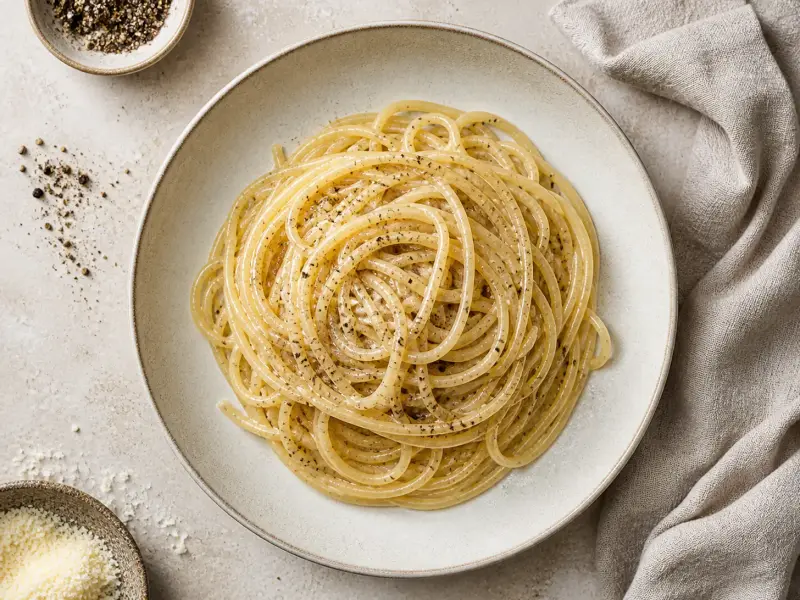 Cacio e Pepe
 Baked Lasagne
 Basil Pesto
 Classic Margherita Pizza
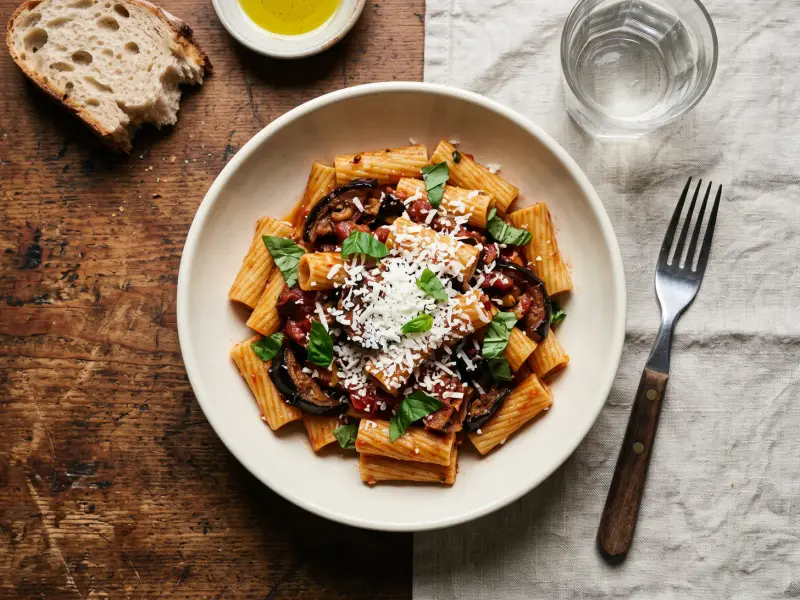 Pasta alla Norma
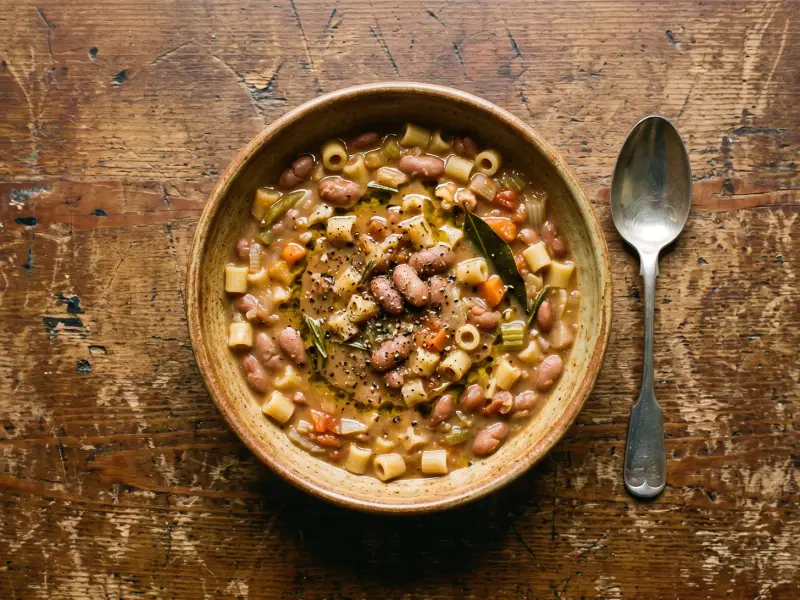 Pasta e Fagioli
Categories
Cuisines
Courses & dish types
Main ingredients
Diets
Time & effort