Baked Lasagne
Lasagne al forno
Lasagne al forno — lasagne from the oven.
Ragu and béchamel layered thin between dried pasta sheets, baked until the top blisters and rested so it cuts into squares.
- Prep
- 30 min
- Cook
- 1 hr
- Resting
- 30 min
- Total
- 2 hr
- Serves
- 8
- Revisions
- 5
Ten seconds, if you are in a hurry
The whole dish, carried in and set down, with the one thing worth knowing about it said out loud. No method, no measuring — just what it should look like when it arrives.
Watch on YouTubeAllergens
- Celery (via Slow-Cooked Beef Ragu)
- Cereals containing gluten
- Eggs (via Slow-Cooked Beef Ragu)
- Milk
- Sulphites (via Slow-Cooked Beef Ragu)
Named from the ingredients as written, including those carried in from sub-recipes. This is not a guarantee — check the labels on what you actually buy, and note that a product’s recipe can change.
Ingredients
Serves
Method
Make the ragu first, on another day if it suits you. It is three hours of work on its own, and a lasagne assembled around a rushed meat sauce tastes of the shortcut.
Heat the oven to 180C/350F.
Warm the milk with the bay leaf in a pan over medium heat for 4-5 minutes, until steam rises and the surface trembles, then take it off the heat.
Melt the 70g of butter in a heavy pan over medium-low heat.
Stir in the flour and cook for 2-3 minutes, stirring constantly, until the paste loosens, foams gently and smells of biscuit rather than raw flour.
Fish out the bay leaf and pour in a ladleful of the warm milk, whisking hard until the paste is smooth again before the next ladle goes in.
Carry on adding the milk a ladle at a time, whisking each one smooth. Tipping it all in at once leaves lumps that no amount of later whisking takes out.
Speed up to a steady stream once about half the milk is in and the sauce is already loose.
Simmer gently for 5-8 minutes, stirring, until the béchamel coats the back of a spoon and just falls off it.
Grate in nutmeg to taste from the quarter nutmeg and season with the 4g of fine salt.
Leave it looser than looks right, thin enough to pour rather than spoon. The dried sheets drink a surprising amount as they bake, and a thick béchamel gives you chalky pasta and a dry slab.
Check the packet on the sheets. Most modern ones go in dry; if yours ask to be boiled first, do it, because dry sheets that were meant to be boiled will still be hard in the middle after an hour.
Butter a 25x35cm baking dish at least 6cm deep with the 10g of butter.
Spread a thin smear of ragu across the base, just enough to stop the first sheets sticking.
Lay sheets over it in a single layer, edge to edge and barely touching. Overlapping them doubles the pasta in that spot and leaves a hard band running through the finished dish.
Snap sheets to fit the corners rather than leaving gaps.
Spread about a fifth of the ragu over the sheets in a thin, even layer.
Pour over a ladleful of béchamel and spread it to the edges with the back of the spoon.
Scatter over a small handful of the parmesan.
Build four more layers the same way, keeping every layer thin. A lasagne is built in five thin layers rather than three thick ones, and a dish loaded with sauce slides apart the moment a knife goes into it.
Finish with sheets, the last of the béchamel spread right to the corners, and the rest of the parmesan.
Set the dish on a baking tray to catch anything that boils over.
Bake for 40-45 minutes, until the top is blistered brown in patches and the sauce is bubbling slowly at the edges rather than sitting still.
Push a thin knife into the middle. It should meet no resistance at any depth; anything that grips is a sheet that has not softened, and that wants another 10 minutes covered with foil.
Rest the dish on the worktop for 30 minutes before cutting. This is not politeness — straight from the oven the layers have not set and every slice collapses into a puddle on the plate, where a rested one lifts out square.
Cut into 8 squares and lift them out with a fish slice.
Nobody has rated this recipe yet.
Sign in to rate this recipe. One rating per person, and you can change it.
What to expect
- Taste
Deep, meaty and savoury from the long-cooked ragù, rounded out by the béchamel's mild dairy sweetness and the nutmeg's faint warmth, with the parmesan on top bringing a salty, savoury crust where it has browned. No single element dominates the way it might in a simpler pasta dish — the point of the layering is that meat, sauce and pasta arrive together in every forkful.
- Aroma
A rich, meaty smell of slow-cooked beef and tomato as the dish comes out of the oven, with a milkier, nutmeg-scented note from the béchamel and a toasted, cheesy smell where the parmesan has caught and browned on top.
- Texture
Soft throughout once the sheets have fully softened, with a firmer, slightly chewier bite right at the browned top where the parmesan has crisped; the layers should hold together as a coherent square rather than sliding apart, which is what the rest and the thin-layer building are both for.
- Sound
Quiet — a soft bubbling at the edges of the dish as it comes out of the oven, and a gentle scrape as a fish slice lifts the first square clear.
- How the flavour moves
The béchamel's mild creaminess registers first on the palate, the ragù's deeper, meatier savouriness follows through the middle of the bite, and the browned parmesan on top delivers a saltier, more concentrated finish, especially wherever a piece of the crust is included in the forkful.
- Serve it
Served hot but not straight from the oven — the rest brings it down to a temperature where the layers hold their shape rather than flooding the plate.
- Goes with
A simple green salad dressed sharply, and bread only if there is sauce left on the plate worth mopping up — this is a substantial dish that does not need much alongside it.
Cook's notes
- Difficulty
Moderate — no single step is difficult, but it has three components to get right in sequence: the ragù, the béchamel and the bake, and each one can undo the others if rushed.
- Cost
Moderate — the beef mince and the parmesan are the main costs; the pasta sheets, milk and flour are cheap.
- Equipment
A deep baking dish at least 6cm deep, a wide pan for the béchamel, and whatever the ragù itself needs.
- When to make it
A family meal, a dinner party, or a make-ahead dish for a busy week — it is equally suited to all three.
- Best season
None; every ingredient is available year round.
- You know it is done when
The top should be blistered and browned in patches rather than uniformly pale, and the sauce should be bubbling slowly at the edges of the dish rather than sitting still.
- And it feels like
A thin knife pushed into the centre should meet no resistance at any depth; any part that grips is a sheet that has not fully softened and needs another 10 minutes covered with foil.
- Food safety
The béchamel and ragù are both fully cooked before assembly, so the bake is mainly about softening the dried pasta through rather than cooking any raw ingredient; the finished dish should reach a visible simmer throughout before it is judged done.
- Where it goes wrong
- Making the béchamel too thick, which leaves the finished dish dry and chalky once the dried sheets have drawn liquid out of it during baking.
- Building thick layers rather than five thin ones, which makes the dish harder to cut and more likely to slide apart on the plate.
- Overlapping pasta sheets rather than laying them edge to edge, which creates a hard, doubled band of pasta running through the finished dish.
- Cutting the lasagne straight from the oven rather than resting it, which floods the plate and collapses the square.
- If it does go wrong
Dry and chalky rather than moist: the béchamel was too thick going in, or the sheets needed pre-boiling and were not. Falls apart when cut: it was not rested the full 30 minutes, or the layers were built too thick. Pasta still firm in the centre after the stated bake time: cover with foil and give it another 10 minutes, since a knife meeting resistance anywhere means a sheet has not fully softened.
- Making it ahead
Assembles well a day ahead and refrigerated unbaked, then baked straight from the fridge with a little extra time added; the ragù itself is also best made ahead, since it is a three-hour cook on its own.
- Keeping it
Keeps covered in the fridge for up to three days; the layers set firmer once fully cold, which makes it easier to cut into clean portions.
- Reheating
Reheats well covered in a moderate oven until hot through, or in individual portions in a microwave; it holds its structure better reheated from cold than served the same day straight from the first bake.
- Freezing
Freezes well either whole or in individual portions, before or after baking; a frozen unbaked lasagne should be thawed fully before it goes into the oven so the centre has a chance to cook through.
- Leftovers
Good the next day and arguably better, since the layers have had time to firm and the flavours to settle; reheated leftovers are a genuinely common way to eat this dish rather than a compromise.
- Scaling it
Scales up cleanly in a larger dish, though a deeper dish needs a longer bake to bring the centre up to temperature and the layer count should stay the same rather than adding more, thicker layers.
- Substitutions
Fresh spinach-coloured sfoglia is the traditional Bolognese sheet, but dried durum sheets are the standard domestic substitute worldwide and are what this recipe is built around — the béchamel here is deliberately looser to compensate for how much more liquid dried sheets pull from the dish as they bake.
- Dietary swaps
Contains gluten and milk. Not easily made dairy free without changing the béchamel's whole method; gluten-free lasagne sheets exist and can be substituted, though the cooking time and liquid balance may need adjusting.
- Shopping for it
Parmesan bought as a block and grated fresh melts and browns better on top than pre-grated cheese, which is often cut with anti-caking agents that resist browning.
- Keeping the cost down
Making a double batch of the ragù and freezing half is the most efficient way to have this dish ready again with only the béchamel and assembly left to do.
- Sustainability
A reasonably efficient way to serve a group from a modest quantity of beef, since the ragù is stretched across pasta and béchamel rather than served as a standalone portion of meat.
- Nutrition
A rich, substantial dish carrying real protein from the beef and calcium from the milk and parmesan, best treated as a main course rather than a side.
- Worth it?
A genuinely substantial dish that rewards making the ragù properly rather than rushing it, and one of the better make-ahead options in the collection for feeding a group.
Where it comes from
- Origin
Italy, with the specific ragù-and-béchamel form associated with Emilia-Romagna and Bologna.
- Also called
Lasagne alla bolognese, where the ragù-and-béchamel version is meant specifically.
- Said out loud
lah-ZAN-yeh.
- What the name means
The name is thought to derive from a term for a wide, flat sheet of pasta, though the word's own earlier history well predates the layered baked dish it now names.
- History
Layered baked pasta is recorded in Italian cookery from the medieval period onward, well before the dish now understood by the name existed in anything like its current form; the Bolognese version built on a slow meat ragù and béchamel, traditionally with fresh spinach-coloured pasta sheets, is a codification of Emilia-Romagna home and Sunday cooking through the 20th century rather than a single person's invention.
- Why it matters
A Sunday and holiday dish in Emilia-Romagna, where the pasta sheets are traditionally made fresh at home, and one of the most widely cooked Italian dishes outside Italy, though often made abroad with a considerably heavier hand on the sauce than the Bolognese original uses.
- When it is eaten
Sunday lunch and family gatherings in its home region; a standard dinner-party and family meal dish everywhere else it is cooked.
- The traditional way
Fresh spinach pasta sheets layered thin with a slow-cooked ragù and a besciamella seasoned mainly with nutmeg, baked until the top colours.
- How it changed
Dried durum-wheat sheets have replaced fresh sfoglia as the default outside Italy, which is a genuine change in the dish's texture rather than a neutral substitution — dried sheets pull far more liquid from the sauce as they bake, which is why a béchamel built for them needs to be looser than a béchamel built for fresh pasta.
- Regional variations
Countless regional and family variations exist across Italy and beyond, including versions with ricotta in place of some or all of the béchamel, and vegetable-based versions with no meat at all; the ragù-and-béchamel Bolognese form is one tradition among several rather than the only authentic one.
- How this version differs
This recipe uses dried durum sheets rather than fresh spinach sfoglia, and deliberately keeps the béchamel thinner and more pourable than a béchamel made for fresh pasta would need to be, to compensate for how much liquid the dried sheets draw out of the dish during the bake.
- Sources and credit
No individual is credited with inventing the dish; it is a regional home-cooking tradition codified over the 20th century rather than an authored recipe.
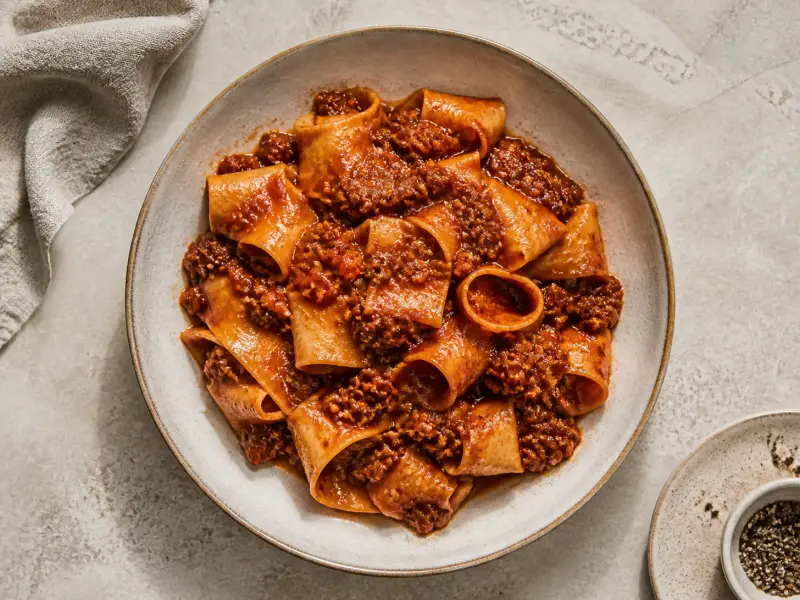 Slow-Cooked Beef Ragu
 Cacio e Pepe
 Spaghetti Carbonara
 Classic Margherita Pizza
 Mushroom Risotto
 Pasta alla Norma
 Pasta e Fagioli