Slow-Cooked Beef Ragu
Ragù di manzo
Coarse beef mince browned in batches then held at a bare simmer for three hours, finished in the pan with the pasta.
- Prep
- 25 min
- Cook
- 3 hr 40 min
- Resting
- 30 min
- Total
- 4 hr 35 min
- Serves
- 6
- Revisions
- 5
Allergens
- Celery
- Cereals containing gluten
- Eggs
- Milk
- Sulphites
Named from the ingredients as written, including those carried in from sub-recipes. This is not a guarantee — check the labels on what you actually buy, and note that a product’s recipe can change.
Ingredients
Serves
Method
Break the mince up loosely with your fingers on a plate, so it goes into the pan in pieces rather than as one cold slab.
Heat 1 tbsp of the olive oil in a wide heavy pan over high heat, until it shimmers and runs thin across the base.
Lay half the mince in the pan in a single layer, with bare metal showing between the pieces.
Scatter 3g of the fine salt over it.
Leave it alone for 3-4 minutes, until the underside has crusted deep brown and lifts off the base without tearing.
Brown the meat in two batches with room around it. All 800g in the pan at once cannot shed its water fast enough, the pan drops below browning temperature and the mince stews grey in its own juice — and that crust is where most of the flavour of a ragu is made, before any liquid goes near it.
Break the meat up with a wooden spoon and cook for a further 2-3 minutes, until it is browned in patches throughout.
Move it to a plate.
Brown the second half the same way in the remaining oil, with the remaining 3g of fine salt.
Move that batch to the plate as well.
Turn the heat down to medium-low and add the diced onion, carrot and celery to the same pan — the soffritto, the aromatic base softened slowly in fat before anything else joins it.
Cook for 12-15 minutes, stirring and scraping the brown film off the base as the vegetables release their water, until they are soft, sweet and just starting to colour.
Stir in the garlic and cook for 1 minute, until it smells sweet.
Add the tomato puree and cook for 2 minutes, stirring constantly, until it darkens from bright red to brick.
Return the meat and any juice on the plate to the pan.
Pour in the milk.
Simmer for 10-15 minutes, until the milk has all but gone and only fat is left glossing the meat. It may look curdled on the way, which is normal and cooks out. The milk goes in before any acid, and it softens the meat in a way nothing later in the recipe can.
Pour in the wine.
Simmer for 5-8 minutes, scraping the base, until the sharp alcohol smell has gone.
Crush the tinned tomatoes into the pan one at a time in your fist, keeping your hand below the surface of the juice. Do not blend them, for the reason set out in the simple tomato sauce in this collection: a blender aerates the pulp and shears it too fine to gain any body.
Pour in the hot stock. A batch of the chicken stock in this collection makes this sauce six times over.
Tuck in the bay leaves.
Bring it to a bare simmer, where a bubble breaks somewhere on the surface every second or two. This is the same heat the slow-braised beef shin is held at, and for the same reason — a ragu kept at a proper boil tightens the meat into dry grains and drives the fat out as a slick, and three hours of that cannot be undone.
Cook uncovered, or with the lid propped ajar, for 2.5-3 hours, stirring every 20 minutes and scraping the base as you go.
Add a splash of hot water whenever the sauce thickens enough to catch.
Stop when the fat has separated out as an orange rim at the edge of the pan and a piece of meat crushes to nothing against the side under a spoon.
Take the pan off the heat and stand it for 30 minutes, which lets the fat rise where it can be reached.
Spoon off most of the risen fat, leaving a little behind for gloss.
Fish out the bay leaves.
Season with the ground peppercorns.
Taste and add fine salt, bearing in mind the parmesan still to come.
Bring the 3 litres of water to the boil in a large pan.
Stir in the 15g of fine salt for the pasta water.
Cook the pasta for 1 minute less than the packet says, until it still has a firm core when you bite a piece.
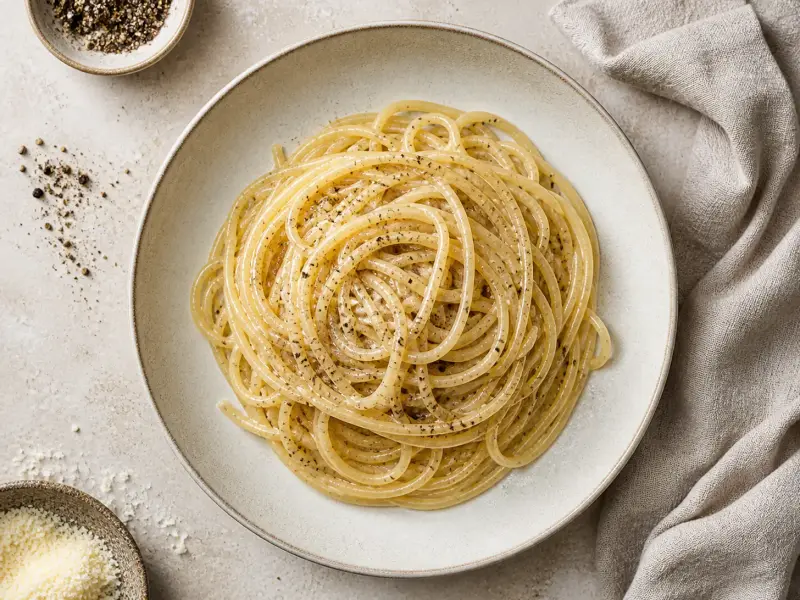
Ladle 300ml of the cooking water into a jug before anything is drained. As in the cacio e pepe in this collection, that starchy water is an ingredient, and once it is down the sink there is no way back.
Warm the ragu through in its wide pan over medium heat.
Lift the pasta straight into the sauce with tongs, or a spider for short shapes, letting it drip but not draining it dry.
Toss over the heat for 1-2 minutes, adding the reserved water a splash at a time, until the sauce coats every piece and slides slowly rather than sitting still.
Never ladle ragu over a bowl of bare pasta. Those last two minutes in the pan are what make the sauce hold on; spooned over the top it slips to the bottom of the bowl and the pasta above it stays dry.
Take the pan off the heat and stir through half the parmesan.
Serve into warm bowls with the rest of the parmesan scattered over.
Nobody has rated this recipe yet.
Sign in to rate this recipe. One rating per person, and you can change it.
What to expect
- Taste
Deep, savoury and meaty rather than sharply tomato-forward, since the tomato content is relatively modest against the quantity of meat — the soffritto's sweetness, the milk's tenderising richness and the long reduction all build a rounded, layered savouriness that a quick tomato-heavy sauce cannot replicate in less time.
- Aroma
A rich, meaty smell dominates throughout the long cook, with the sweet, vegetal smell of the soffritto underneath and a warm tomato note rather than a sharp, acidic one.
- Texture
A thick, clinging sauce that coats pasta rather than pooling around it, with the meat broken down to a fine, tender texture rather than remaining in distinct chunks — the coarse mince keeps some bite without ever feeling tough.
- Sound
A slow, steady, occasional bubble breaking the surface throughout the long simmer — deliberately quiet rather than a vigorous, audible boil.
- How the flavour moves
The soffritto's sweetness and the tomato's gentle acidity register first, the meat's deep savouriness builds through the middle of the bite, and a lingering richness from the reduced milk and fat carries the flavour through to the finish.
- Serve it
Served hot, tossed together with the pasta in the pan immediately before eating, since the sauce stiffens noticeably once it cools.
- Goes with
Fresh egg tagliatelle is the traditional pairing in its home region, alongside lasagne; pappardelle or rigatoni are given here as more accessible alternatives to the more classic but less widely available fresh tagliatelle.
Cook's notes
- Difficulty
Moderate — no single step is hard, but the browning, the milk stage and the very long, low simmer all need to be respected rather than shortcut.
- Cost
Moderate — coarse beef mince, a modest quantity of wine and a good stock are the main costs.
- Equipment
A wide, heavy pan for browning and simmering, and a separate large pan for the pasta.
- When to make it
A weekend cook, ideally made a day ahead of when it is actually needed, since the flavour settles and improves with a day's rest.
- Best season
None; every ingredient is available year round.
- You know it is done when
The fat should have separated out as a visible orange rim at the edge of the pan, and a piece of meat should crush to nothing against the side of the pot under light pressure from a spoon.
- And it feels like
The sauce should coat the back of a spoon and slide slowly off it rather than running thin, and the meat should feel tender enough to crush rather than chewy — a texture only the full simmer time reliably produces.
- Food safety
The beef is fully cooked through both by the initial hard browning and the long subsequent simmer; standard care applies to handling raw mince before it goes into the pan.
- Where it goes wrong
- Browning all the mince in one batch, which stews it grey rather than developing a proper crust.
- Skipping the milk stage, which loses a tenderising effect the wine and tomatoes cannot replicate.
- Simmering at a proper boil rather than a bare simmer, which toughens the meat and drives out the fat over the long cook time.
- Rushing the total simmer time, which is genuinely three hours for a reason rather than a rough suggestion.
- If it does go wrong
Sauce tastes flat or thin: it likely needed longer at a proper simmer to concentrate, or was simmered too gently to reduce at all — check it is genuinely at a bare simmer rather than barely warm. Meat tastes tough or dry: the sauce was likely kept at too vigorous a boil rather than the intended bare simmer. Sauce catching or sticking to the base: it needs a splash of hot water stirred through and the heat turned down slightly.
- Making it ahead
An excellent make-ahead dish — it keeps for days in the fridge and freezes very well, and the flavour genuinely improves after a day's rest, which makes cooking it a day or two before it is needed a genuine improvement rather than just a convenience.
- Keeping it
Keeps in the fridge for up to four days, and the flavour is, if anything, better a day or two after cooking once the sauce has had time to settle.
- Reheating
Reheats gently on the hob with a splash of water or stock to loosen it back to its original consistency, since it thickens further once cold.
- Freezing
Freezes very well for up to three months; this is a genuinely good dish to make in a double batch specifically to freeze half, since the long cook time is the same whether a single or double quantity is made.
- Leftovers
Excellent, and arguably improves with a day's rest — a strong candidate for deliberately cooking more than needed for one meal.
- Scaling it
Scales up well, though a much larger batch may need an even longer simmer to reduce properly, since a bigger volume of liquid takes longer to concentrate at the same bare-simmer heat.
- Substitutions
The milk stage, added before the wine, is specifically about tenderising the meat in a way that neither the wine nor the tomatoes can replicate afterwards; skipping it changes the texture of the finished meat noticeably rather than simply the flavour.
- Dietary swaps
Contains celery, gluten, eggs (if using egg pappardelle), milk and sulphites (commonly in the wine). Can be made gluten and egg free by choosing rigatoni made with durum wheat and water only rather than egg pappardelle; not easily made dairy free given the milk's structural role in the meat sauce.
- Shopping for it
A well-flavoured chicken stock, home-made if possible, makes a genuine difference across the long simmer, since it is one of relatively few liquid components carrying flavour into the pot.
- Keeping the cost down
A cheaper coarse mince works well here, since the long cook and the crust from proper browning both contribute more flavour than a premium cut would add for the price difference.
- Sustainability
Making a double batch specifically to freeze half is a genuinely efficient use of the long, unattended cooking time this dish requires regardless of quantity.
- Nutrition
A good source of protein from the beef, with a reasonable vegetable content from the soffritto; a rich dish best served in a sensible portion alongside the pasta rather than as an especially light one.
- Worth it?
A dish that rewards trusting the process — the long simmer and the milk stage in particular — rather than trying to shortcut a result that genuinely needs hours to develop.
Where it comes from
- Origin
Emilia-Romagna, Italy, specifically the city of Bologna.
- Also called
Ragù alla bolognese.
- Said out loud
rah-GOO al-lah bo-lo-NYEH-zeh.
- What the name means
Ragù is a general Italian term for a slow-cooked meat sauce; alla bolognese specifies the Bologna style of it.
- History
Pellegrino Artusi's 1891 recipe for a meat sauce served over maccheroni is generally treated as the first widely circulated version of what became known as ragù alla bolognese. The Accademia Italiana della Cucina formally registered an official version of the recipe with the Bologna chamber of commerce in 1982, and updated that registration in 2023, giving the dish an unusually specific documented standard for a traditional regional recipe.
- Why it matters
Everyday cooking in Emilia-Romagna, and one of the most cooked pasta sauces in the world outside Italy, though frequently served there in a form — spaghetti bolognese — that does not reflect how the dish is actually eaten in its home region.
- When it is eaten
Everyday family and Sunday cooking in its home region, and a globally familiar comfort-food dish everywhere else.
- The traditional way
Coarse mince browned hard for a real crust, a soffritto built slowly, milk added ahead of any acid to tenderise the meat, and a very long, low simmer that is never rushed by raising the heat.
- How it changed
Outside Italy, the dish is very commonly served over spaghetti and made with a considerably higher proportion of tomato than the registered Bolognese recipe specifies, both changes that developed through international, especially Anglophone, home cooking rather than from the dish's home region.
- Regional variations
The registered Bologna version uses coarsely minced beef with pancetta and very little tomato, closer to a meat sauce than a tomato sauce; the internationally familiar version leans much further toward tomato, and is usually served with spaghetti rather than the traditional tagliatelle or in a lasagne.
- How this version differs
This recipe leans toward the traditional meat-forward balance and recommends pappardelle or rigatoni over spaghetti, though it does not follow the officially registered recipe's specific ingredient list exactly.
- Sources and credit
Pellegrino Artusi is credited with the first widely circulated printed version; the Accademia Italiana della Cucina is the body responsible for the modern official registration of the recipe.
 Chicken Stock
 Baked Lasagne
 Cacio e Pepe
 Classic Margherita Pizza
 Pasta alla Norma
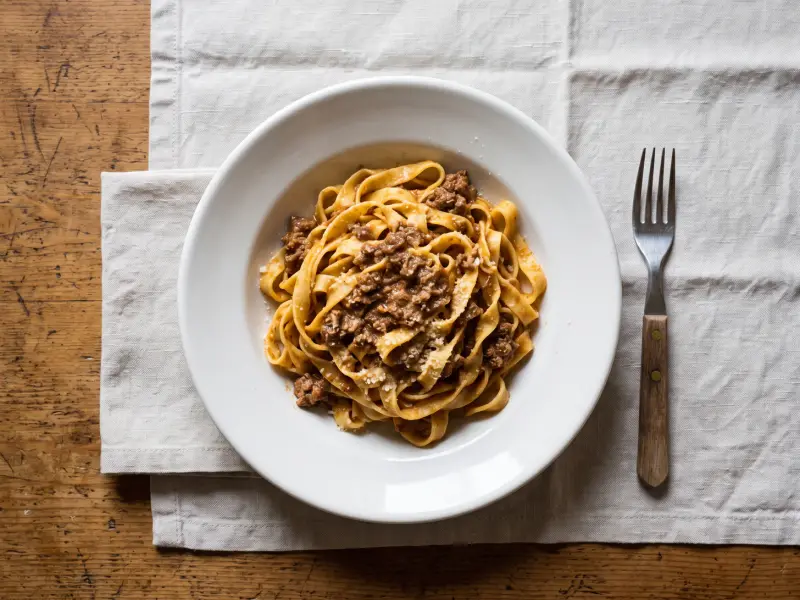 Tagliatelle al Ragù
 Pork and Fennel Meatballs
 Slow-Braised Beef Shin