Warm Farro and Roast Squash Bowl
Farro boiled like pasta and dressed while it is still hot, under roast squash, crisped kale and feta, so it eats as a meal.
- Prep
- 20 min
- Cook
- 40 min
- Resting
- 5 min
- Total
- 1 hr 5 min
- Serves
- 4
- Revisions
- 5
Allergens
- Cereals containing gluten
- Milk
- Mustard (via Everyday Vinaigrette)
- Sulphites (via Everyday Vinaigrette)
Named from the ingredients as written, including those carried in from sub-recipes. This is not a guarantee — check the labels on what you actually buy, and note that a product’s recipe can change.
Ingredients
Serves
Method
Heat the oven to 200C/400F.
Toss the squash chunks with 2 tbsp of the olive oil, the 4g of fine salt and the chilli flakes.
Spread them on a large tray in a single layer with space between the pieces, so the water coming off them can evaporate instead of pooling and stewing them pale.
Roast for 25 minutes.
Toast the pumpkin seeds in a dry frying pan over medium heat for 3-4 minutes, shaking often, until they swell, pop and smell nutty.
Tip them straight out of the pan onto a plate. Seeds left in hot metal go on cooking and are bitter within a minute of being perfect.
Bring the 2 litres of water to the boil in a large pan and stir in the 10g of fine salt.
Cook the farro like pasta, uncovered, for 18-22 minutes.
Toss the torn kale with the remaining 1 tbsp of olive oil and add it to the squash tray for the last 8 minutes, turning it through the pan juices.
Take the tray out when the kale edges are crisp and dark and the thicker parts are still supple, and the squash is browned at the corners and gives under a knife tip.
Taste the farro from 18 minutes. Every grain should be tender with a distinct chew at the centre, closer to barley than to rice — cooked to fluffy it turns to mush once the dressing goes on.
Drain the farro well and shake the sieve hard, since water left clinging thins the dressing.
Tip the hot farro into a wide bowl.
Pour over the vinaigrette and turn it through while the grains are still steaming. Dressing it hot is the point of the recipe: a cold grain sits in dressing without drawing any of it in, and the bowl ends up tasting only of its surface.
Leave it to stand for 5 minutes, stirring once, until the dressing has visibly thinned as the farro takes it up.
Fold the roast squash and the kale through gently, with two or three turns rather than stirring, so the squash keeps its shape.
Fold in the lemon zest, the parsley and the ground peppercorns.
Taste for salt with the feta in mind, since it brings a good deal of its own.
Scatter the feta and the toasted pumpkin seeds over the top rather than mixing them in. Folded through, the feta smears across the grains and turns the whole bowl a flat pink-grey.
Serve warm or at room temperature, within an hour, while the kale is still crisp.
Nobody has rated this recipe yet.
Sign in to rate this recipe. One rating per person, and you can change it.
What to expect
- Taste
A nutty, chewy grain base carrying the sharp, mustardy tang of the vinaigrette right through it, against sweet, caramelised roast squash and kale that's turned crisp and slightly bitter at its charred edges. Feta brings a salty, tangy sharpness in distinct pockets rather than smoothed through, and toasted pumpkin seeds add a nutty crunch and their own slightly sweet, roasted flavour.
- Aroma
Sweet, caramelised roasting squash first, then the sharper, slightly bitter smell of kale crisping at its edges, with lemon zest's bright citrus note lifting over the top once it's folded through.
- Texture
Distinctly chewy from the farro, contrasted with soft, tender roast squash, crisp-edged kale, crumbly feta and crunchy toasted seeds — more textural variety in one bowl than almost anything else in the collection, deliberately kept apart rather than blended into a uniform mouthfeel.
- Sound
A quiet crackle from the crisp kale edges and the toasted seeds, otherwise a fairly quiet dish to eat.
- How the flavour moves
The vinaigrette's sharpness arrives first from the dressed farro, the sweet roasted squash filling the middle, and the salty feta and nutty seeds the last things registered as distinct pockets of flavour rather than a smoothed-through finish.
- Serve it
Served warm rather than piping hot, which is part of why the dressing has to go on while the farro is still steaming — the dish cools quickly once assembled and the window for the grain to properly absorb the dressing is short.
- Goes with
Nothing further is really needed — this is designed as a complete meal in one bowl, though a simple green salad alongside would not clash with it.
Cook's notes
- Difficulty
Easy, and largely a matter of good timing across several components rather than any single difficult technique.
- Cost
Cheap to moderate — farro, squash and kale are all inexpensive; feta is the priciest single ingredient.
- Equipment
A large baking tray, a pan for cooking the farro, and a dry frying pan for toasting the pumpkin seeds.
- When to make it
Autumn and winter especially, given the squash, though farro salads of this kind work in any season with a different vegetable.
- Best season
Squash and kale are both classic autumn and winter vegetables, making this a genuinely seasonal dish in its current form even though the format itself could carry almost any vegetable through the year.
- You know it is done when
The squash should be browned at the corners with edges giving under a knife tip; the kale should have crisp, dark edges while the thicker ribs stay supple.
- And it feels like
Every grain of farro should be tender with a distinct chew at the centre, closer to barley than rice — cooked to fully soft, it turns to mush once the dressing is folded through.
- Food safety
Nothing beyond ordinary hygiene.
- Where it goes wrong
- Dressing the farro once it's cooled rather than while it's still hot, which means the dressing sits on the surface rather than being absorbed.
- Crowding the squash on the tray, which steams rather than roasts it and leaves it pale and soft rather than browned.
- Cooking the farro to full softness rather than stopping at a distinct chew, which turns to mush once the dressing and other ingredients are folded through.
- Folding the feta through rather than scattering it on top, which smears it across the grains and turns the whole bowl a flat pink-grey.
- If it does go wrong
Bland, undressed-tasting grain: it was dressed cold rather than hot. Soft, pale squash: the tray was overcrowded. Mushy farro: overcooked, or cooked too far in advance and left to sit in the dressing.
- Making it ahead
The squash can be roasted ahead and the farro cooked ahead, but the final assembly and dressing is best done close to serving for the best texture.
- Keeping it
A day or two refrigerated, though best eaten within the hour it's made, while the kale is still crisp.
- Reheating
Best served warm or at room temperature rather than fully reheated, which softens the kale further and can make the feta greasy.
- Freezing
Not recommended — the fresh kale and feta don't survive freezing and thawing well.
- Leftovers
Good taken cold the next day as a packed lunch, accepting that the kale will have softened further overnight.
- Scaling it
Scales up easily; roasting in batches on multiple trays if the squash and kale would otherwise be crowded.
- Substitutions
Any winter squash variety works in place of crown prince or butternut. Pearled farro cooks in roughly half the time of the whole grain and needs no soaking; whole-grain farro is a legitimate substitute but needs a considerably longer cooking time.
- Dietary swaps
Vegetarian as written, owing to the feta. Vegan with the feta omitted or replaced with a plant-based alternative. Contains gluten from the farro (a wheat grain), so not suitable for a gluten-free diet without substituting a different grain entirely, which would meaningfully change the dish.
- Shopping for it
Pearled farro is the more convenient choice for most home cooks, needing no soaking and cooking in roughly half the time of the whole grain.
- Keeping the cost down
Squash and kale are both inexpensive, especially in season; feta is the one ingredient worth budgeting for since it carries a lot of the dish's flavour.
- Sustainability
A largely plant-based main course with only a modest amount of dairy, using two inexpensive, widely available seasonal vegetables.
- Nutrition
A high-fibre, plant-forward main course with a good balance of complex carbohydrate from the farro, vegetables from the squash and kale, and protein and fat from the feta and pumpkin seeds.
- Worth it?
A genuinely well-balanced, complete vegetarian meal in one bowl, and a good demonstration of how much a warm dressing changes a grain salad.
Where it comes from
- Origin
Farro itself is ancient and central Italian; the composed grain-bowl format is a 21st-century North American and Australian café invention.
- Also called
No single traditional name — this is a modern composed dish rather than one with a fixed historical identity, built from an ancient grain.
- Said out loud
FAR-roh.
- What the name means
Farro is the Italian name for the grain, used somewhat loosely to cover emmer, spelt and einkorn wheat depending on region — a genuine ambiguity in the term rather than one fixed botanical definition.
- History
Farro is among the first grains domesticated anywhere, in the Fertile Crescent, and was a dietary staple of ancient Rome; it has remained in continuous use in central Italy, particularly Tuscany, Umbria and Lazio, mostly in soups and salads, through to the present day. The grain-bowl format it's used in here is a recent phenomenon entirely separate from that long history, developing out of North American and Australian café and casual-dining cooking in the 2000s and 2010s.
- Why it matters
Farro itself carries real historical weight as one of humanity's oldest cultivated grains; the grain-bowl format carries none of that weight and is better understood as a contemporary, largely urban dining trend that happens to have adopted an ancient ingredient.
- When it is eaten
An everyday lunch or casual dinner; the grain-bowl format specifically is associated with café and office-lunch culture rather than any traditional occasion.
- The traditional way
Farro is traditionally cooked in soups or dressed as a salad in its home regions; boiling it like pasta in plenty of salted water, as this recipe does, rather than cooking it by absorption, is a technique that lets the cook stop it at exactly the desired point of chewiness.
- How it changed
The grain itself has changed little; what's new is entirely the presentation as a composed bowl with roasted vegetables and cheese, a format with no real precedent in farro's long traditional use.
- Regional variations
Farro is most often pearled (farro perlato) for sale outside Italy, with the bran partly abraded away, which cuts its cooking time roughly in half compared with the whole grain and removes the need to soak it.
- How this version differs
This recipe leans on a specific technique — dressing the grain while it's still hot rather than once cooled — that is broadly applicable to any warm grain salad, alongside scattering rather than folding through the feta and seeds so they stay distinct.
- Sources and credit
No individual can be credited with the composed grain bowl, which is a broad contemporary food trend rather than an invented dish with a traceable creator; farro's own ancient history belongs to the crop, not to this specific recipe.
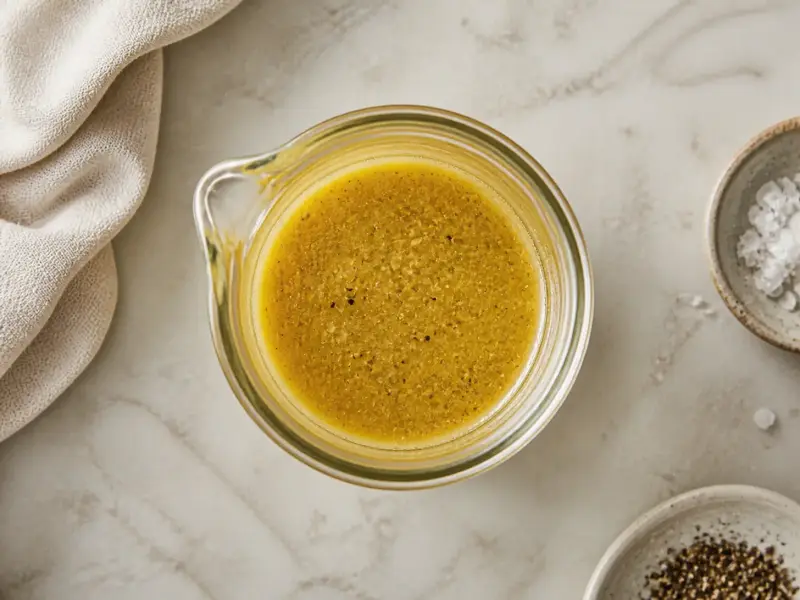 Everyday Vinaigrette
 Cacio e Pepe
 Chickpea and Spinach Stew
 Classic Margherita Pizza
 Egg Fried Rice
 Mushroom Julienne
 Potato Gnocchi with Sage Butter