Chicken Kiev
Котлета по-киевски
Kotleta po-kiyevski
Котлета по-киевски — cutlet in the Kyiv style.
Crumbed chicken breast sealed around garlic-and-herb butter, chilled hard so the filling stays in until cutting.
- Prep
- 35 min
- Cook
- 20 min
- Resting
- 1 hr 30 min
- Total
- 2 hr 25 min
- Serves
- 4
- Revisions
- 5
Allergens
- Cereals containing gluten
- Eggs
- Milk
Named from the ingredients as written, including those carried in from sub-recipes. This is not a guarantee — check the labels on what you actually buy, and note that a product’s recipe can change.
Ingredients
Serves
Method
Beat the softened butter with the garlic paste, the parsley, the dill, the lemon juice and the 2g of fine salt until evenly green.
Roll the butter into a tight log about 3cm across inside cling film and twist the ends closed.
Freeze the log for 30 minutes, until hard right through.
Cut the frozen log into four short batons and return them to the freezer.
The butter must be frozen solid, not merely cold. Soft butter smears as you wrap the chicken around it, and every smear is a channel for it to escape through later.
Lay a chicken breast between two sheets of cling film and beat it out to an even 5mm with a rolling pin.
Work from the centre outwards with glancing, sideways blows rather than hammering straight down. Straight-down blows punch holes, and a hole is exactly where the butter will leave.
Season the flattened breasts on both sides with the 4g of fine salt and the ground peppercorns.
Lay a frozen butter baton across the narrow end of each breast.
Fold the two long sides in over the butter, then roll the breast up into a tight parcel with no opening anywhere along it.
Put the flour, the beaten eggs and the breadcrumbs in three shallow dishes.
Roll each parcel in flour, then egg, then breadcrumbs, keeping the seam side down as you work.
Now do the egg and the breadcrumbs a second time.
Double-crumb every one. The first coat wets and fills the irregularities in the surface but seals nothing; the second coat is the one that actually holds. A single-crumbed parcel splits at the seam as soon as the butter turns liquid and starts pushing outwards.
Chill the crumbed parcels uncovered in the fridge for at least 1 hour, or freeze them for 30 minutes.
This chill does two jobs: it dries the crumb into a firm shell, and it keeps the butter solid for the first minutes in the oil, which is when the seams are most vulnerable.
Heat the oven to 180C/350F.
Heat the oil in a deep heavy pan to 175C/350F, with at least 8cm of clear space above the surface.
Fry two parcels at a time for 4-5 minutes, turning once, until deep even gold.
Lift them onto a rack set over a tray and finish in the oven for 10-12 minutes.
Check with a thermometer pushed into the meat at the thickest point, avoiding the butter channel, and look for 74C/165F.
Rest for 4 minutes on the rack, not on kitchen paper, which traps steam and softens the underside.
Cut into them at the table, with the plate tilted, and stand back. The butter comes out fast and hot.
Nobody has rated this recipe yet.
Sign in to rate this recipe. One rating per person, and you can change it.
What to expect
- Taste
A crisp, well-seasoned crust giving way to tender chicken, with a rush of garlicky, herby, faintly lemony melted butter as the parcel is cut into, which carries most of the dish's flavour.
- Aroma
A warm, toasted breadcrumb smell from the fried crust, and a sharp burst of garlic, parsley and dill once the parcel is opened and the butter escapes.
- Texture
Crisp on the outside, tender chicken beneath, and a genuinely liquid, hot butter filling at the centre.
- Sound
A sharp sizzle as the parcels fry, and a quiet crackle as the crisp crust is cut into at the table.
- How the flavour moves
The crisp, salty crust registers first, tender chicken follows, and the rush of hot, garlicky, herby butter is the dramatic final stage of the mouthful, arriving all at once as the parcel is cut into.
- Serve it
Served very hot, and specifically hot enough that the butter filling is still fully liquid when the parcel is cut open — this is the entire point of the dish and it should be eaten immediately.
- Goes with
Buttery mashed potato and a simple green vegetable, both there to make use of any butter that escapes onto the plate.
Cook's notes
- Difficulty
Moderate to hard — sealing the parcel and double-crumbing it properly both take real care.
- Cost
Moderate — chicken breast, butter and a modest amount of herbs.
- Equipment
A rolling pin, cling film, and a deep, heavy pan for frying.
- When to make it
A special dinner or a weekend project rather than a fast weeknight meal, given the freezing and chilling stages required.
- Best season
None; every ingredient is shelf-stable or standard fresh produce available year round.
- You know it is done when
The crust should be deep, even gold on all sides once fried, and the chicken should read 74C/165F at its thickest point when checked with a thermometer positioned away from the butter channel.
- And it feels like
A crisp, sealed crust giving way to tender chicken and a fully liquid, hot butter filling that should not have escaped anywhere along the seam.
- Food safety
Checking the internal temperature away from the still-liquid butter channel is important, since a thermometer placed directly in the butter will read differently from the chicken meat itself; 74C/165F in the meat is the safe target.
- Where it goes wrong
- Using merely chilled rather than genuinely frozen butter, which smears while wrapping and creates weak points in the seal.
- Single-crumbing the parcel rather than double-crumbing it, which is not enough to hold against the pressure of the melting butter.
- Puncturing the chicken while beating it thin, using straight-down blows rather than glancing, sideways ones.
- Cutting into the parcel too soon after it comes out of the oven, when the butter and steam inside are at their most forceful.
- If it does go wrong
Butter leaking out during frying: the butter was not frozen solid enough, or the parcel had a gap in its seam. Crust splitting open: it was single-crumbed rather than double-crumbed, or the chill before frying was skipped. Chicken torn or holed: it was beaten with straight-down blows rather than glancing, sideways ones.
- Making it ahead
The crumbed, uncooked parcels can be made a day ahead and chilled, or frozen for considerably longer, and fried straight from that state when needed.
- Keeping it
Best cooked and eaten fresh; the crumbed, uncooked parcels can be kept in the fridge for a day or frozen for longer before frying.
- Reheating
Not recommended once cooked — reheating risks the butter filling either leaking out or not returning to a fully liquid state, losing the point of the dish.
- Freezing
The crumbed, uncooked parcels freeze well and can be fried directly from frozen with a longer finishing time in the oven.
- Leftovers
Best not kept once cooked; if any remain, they are still edible cold but lose the dish's central point of a liquid butter filling.
- Scaling it
Scales up by simply making more parcels, though each one is prepared and cooked individually rather than as a single larger batch.
- Substitutions
There is no real substitute for freezing the butter solid before wrapping; attempting the dish with merely chilled butter is the single most common cause of failure.
- Dietary swaps
Contains cereals containing gluten, eggs and milk. Not easily adapted to major allergen-free categories without changing the structure of the dish considerably.
- Shopping for it
Chicken breasts of an even, moderate size make beating them out to a uniform 5mm considerably easier than very large or uneven ones.
- Keeping the cost down
Making the dish at home from chicken breast and standard pantry ingredients is considerably cheaper than buying a premium version ready-made.
- Nutrition
A rich source of protein from the chicken, with a significant amount of fat from the butter filling.
- Worth it?
A dish whose theatrical reveal is genuinely earned by the care taken in freezing the butter and double-crumbing the parcel, and one that rewards patience with the preparation far more than any complex cooking skill.
Where it comes from
- Origin
Contested, generally placed between Ukraine, Russia and French-influenced Russian imperial kitchens.
- Also called
Kotleta po-kievski (котлета по-киевски).
- Said out loud
KEE-ev, or koh-TLYEH-tah poh-kee-YEV-skee in the original.
- What the name means
Named for Kyiv, the Ukrainian capital; kotleta simply means a shaped cutlet, the same word behind the everyday dish kotlety.
- History
The dish's exact origin is genuinely contested. One account credits early 20th-century Russian restaurant cooking in the imperial capitals; another traces its roots to the French cotelette de volaille, a stuffed and crumbed chicken cutlet taken up in Russian and Ukrainian kitchens during the 19th century, when French chefs were commonly employed in grand houses across the region. Precisely when and where the name attached itself to Kyiv cannot be fixed to a specific year, and both Soviet-era restaurants and mid-20th-century New York restaurants serving Ukrainian clientele have separately been credited with helping popularise the dish under its current name.
- Why it matters
A restaurant and household dish throughout Ukraine and Russia, and, in a chilled, ready-made form, one of the earliest widely sold chilled ready meals in Britain from the 1970s onward.
- When it is eaten
A restaurant dish historically, given the preparation involved, and now equally a supermarket staple eaten as an everyday convenience meal.
- The traditional way
Freezing the herb butter solid before wrapping it in beaten-out chicken, double-crumbing the parcel for insurance, and finishing with a fry followed by a gentler oven bake.
- How it changed
The dish's spread through the British supermarket trade as one of the earliest chilled ready meals is how most English speakers first encountered it, considerably removed from the restaurant-cooked original.
- Regional variations
The classical presentation leaves the wing bone attached, partly as a handle and partly to visually distinguish the dish from a plain crumbed cutlet — a detail commonly dropped in the boneless, breast-only home and supermarket versions.
- How this version differs
This recipe uses boneless chicken breast throughout rather than the classical bone-in presentation with the wing bone left attached.
- Sources and credit
No single individual or restaurant is definitively credited; the dish's Ukrainian, Russian and French-influenced threads are all genuinely disputed rather than resolved.
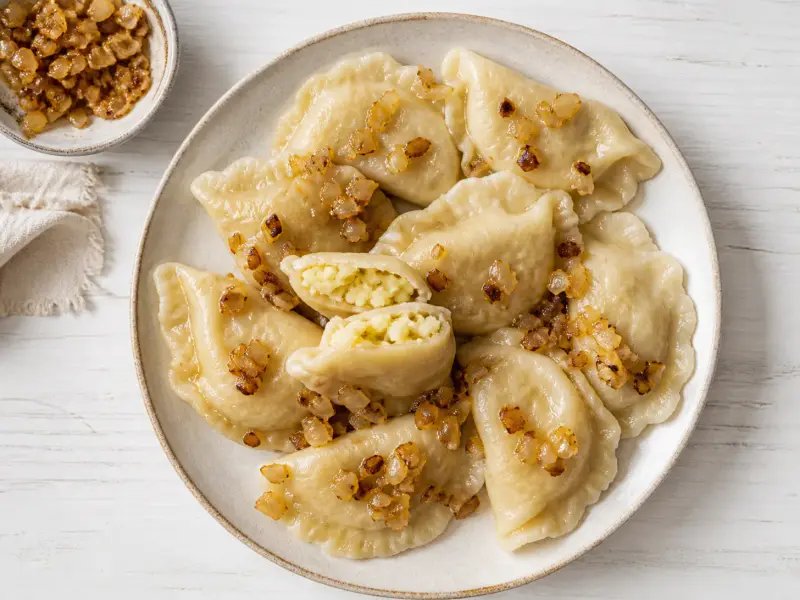 Vareniki
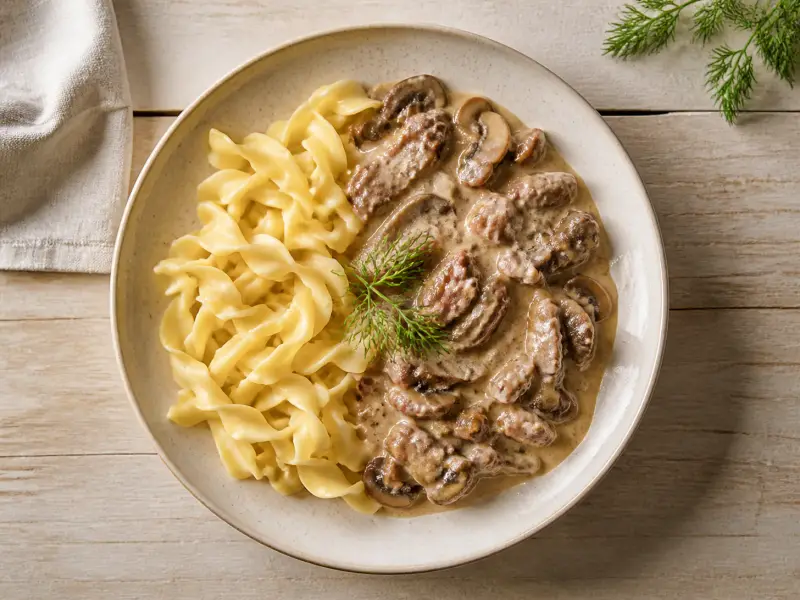 Beef Stroganoff
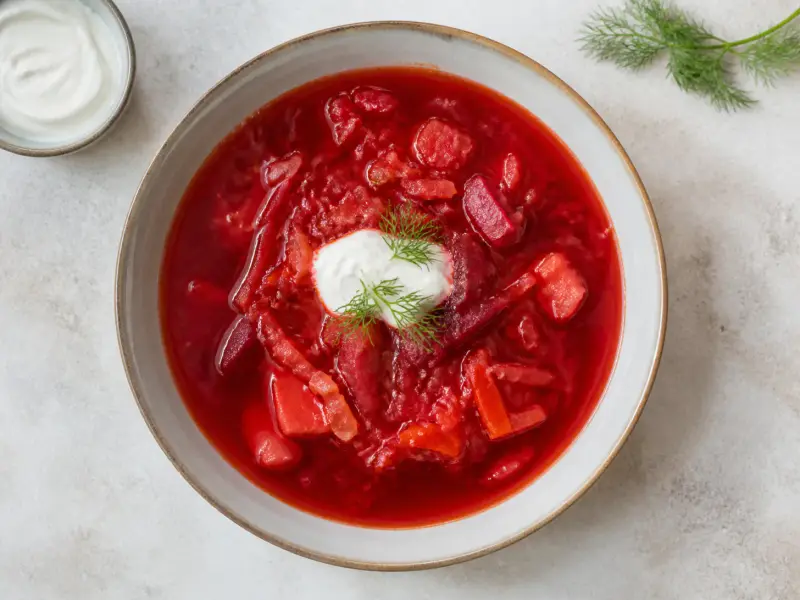 Borscht
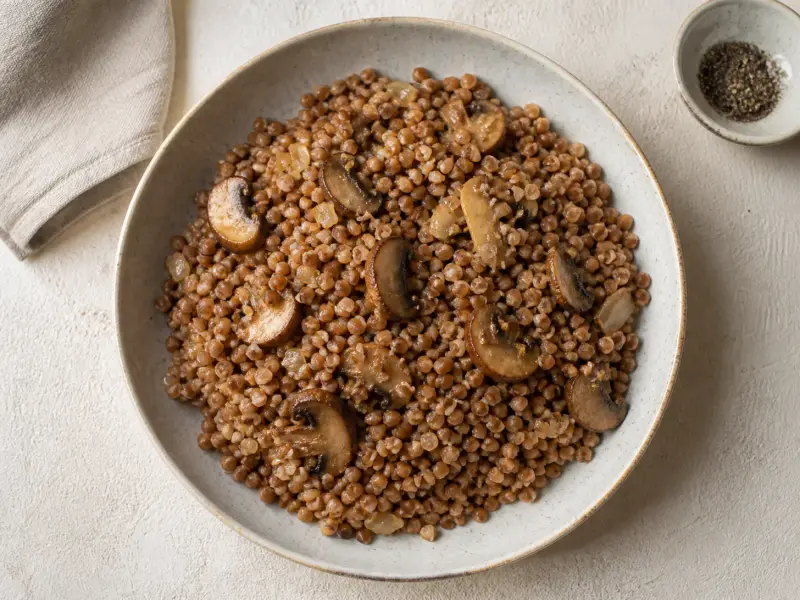 Buckwheat Kasha with Mushrooms
 Chicken à la King
 Chicken and Prawn Paella