Vareniki
Вареники
Вареники — boiled things, from varit, to boil.
Larger Ukrainian dumplings filled with potato and fried onion or with sweetened curd, boiled and dressed in butter.
- Prep
- 55 min
- Cook
- 30 min
- Resting
- 30 min
- Total
- 1 hr 55 min
- Serves
- 4
- Revisions
- 5
Allergens
- Cereals containing gluten
- Eggs
- Milk
Named from the ingredients as written, including those carried in from sub-recipes. This is not a guarantee — check the labels on what you actually buy, and note that a product’s recipe can change.
Ingredients
Serves
Method
Mix the flour, the egg, the warm water, the sunflower oil and the 5g of fine salt into a soft dough.
Knead for 8 minutes, until smooth and elastic and no longer sticking to your hands.
Wrap the dough and rest it for 30 minutes. Rolled straight away it fights back and shrinks the moment you lift the pin.
Boil the potatoes in salted water for 15-18 minutes, until a knife slides into a chunk and out again with no resistance at all.
Drain them and leave them in the hot dry pan for 2 minutes to steam off. Wet mash makes a wet filling, and a wet filling soaks through the dough and tears it as you seal.
Melt 50g of the butter in a frying pan over medium-low heat and add the chopped onions.
Cook the onions for 12-15 minutes, stirring now and then, until they are deep gold, soft and sweet.
Take the onions past pale and translucent. This is where the filling gets its flavour, and onions pulled off while still white leave you with plain mashed potato in pastry.
Mash the potatoes and beat in about two thirds of the onions with their butter, the 5g of fine salt and the ground peppercorns. Keep the rest of the onions for serving.
Spread the filling out on a plate and let it cool to room temperature. Warm filling steams the dough from the inside and slackens it while you are still shaping.
Roll the dough out to 2-3mm and cut 8cm rounds.
Put a heaped tablespoon of filling on each round.
Fold into a half-moon and press the edges firmly together, working from the middle outwards and pushing out the air.
Crimp the sealed edge by folding a rope of small pleats along it, or press it flat with a fork.
Lay them on a floured tray without letting them touch. You should get about 30.
Bring a large pan of water to a rolling boil and add the 20g of coarse salt.
Cook them in two batches so the pan is never crowded, stirring once as they go in.
Boil for 4-5 minutes after they rise to the surface, until the dough at the crimped edge is no longer chalky when you bite it. That doubled edge is the thickest part and the last to cook.
Lift them out with a slotted spoon, draining well.
Toss them with the remaining 30g of butter and the reserved fried onions.
Serve with smetana and the dill.
Nobody has rated this recipe yet.
Sign in to rate this recipe. One rating per person, and you can change it.
What to expect
- Taste
Onion, and it is what makes the difference between vareniki and a bag of boiled potato. Onions fried properly in butter until brown are sweet and deep, and there are two onions in a filling for four. Potato is bland and starchy by design — it is a carrier. The dough is plain, faintly salty and eggy. Butter is the third flavour and is generous. And then smetana, which is the acid: soured cream against butter, potato and onion is the whole balance of the dish, and vareniki eaten without it are heavy going. Dill is the finish. Nothing here is complicated and the pleasure is in the combination rather than in any component.
- Aroma
Frying onions in butter for the length of time this takes, which is one of the best domestic smells there is. Then boiling dough, which smells of very little. Dill at the end.
- Texture
Soft against soft, which is the honest description — tender dough around smooth mashed potato, with the fried onions supplying the only textural contrast. That is why the onions go both inside and on top, and it is why frying leftovers is such an improvement: a crisp face changes the dish completely. The sealed edge is the thickest part and should be tender rather than chewy.
- Sound
Almost nothing. The onions frying is the only sustained sound, and the dumplings going into water make a brief clatter. Boiling vareniki are silent, and their rising to the surface is a visual cue rather than an audible one.
- How the flavour moves
Butter first. Then the dough, plain and soft. Then the filling arriving sweet with onion. Smetana cuts across all of it. The finish is buttery and mild and quite long, which is why the soured cream and the dill are not garnishes.
- Serve it
Hot, and served immediately in butter — they stick together as they cool and go doughy.
- Goes with
Smetana, which is effectively part of the dish. Fried onions. Dill. A green salad with a sharp dressing afterwards. Cold vodka. A bowl of borsch beforehand, which is the traditional Ukrainian order of things. Where they fail is next to anything else soft and starchy.
Cook's notes
- Difficulty
Easy in every component and long in the doing. Making forty dumplings by hand is an hour of repetitive work, and it is traditionally done by more than one person for exactly that reason.
- Cost
Very low. Flour, potatoes, onions and butter.
- Equipment
A rolling pin, a round cutter or a glass, and a wide pan. Nothing else.
- When to make it
Winter, weekends, and Christmas Eve.
- Best season
None, except that the sour cherry version is genuinely a summer dish.
- You know it is done when
They rise to the surface and then swell slightly and go slightly translucent. The seal should still be intact, which is the real test.
- And it feels like
The dough should be tender all the way through with no chalky raw patch at the folded edge, which is where a doubled thickness of dough sits and where under-cooking shows.
- Food safety
Nothing unusual. Everything is cooked.
- Where it goes wrong
A warm filling, which is the fault — it steams inside the dough, softens the seal from within, and the dumplings burst. A badly sealed edge, for the same result. Rolling the dough too thick, which gives a doughy dumpling with a chalky seam. Boiling too violently, which knocks them apart. Taking them out the moment they float, before the thick sealed edge has cooked. And not dressing them in butter immediately, after which they stick into a single mass.
- If it does go wrong
Burst in the water: warm filling, or a poor seal, or too vigorous a boil. Doughy: rolled too thick. Chalky at the edge: taken out too early — give them another two minutes after they float. Stuck together: they were not buttered immediately. Bland: the onions were not browned enough, and salt.
- Making it ahead
Freeze them raw, which is the correct way to use this recipe. A tray in the freezer and then a bag, boiled from frozen with two extra minutes. Two hours of work becomes six dinners.
- Keeping it
Cooked, two days in the fridge. Uncooked, see freezing.
- Reheating
Fried in butter until crisp on both faces, which is a better dish than the boiled one and is what leftovers are for.
- Freezing
This is the point of making forty. Freeze them raw in a single layer on a tray, then bag them, and boil from frozen with a couple of extra minutes. They keep three months and turn two hours of work into a twenty-minute dinner half a dozen times over.
- Leftovers
Fried in butter, as above. Genuinely better.
- Scaling it
Doubles well and the labour is the same per dumpling, which is why they are traditionally made in enormous batches.
- Substitutions
The filling is where the variation lives. Sweetened tvorog is the other classic, and it turns them into a dessert. Sauerkraut and mushroom, braised cabbage, or — in summer — sour cherries, which are a genuine Ukrainian tradition and are eaten with soured cream and sugar. The dough is the same in every case.
- Dietary swaps
Vegetarian as written. Vegan without the egg in the dough — a water-and-oil dough works and is slightly less tender — and with oil for butter and a plant soured cream. Not gluten-free. Contains cereals containing gluten, eggs and milk.
- Shopping for it
Plain flour, floury potatoes, and smetana if you can find it. Nothing needs a special trip.
- Keeping the cost down
It is already among the cheapest meals here. Making a double batch and freezing costs nothing extra in time per dumpling and is the real economy.
- Sustainability
Low impact — flour, potato, onion and dairy, no meat, and they freeze so nothing is wasted.
- Nutrition
Around 610 calories a serving with butter and smetana. It is dough, potato and dairy fat — filling, cheap and not light. The vegetarian filling means it is lower in saturated fat than the meat dumplings it is related to.
- Worth it?
Worth it if you make enough to freeze, and a poor use of an afternoon if you do not — the labour per dumpling is the same whether you make twenty or eighty. Get somebody to help, make a large batch, and put most of them in the freezer. Cold filling, sealed edges, and butter the moment they come out.
Where it comes from
- Origin
Ukraine, and eaten across the surrounding region.
- Also called
Varenyky in Ukrainian, vareniki in Russian.
- Said out loud
va-REH-ni-kee.
- What the name means
From the verb to boil — varyty in Ukrainian. They are, straightforwardly, the boiled things.
- History
Filled dumplings appear across Eurasia and the relationships between them are real but hard to trace: Chinese jiaozi, Central Asian manti, Russian pelmeni, Polish pierogi, Italian ravioli and Ukrainian varenyky are all versions of an obvious idea that spread and mutated. What distinguishes varenyky within that family is size and filling: they are larger and softer than pelmeni, and where pelmeni are almost always meat, varenyky are usually not. That reflects a specific tradition — varenyky are strongly associated with Ukrainian Christmas Eve, Sviata Vecheria, which is a meatless meal of twelve dishes, and with fasting periods generally. The sweet cherry version is a summer dish and one of the genuinely distinctive things in Ukrainian cooking.
- Why it matters
They are a national dish and a communal one — making forty by hand is a job for several pairs of hands round a table, and that is how they have always been made. Their association with Christmas Eve and with home is very strong.
- When it is eaten
Christmas Eve, fasting periods, Sundays, and any time somebody is prepared to spend an hour shaping them.
- The traditional way
Rolling, cutting, filling and sealing by hand. A pleated edge is traditional in some regions and functional in all of them — a wider seal is a stronger one.
- How it changed
Freezing changed how they are used more than how they are made. A tray of raw varenyky in a freezer is now normal and it is genuinely transformative for a dish that takes two hours.
- Regional variations
The filling is the variation and there are dozens: potato and onion, potato and curd, curd alone, sauerkraut, mushroom, braised cabbage, liver, and in summer sour cherries, blueberries or plums. Polish pierogi are the same construction under a different name. Russian pelmeni are smaller, meat-filled and traditionally frozen outdoors in Siberia.
- How this version differs
It is the standard potato and onion filling, with half the onions reserved for the top. That reservation is common and is worth doing because it gives the only crisp element in the bowl.
- Sources and credit
None. Traditional and unauthored.
Related recipes
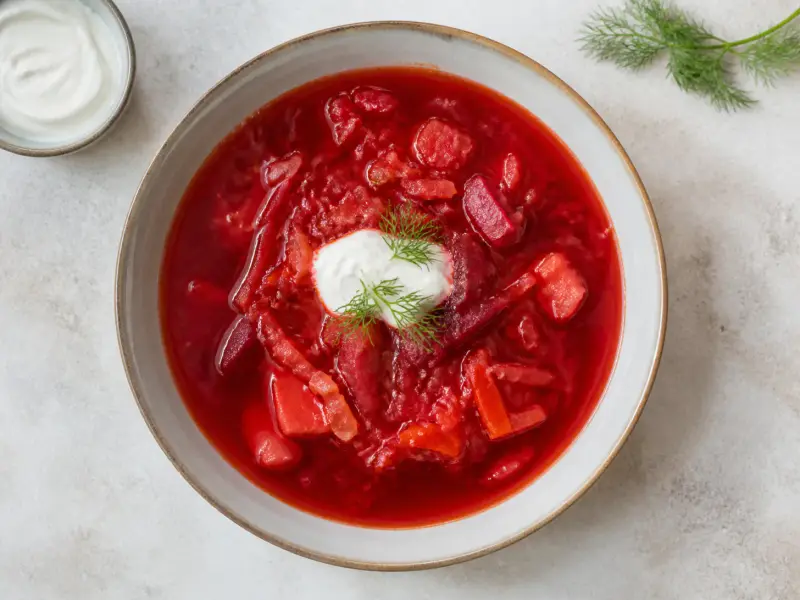 Borscht
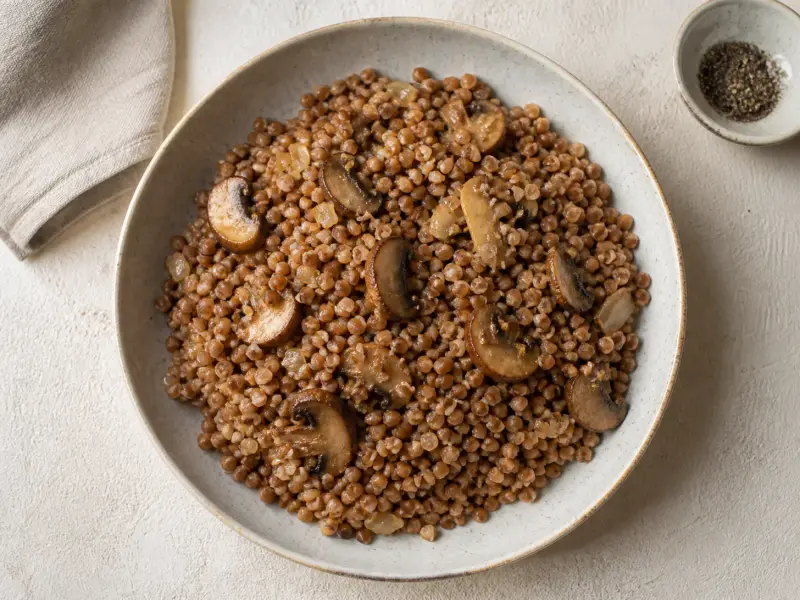 Buckwheat Kasha with Mushrooms
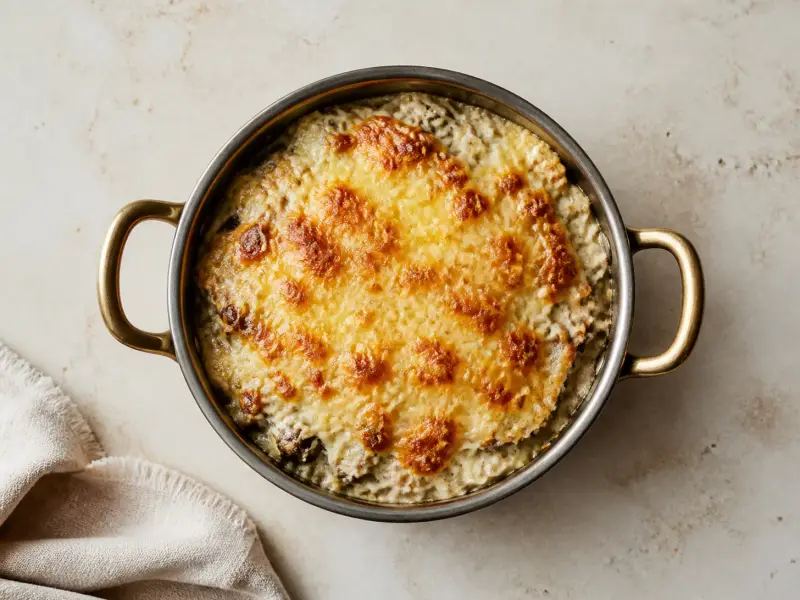 Mushroom Julienne
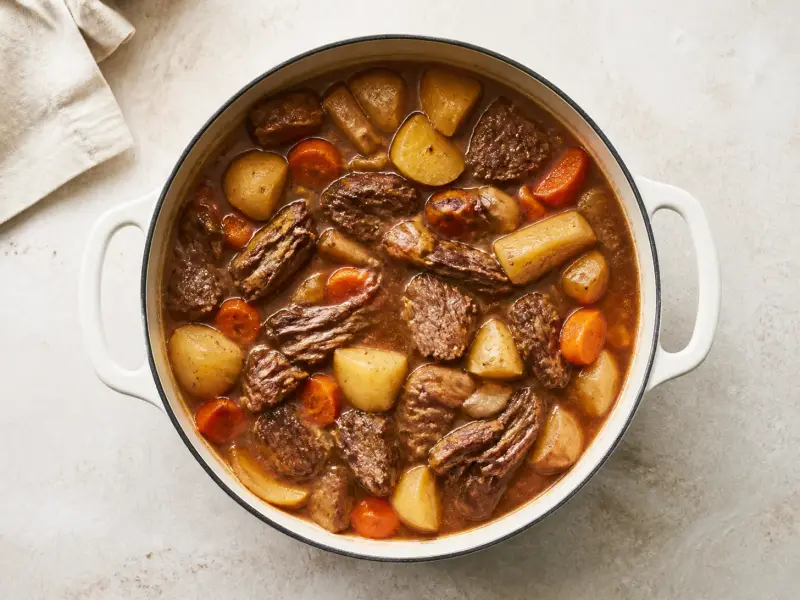 Zharkoye
 Beef Stroganoff
 Chicken Kiev
Categories
Courses & dish types
Diets