Double-Crust Apple Pie
Two kinds of apple under a vented pastry lid, thickened with cornflour so the filling holds together when the pie is cut.
- Prep
- 45 min
- Cook
- 1 hr
- Resting
- 1 hr 20 min
- Total
- 3 hr 5 min
- Serves
- 8
- Revisions
- 5
Allergens
- Cereals containing gluten
- Eggs
- Milk
Named from the ingredients as written, including those carried in from sub-recipes. This is not a guarantee — check the labels on what you actually buy, and note that a product’s recipe can change.
Ingredients
Serves
Method
Rub the cold butter into the flour, the 20g of caster sugar and the fine salt with your fingertips, lifting the mixture high out of the bowl and letting it fall back so it stays cool.
Stop while flakes of butter the size of small peas are still visible. Those flakes turn to steam in the oven and lift the pastry into layers; rubbed down to fine crumbs, it bakes short and sandy with nothing to flake.
Pour in the 90ml of ice-cold water.
Cut it through with a table knife until the mixture clumps, then press it together with one hand until no dry flour is left.
Divide the dough into a larger piece of about 380g for the base and a smaller one for the lid.
Flatten both into discs, wrap them and refrigerate for 1 hour.
Toss both kinds of apple with the 100g of caster sugar, the cornflour, lemon juice, cinnamon and nutmeg until every chunk is coated.
Use both apples rather than one. Bramleys collapse to a sauce and eating apples hold their shape, and a pie made from only one is either soup under a lid or raw chunks in syrup. The apple and blackberry crumble in this collection can take Bramleys alone because nothing has to hold together under a slice.
Roll the larger disc out on a floured worktop to a round about 32cm across and 3mm thick.
Line a 23cm pie dish with it, easing the pastry into the corner rather than stretching it.
Pile the fruit in, mounding it slightly higher in the middle than at the edges.
Roll the second disc out to a round about 26cm across.
Brush the pastry rim of the base with beaten egg.
Lay the lid over the fruit and press the two edges together all the way round.
Trim the overhang with a knife and crimp the edge between finger and thumb, sealing it properly. A seam that opens lets the juices boil out onto the oven floor and leaves the fruit dry.
Cut a 2cm hole in the centre of the lid and two short slashes either side of it. Steam with nowhere to go lifts the lid clean off the fruit and forces the juice out at the crimp.
Chill the assembled pie for 20 minutes.
Heat the oven to 200C/400F with a heavy baking tray inside it, so the base of the pie meets hot metal from the first minute.
Brush the lid with the rest of the beaten egg.
Scatter the demerara sugar over the top.
Set the pie on the hot tray and bake at 200C/400F for 20 minutes, until the pastry has set and taken its first colour.
Turn the oven down to 180C/350F.
Bake for a further 35-40 minutes, until the lid is deep gold and thick juice is bubbling slowly through the central hole rather than running thin.
Push a skewer through the hole into the fruit. It should meet no resistance at all.
Cool the pie for at least an hour before cutting. The cornflour only finishes thickening as the filling cools, and a pie cut straight from the oven floods the plate and the slice falls apart.
Serve warm rather than hot, with cream or the vanilla custard in this collection.
Nobody has rated this recipe yet.
Sign in to rate this recipe. One rating per person, and you can change it.
What to expect
- Taste
A balance of tart and sweet from using two apple varieties together — the Bramley's sharpness against the eating apple's milder sweetness — lifted by lemon juice and warmed by cinnamon and nutmeg, with the buttery pastry providing a rich, savoury-edged contrast to the fruit's acidity.
- Aroma
A warm, spiced apple smell filling the kitchen as it bakes, cinnamon and nutmeg carrying furthest, with a buttery, faintly toasted smell from the pastry itself.
- Texture
A crisp, short, flaky pastry giving way to a filling that ranges from soft, collapsed purée to still-distinct, tender apple chunks within the same slice, held together by a glossy, only lightly set syrup rather than a stiff, jam-like filling.
- Sound
A crisp, audible crackle when the pastry lid is broken into with a fork or spoon.
- How the flavour moves
The buttery pastry registers first, the tart Bramley and sweeter eating apple's contrasting flavours follow through the middle of the bite, and the warm spice notes of cinnamon and nutmeg linger longest at the finish.
- Serve it
Best served warm rather than hot from the oven, since the filling needs the cooling time to finish setting properly.
- Goes with
Custard or double cream, both of which add a cool, plain richness against the pie's warm spice and fruit acidity.
Cook's notes
- Difficulty
Moderate — the pastry and the fruit both need attention, and using only one kind of apple is a common shortcut that noticeably weakens the result.
- Cost
Low to moderate — butter and apples are the main costs, both reasonably priced.
- Equipment
A 23cm pie dish, a rolling pin, and a heavy baking tray heated in the oven ahead of time.
- When to make it
A weekend bake, a Sunday pudding, or a holiday dessert depending on the tradition being followed.
- Best season
British apples are at their best in autumn, which is the traditional season for this pie, though good eating and cooking apples are available for most of the year.
- You know it is done when
The lid should be deep gold all over, with thick juice bubbling slowly up through the central vent hole rather than running thin and watery.
- And it feels like
A skewer pushed through the vent into the fruit should meet no resistance at all; the filling should look thickened and glossy rather than loose and liquid.
- Food safety
No particular hazard beyond standard care with raw egg in the glaze; the filling is fully cooked through by the combination of the parboiled-style softening in the oven and the visible bubbling through the vent.
- Where it goes wrong
- Using only one variety of apple, which gives either a collapsed, soupy filling or unsoftened raw chunks rather than the intended mix of textures.
- Sealing the edge poorly, which lets juices boil out at the crimp and leaves the filling dry.
- Forgetting to vent the lid, which traps steam and can force the lid to lift clean off the fruit.
- Cutting the pie before it has properly cooled, which floods the plate since the cornflour has not finished setting.
- If it does go wrong
Filling too runny even after cooling: the cornflour may have been measured short, or the pie was cut before the full cooling time had passed. Pastry soggy on the base: the oven tray may not have been fully preheated before the pie went in. Pastry burst or juices leaked at the edge: the crimp was not sealed firmly enough, or the pie was overfilled.
- Making it ahead
The pastry can be made and chilled up to two days ahead, and the whole pie can be assembled, chilled and baked the same day or frozen unbaked for later.
- Keeping it
Keeps covered at room temperature for a day, or refrigerated for up to three days; the pastry softens somewhat in the fridge but the flavour holds well.
- Reheating
Reheats well in a moderate oven, uncovered, until warmed through — this restores some crispness to the pastry that a microwave would not.
- Freezing
Freezes well either baked or unbaked; an unbaked pie can go from frozen straight into the oven with extra time added, and a baked pie freezes and reheats cleanly in slices or whole.
- Leftovers
Good for a couple of days reheated, and the flavour if anything settles and rounds out slightly with a day's rest.
- Scaling it
Not easily scaled up within one dish, since a larger pie needs a proportionally longer bake to cook the fruit through without burning the crust; making two pies is more reliable than one very large one.
- Substitutions
Cornflour is specifically chosen over plain flour for the filling because it sets clear as the juices boil and holds them as a gel, where plain flour clouds the filling and takes longer to lose its raw, starchy taste.
- Dietary swaps
Contains gluten, eggs and milk (from the pastry, glaze and, if used, the custard). Can be made egg free by using a milk glaze instead of egg wash; not easily made gluten free without a significant change to the pastry recipe, since the flour is structural to both the lid and the base.
- Shopping for it
A metal or enamel pie dish browns the base better than a thick ceramic one, which insulates the pastry and leaves it pale — worth choosing deliberately if a crisp base matters.
- Keeping the cost down
A mix of a cheaper cooking apple like Bramley with whatever firm eating apple is on offer keeps the cost down without sacrificing the two-texture filling this recipe depends on.
- Nutrition
A rich, moderately indulgent dessert; the fruit content offsets some of the richness of the buttery pastry compared to an all-pastry dessert.
- Worth it?
A pie that rewards the extra step of using two apple varieties, and one where the cooling time is as important to the final result as anything that happens in the oven.
Where it comes from
- Origin
England, for the earliest documented form; claimed culturally by both Britain and the United States in its modern popular identity.
- Also called
Apple pie.
- What the name means
Descriptive — a pie filled with apples.
- History
A recipe for apples baked in a pastry case survives in English manuscript cookery from the late 14th century, making the dish at least that old, with no earlier origin date documented. The pie travelled to North America with English and Dutch settlers from the 17th century onward, and it became so closely associated with American national identity that the phrase "as American as apple pie" entered common usage in the early 20th century, despite the dish's older English roots.
- Why it matters
Standard home baking in Britain and Ireland, served hot with custard or cream, and a fixture of American holiday tables, particularly Thanksgiving, where it is more often served with ice cream than custard.
- When it is eaten
A standard British pudding at any time of year; a specifically holiday-associated dish, especially Thanksgiving, in the United States.
- The traditional way
A double crust of shortcrust pastry, a mixed-apple filling for both structure and flavour, and a vented lid to let steam escape rather than force the juices out at the seal.
- Regional variations
American apple pie is typically served with ice cream rather than the custard or cream more common in Britain; crumble toppings and lattice lids are common variations on the same basic apple-and-pastry idea across both traditions.
- How this version differs
This recipe uses cornflour rather than plain flour to thicken the filling, giving a clearer, glossier set than a flour-thickened filling would produce.
- Sources and credit
No individual is credited with inventing the dish; it developed across centuries of English and later American home baking.
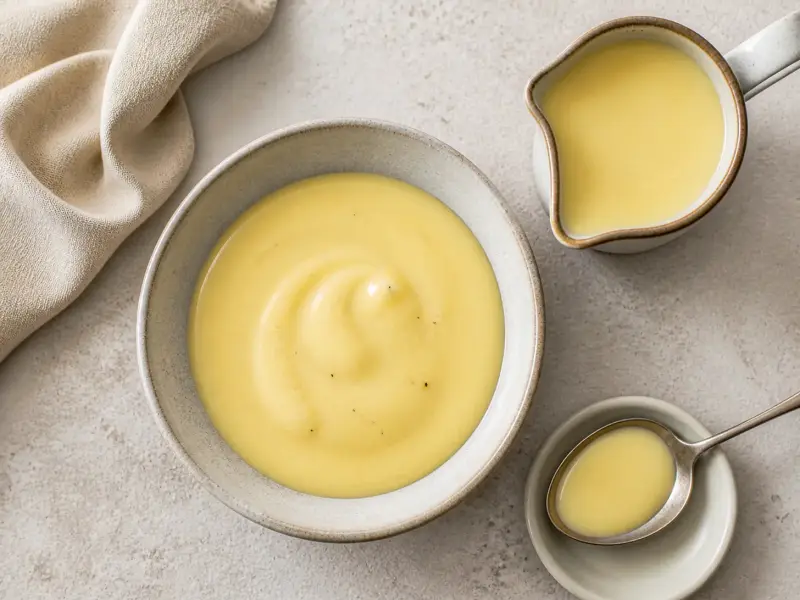 Vanilla Custard
 Baked Vanilla Cheesecake
 Brown Butter Chocolate Chip Cookies
 Dark Chocolate Brownies
 Apple and Almond Tart
 Apple and Blackberry Crumble
 Baked Alaska