Garlic Naan
लहसुन नान
Lehsun naan
A yoghurt-enriched yeasted dough cooked in a screaming hot pan and blistered under the grill, which stands in for a tandoor.
- Prep
- 25 min
- Cook
- 20 min
- Resting
- 1 hr 25 min
- Total
- 2 hr 10 min
- Serves
- 4
- Revisions
- 5
Allergens
- Cereals containing gluten
- Milk
Named from the ingredients as written, including those carried in from sub-recipes. This is not a guarantee — check the labels on what you actually buy, and note that a product’s recipe can change.
Ingredients
Serves
Method
Whisk the flour, yeast, sugar and fine salt together in a large bowl.
Beat the yoghurt into the warm milk until it is smooth.
Pour the yoghurt mixture and the oil into the flour.
Mix to a soft, slightly sticky dough.
Rest it for 10 minutes so the flour hydrates.
Knead for 8-10 minutes, until it is smooth and springy but still soft enough to take a fingerprint without resistance.
Keep it softer than a tin loaf dough. A firm naan dough rolls out tight, springs back at you and bakes into a biscuit.
Cover and prove at room temperature for 60-90 minutes, until doubled.
Divide the dough into 8 pieces of about 110g.
Roll each into a ball and keep them covered.
Rest the balls for 15 minutes, so they roll out without springing back.
Heat the grill to its highest setting.
Set a heavy cast-iron frying pan over the highest heat you have for 5 minutes, until a flick of water skitters across it and vanishes at once.
Melt the butter in a small pan with the chopped garlic over low heat for 60-90 seconds, until the garlic is pale gold and smells sweet.
Take it off the heat there. Garlic in hot butter goes from gold to bitter brown in seconds, and nothing brings it back.
Roll one ball out on a lightly floured worktop into a teardrop about 3mm thick, pulling one end longer as you go.
Scatter a pinch of the nigella seeds over it and give it one more pass with the pin to press them in.
Roll them one at a time, as the pan frees up. Rounds rolled in advance dry at the edges, stick to one another and lose the puff.
Lay the naan in the dry pan.
Cook for 60-90 seconds, until large bubbles rise across it and the underside is spotted black in patches.
Slide the whole pan under the grill for 30-60 seconds, until the top balloons and blisters.
Do not settle for a pan that is merely hot. The puff is steam, and the water in the dough has to turn to vapour faster than it can escape; at a lower heat the bread simply dries out flat.
Brush the hot naan with the garlic butter.
Scatter over the coriander and a pinch of flaky salt.
Stack the finished breads under a clean tea towel, where the trapped steam keeps them soft.
Cook the rest the same way.
Serve straight away, with the weeknight red lentil dal in this collection or anything else with sauce to mop.
The skillet flatbreads in this collection are the same shape without the yeast: they rise on baking powder, take twenty minutes start to finish, and come out thinner and less open than these.
Nobody has rated this recipe yet.
Sign in to rate this recipe. One rating per person, and you can change it.
What to expect
- Taste
Mild and slightly sweet from the dough itself, with the garlic butter carrying most of the flavour on top — sweet, mellow, cooked garlic rather than raw sharpness, since the garlic goes in gently over low heat and is pulled off before it can brown. The yoghurt in the dough contributes a faint, barely-there tang rather than anything assertively sour.
- Aroma
Toasted wheat and char from the blistered spots, with warm garlic butter arriving as soon as it's brushed on — that garlic aroma is the dominant one at the table, more noticeable than the bread itself.
- Texture
Soft, pillowy and slightly chewy at the blistered spots, with pockets of trapped air where the dough has ballooned under the grill's heat — the contrast between the soft interior and the occasional crisp, charred edge is the main textural interest.
- Sound
A soft tear as it's pulled apart by hand, and a faint sizzle as the garlic butter is brushed onto the still-hot surface.
- How the flavour moves
Garlic butter first, off the surface, then the mild, slightly sweet bread underneath, with the charred blister spots contributing a brief bitter note wherever the crust has caught properly.
- Serve it
Served hot, straight from the pan and grill — this bread loses much of its appeal once it cools, since the softness and the pliability both depend on residual heat.
- Goes with
The weeknight red lentil dal and the slow-cooked black dal in this collection, or any curry with a sauce worth mopping — this bread's whole purpose is scooping.
Cook's notes
- Difficulty
Moderate. The dough itself is straightforward, but working quickly through eight rounds while the pan stays at the right heat, and timing the garlic butter so it doesn't burn, both take a little practice.
- Cost
Cheap — flour, yeast, yoghurt and a little butter and garlic.
- Equipment
A heavy cast-iron frying pan capable of taking very high, sustained heat, an overhead grill, and a rolling pin. No tandoor, no pizza stone, nothing specialist.
- When to make it
Alongside any curry night — this is a bread to make just before serving, since it is genuinely best eaten within minutes of coming off the heat.
- Best season
None.
- You know it is done when
Large bubbles rising across the surface and the underside spotted black in patches from the pan; ballooning and blistering on top from the grill.
- And it feels like
Soft and pliable straight off the heat, with a slight chew at the blistered spots; it should not be crisp or biscuit-like anywhere.
- Food safety
Nothing perishable beyond the dairy in the dough and the butter, both cooked through. No particular hazard, though a cast-iron pan at this heat needs careful handling.
- Where it goes wrong
- A pan that is merely hot rather than genuinely scorching. The puff depends on steam building faster than it can escape, and a lower heat just dries the dough out flat.
- Rolling all the dough balls in advance. Left waiting, the rolled rounds dry at the edges, stick together and lose their ability to puff.
- Letting the garlic go past pale gold in the butter, which turns bitter within seconds and cannot be rescued.
- A dough rolled too firm, which fights back under the pin and bakes into something closer to a cracker.
- If it does go wrong
Naan won't puff: the pan or grill isn't hot enough, or the dough was rolled too thick or too firm. Tough, biscuit-like naan: dough was over-kneaded or under-hydrated. Bitter garlic butter: it went in too early or stayed on the heat a few seconds too long.
- Making it ahead
The dough can be made and proved through its first rise, then shaped and cooked closer to serving; naan itself does not hold well once made, so it is not a genuine make-ahead bread.
- Keeping it
Best eaten the same day; they firm up noticeably within a few hours.
- Reheating
A few seconds per side in a dry hot pan, or wrapped in foil in a low oven, brings them back closer to fresh than a microwave does.
- Freezing
Freezes well once cooled; reheat from frozen in a dry pan or foil-wrapped in the oven.
- Leftovers
Best used the same way as fresh — torn and used to scoop dal or curry — rather than repurposed into another dish.
- Scaling it
Scales up cleanly by weight, though cooking stays a one-at-a-time process regardless of batch size, since only one naan fits the pan at once.
- Substitutions
Ghee in place of the butter is closer to how it would traditionally be finished and gives a slightly nuttier, more savoury result. A grill-less oven can substitute a very hot oven with a pizza stone or upturned heavy tray preheated inside it, though the blister and char will be less pronounced than the pan-and-grill method gives.
- Dietary swaps
Vegetarian as written. Dairy-free is workable with a plant-based yoghurt and milk and oil instead of butter, though the texture and tang will differ somewhat from the dairy version. Not naturally gluten-free — the dough's stretch and puff depend on wheat gluten, and there is no straightforward substitute that behaves the same way under this exact method.
- Shopping for it
Full-fat plain yoghurt gives the dough more tenderness than a low-fat version; a heavy cast-iron pan, rather than a thin non-stick one, is what actually gets hot enough to work.
- Keeping the cost down
Inexpensive as written — the most costly single ingredient is the small amount of butter and garlic for finishing.
- Sustainability
A modest-footprint bread — no long bake time, no specialist equipment beyond a pan most kitchens already own.
- Nutrition
An enriched bread — yoghurt, milk and butter all add fat and a little protein beyond a plain flatbread.
- Worth it?
The best approximation of tandoor naan achievable without one, and worth the slightly fiddly technique for how much closer it gets than an oven-only method.
Where it comes from
- Origin
Persia and Central Asia broadly, with the word itself simply meaning bread; the tandoor-baked form is documented in Mughal court records by the 16th century and is almost certainly far older as an everyday technique.
- Also called
Naan.
- Said out loud
nahn, a single syllable with a long open vowel.
- What the name means
Naan is the Persian word for bread in general, not a name specific to this shape or method — which is why so many different flatbreads across the region carry some form of the same word.
- History
The Ain-i-Akbari, the administrative chronicle of the Mughal emperor Akbar's court compiled in the late 16th century, records naan-e-tunuk and naan-e-tanuri among the breads served at court, which puts a documented version of tandoor-baked naan in an elite Mughal setting by that period. As an everyday flatbread cooked against the wall of a clay oven, the technique is understood to be considerably older across the region, though no single origin point can be fixed.
- Why it matters
Everyday bread in Punjab, northern India, Pakistan, Afghanistan and Iran, usually bought fresh from a tandoor rather than made at home, since a home kitchen traditionally had no oven capable of the technique. In Britain it has taken on a second identity as the default bread on an Indian restaurant menu, generally served larger and softer than the versions eaten at source.
- When it is eaten
An everyday bread wherever tandoors are common; in Britain, more often an occasion or restaurant food precisely because home ovens can't reproduce it easily.
- The traditional way
Dough slapped directly onto the vertical inner wall of a clay tandoor, where it clings, puffs and blisters in the intense radiant heat before being peeled off with a hooked skewer.
- How it changed
Naan's move from a tandoor-only bread to a widely eaten restaurant item outside South Asia is a mid-to-late 20th-century development, following British and North American Indian restaurant culture from the 1960s onward — a shift in audience and setting rather than in the bread's method at source.
- Regional variations
Peshawari naan is stuffed with nuts and dried fruit; keema naan is filled with minced meat; roghani naan is enriched further with extra ghee. The skillet flatbreads in this collection are a related but distinct form — unleavened with baking powder rather than yeast, and cooked in minutes with no need to approximate a tandoor at all.
- How this version differs
This recipe substitutes a screaming-hot cast-iron pan plus an overhead grill for the tandoor, which gets closer to the real blister-and-char effect than a domestic oven alone can manage, though it will never fully match a genuine clay oven's combination of heat and vertical cling.
- Sources and credit
No individual can be credited with naan, which is a broad regional bread family rather than a single invented dish.
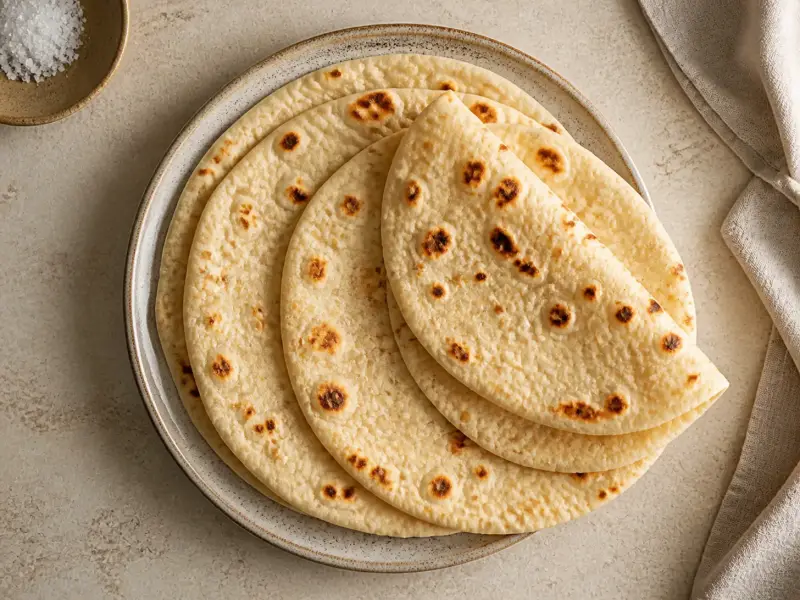 Skillet Flatbreads
 Borodinsky Rye Bread
 Buckwheat Kasha with Mushrooms
 Buttermilk Soda Bread
 Chana Masala
 Crumpets