Herring Under a Fur Coat
Селёдка под шубой
Selyodka pod shuboy
Селёдка под шубой — herring under a fur coat.
Layers of salted herring, onion, potato, carrot and beetroot under mayonnaise, left overnight so it sets firm enough to cut.
- Prep
- 45 min
- Cook
- 1 hr
- Resting
- 8 hr 10 min
- Total
- 9 hr 55 min
- Serves
- 8
- Revisions
- 5
Allergens
- Eggs
- Fish
- Mustard (via Mayonnaise)
- Sulphites
Named from the ingredients as written, including those carried in from sub-recipes. This is not a guarantee — check the labels on what you actually buy, and note that a product’s recipe can change.
Ingredients
Serves
Method
Taste a corner of a herring fillet before anything else.
Soak the fillets in cold water for an hour if it is fiercely salty, and use them as they come if it is not. Everything else in this dish is bland, so the herring sets the seasoning for all of it and there is no correcting it later.
Run your fingertips down each fillet, feeling for pin bones, and pull out any you find with tweezers.
Cut the fillets into 1cm pieces and pat them dry.
Cook the beetroot whole and unpeeled in its own pan of simmering water for 45-60 minutes, until a skewer goes to the centre with no resistance.
Cook the potatoes and carrots whole and unpeeled in a second pan with the 10g of fine salt for 20-25 minutes, lifting each out as it gives to a skewer.
Boil the eggs for 9 minutes from the moment the water returns to the boil, then cool them under cold running water and peel them.
Cool everything completely before a single layer is built. Warm vegetables slump, and mayonnaise spread on anything warm thins and slides straight out of the stack.
Peel the cold beetroot, potatoes and carrots.
Grate the potato, carrot, beetroot and egg on the coarse side of a box grater, each into its own bowl, and wash the grater between the beetroot and everything else.
Rinse the diced onion in a sieve under cold water, squeeze it dry and turn the cider vinegar through it.
Leave the onion in the vinegar for 10 minutes, which takes the raw heat off it and gives the one sharp note in an otherwise rich dish.
Spread the herring pieces over the base of a straight-sided glass dish about 20cm across, in a single even layer.
Scatter the vinegared onion over the herring.
Spread the grated potato over next and press it flat with the back of a spoon.
Spread a third of the mayonnaise over the potato in a thin layer, right out to the edges of the dish.
Spread it thin and take it to the edge every time. The mayonnaise is mortar between layers rather than a filling, and a thick soft layer lets the stack slide apart the moment a knife goes into it.
Add the grated carrot, press it flat and spread another third of the mayonnaise over it.
Add the grated egg and press it flat.
Squeeze the grated beetroot hard in your hands over the sink before it goes on.
Get that juice out. Beetroot holds a great deal of water, and a wet top layer weeps pink down through every layer below it overnight and leaves the whole dish sodden.
Spread the squeezed beetroot over the top and level it.
Spread the last of the mayonnaise over the beetroot and smooth it flat with a palette knife.
Cover the dish and refrigerate for at least 8 hours, and overnight if you can.
Give it the full night. This is the step that turns six loose layers into something that holds its shape on a plate, and it is also how the salt of the herring travels through the rest of it.
Scatter the dill over and grind the peppercorns over the top just before serving.
Cut down through every layer to the base of the dish and lift each slice out with a palette knife.
Keep it covered in the fridge and eat it within two days.
Nobody has rated this recipe yet.
Sign in to rate this recipe. One rating per person, and you can change it.
What to expect
- Taste
Salt and fish first, and then a long sweetness. Salted herring is intensely savoury, oily and fishy in a cured rather than fresh way, and it is by far the loudest thing in the dish. Against it, beetroot is genuinely sweet and earthy, carrot is sweet, potato is bland, and egg is rich and mild — the entire stack above the fish is there to soften it. Mayonnaise binds everything and adds fat. The vinegared onion is the only sharp note and it is doing real work: in a dish this rich and this sweet, one acidic element is the difference between something you want a second piece of and something you do not. Dill is the finish. It is a strange combination on paper and it works because each layer is doing a job the others cannot.
- Aroma
Cured fish and dill, and very little else. It is a cold dish and smells muted, which is a mercy given what is in it.
- Texture
Soft throughout, uniformly, with everything grated to the same fineness so it eats as a single substance rather than as five. That is deliberate. The only textural interest is the diced onion and the pieces of fish, which are the two things not grated. After a night it is dense and sliceable.
- Sound
None. It is a cold assembled dish.
- How the flavour moves
Mayonnaise and beetroot sweetness first, since the top layers reach the tongue before the bottom ones. Then carrot and potato. Then the fish arriving from underneath, salty and oily, which is the surprise if you have not had it before. The vinegared onion cuts through somewhere in the middle. The finish is salt and fish and stays. Across a plate the sweetness and the salt alternate depending on how the forkful was cut, which is why it is eaten in vertical slices rather than scraped off the top.
- Serve it
Cold from the fridge, and it needs to be — at room temperature the mayonnaise loosens and the fat becomes obvious.
- Goes with
Cold vodka, which is the traditional and genuinely correct pairing — it cuts the fat and the salt in a way nothing else does. Dark rye bread. Everything else on a Russian holiday table, where it sits alongside the Olivier salad and the cold cuts. Where it fails is at any temperature above cold, and next to wine, which salted fish defeats entirely.
Cook's notes
- Difficulty
Easy and tedious. Three separate boiling jobs, a lot of grating, and then patience.
- Cost
Low. Root vegetables and a jar of salted herring.
- Equipment
A straight-sided glass dish about 20cm across — glass because the layers are the entire point and nobody should have to take them on trust. A box grater. Tweezers for pin bones.
- When to make it
New Year, winter, celebrations. It is cold-weather food.
- Best season
None, though it is winter food and root vegetables are at their best then.
- You know it is done when
A skewer to the centre of each vegetable with no resistance, tested individually. The finished dish should show clean horizontal bands through the side of a glass dish, with no bleeding between them beyond a little at the beetroot boundary, which is unavoidable and looks fine.
- And it feels like
After a night it should be firm enough to cut into squares and lift out with a slice intact. Straight after assembly it will not hold at all.
- Food safety
It contains raw-cured fish, egg and mayonnaise and is served cold and often left on a table for hours. Keep it refrigerated until serving, do not leave it out for more than two hours in a warm room, and eat it within two days. If the mayonnaise is homemade, treat it as a raw-egg dish and be stricter.
- Where it goes wrong
Assembling while anything is still warm, which makes the mayonnaise slide and the layers slump. Boiling the beetroot with everything else, which dyes the lot. Not tasting the herring first, so the dish is either bland or inedibly salty. Skipping the overnight rest, after which it will not cut. Not taking the mayonnaise right to the edges, so the layers bleed. And leaving pin bones in the fish.
- If it does go wrong
Will not cut: it needs longer in the fridge. Layers merged: it was assembled warm, or the mayonnaise did not reach the edges. Too salty: the herring was not soaked, and nothing recovers it. Bland: the herring was mild and the dish needed salt at each layer. Everything pink: the beetroot was boiled or grated with the other vegetables.
- Making it ahead
It must be made ahead — overnight minimum. That is the recipe rather than a convenience, and it makes this one of the most useful things on a festive table.
- Keeping it
Two days in the fridge, covered. The beetroot bleeds further and the colours blur, which is cosmetic.
- Reheating
Never.
- Freezing
No.
- Leftovers
It is made in quantity for a festive table and eaten over several days, which is the tradition rather than a failure of planning.
- Scaling it
Freely, in a larger dish. Keep the layers the same thickness rather than making them deeper.
- Substitutions
Salted or pickled herring from a jar is what most people use and works well; rollmops are too vinegary. Any oily salted fish will do the job — matjes, or a mild salted mackerel. Homemade mayonnaise transforms it, as it does the Olivier salad. Some households add a layer of grated apple, which is a real improvement.
- Dietary swaps
Pescatarian. Not vegetarian or vegan. Contains fish and eggs, and mustard and sulphites through the mayonnaise. Gluten-free and nut-free depending on the mayonnaise.
- Shopping for it
Salted herring fillets from an eastern European or Scandinavian shop rather than pickled ones in sweet vinegar. Raw beetroot rather than the pre-cooked vacuum-packed kind, which is sweeter and wetter. Fresh dill.
- Keeping the cost down
Salted herring in a jar is inexpensive and root vegetables are the cheapest things in a shop. Homemade mayonnaise costs a fraction of a jar and improves it more than any other change.
- Sustainability
Herring is one of the better-managed fisheries and one of the more sustainable oily fish. The rest is root vegetables. It is a defensible dish on this axis.
- Nutrition
Around 420 calories a serving. Most of it is mayonnaise. Underneath that, herring is genuinely one of the best sources of omega-3 there is, and beetroot and carrot bring real nutritional value — the dish is better for you than its reputation, and the mayonnaise is what decides the numbers.
- Worth it?
Worth it if you are making a spread rather than a single dish, since it takes most of a day and has to sit overnight. What you get is one of the most striking-looking things in the collection and a combination that sounds implausible and is genuinely good. Taste the herring first, cool everything completely, and vinegar the onion.
Where it comes from
- Origin
Russia, in the twentieth century.
- Also called
Selyodka pod shuboy — селёдка под шубой — herring under a fur coat. Sometimes just shuba, the coat.
- Said out loud
sel-YOD-ka pad SHOO-boy.
- What the name means
The fish is under a coat of vegetables and mayonnaise, which keeps it warm in the way a fur coat does. It is a joke of a name and it is the standard one.
- History
The origin story that circulates is elaborate and worth repeating only to say that it is unsupported: that a Moscow tavern owner named Aristarkh Prokoptsev created it in 1918, that the layers are a political allegory with the herring standing for the proletariat and the beetroot for the red flag, and that the name is an acronym meaning roughly 'chauvinism and degradation — boycott and anathema'. It appears in a great many articles and food historians have found no source for it earlier than the 1990s. The dish is much more likely a mid-twentieth-century Soviet creation, of a piece with the layered mayonnaise salads that period produced in quantity. What is real is why it exists: salted herring was cheap and universally available, root vegetables kept all winter, and mayonnaise had become a Soviet staple. It is a dish built entirely out of what a Soviet kitchen had.
- Why it matters
It is New Year food, in the same bowl-on-the-table way as the Olivier salad, and the two of them together define a Russian festive spread. It is also a genuinely divisive dish outside Russia, which is fair — a stack of beetroot, herring and mayonnaise is not an obvious proposition.
- When it is eaten
New Year above all, and celebrations generally.
- The traditional way
Layering, pressing each layer flat, and sealing each with mayonnaise right to the edges of the dish. The seal is what stops the layers bleeding into one another.
- How it changed
Very little. The main modern variation is the addition of an apple layer and the use of better mayonnaise.
- Regional variations
Grated apple is a common addition. Some versions add a layer of soured cream mixed into the mayonnaise, which lightens it. Some invert the order and finish with egg rather than beetroot. Scandinavian and Baltic herring salads are relatives, generally sharper and less sweet.
- How this version differs
It vinegars the onion, which is not universal and is the single best thing in the recipe. Otherwise it is orthodox.
- Sources and credit
None. The 1918 story is given here only to note that it is not evidenced.
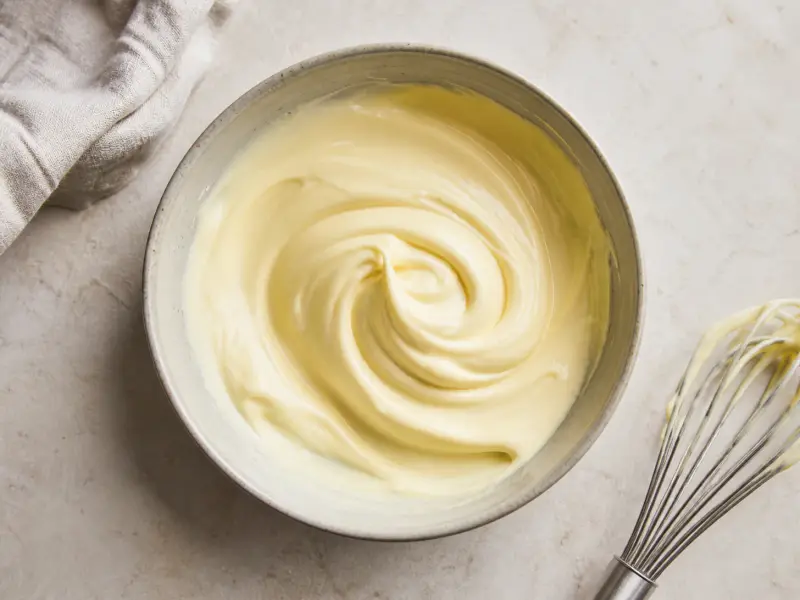 Mayonnaise
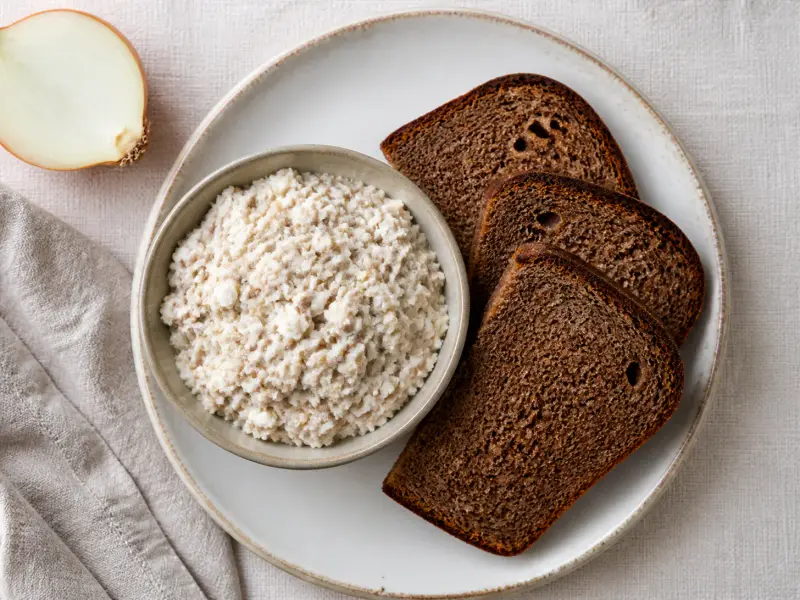 Forshmak
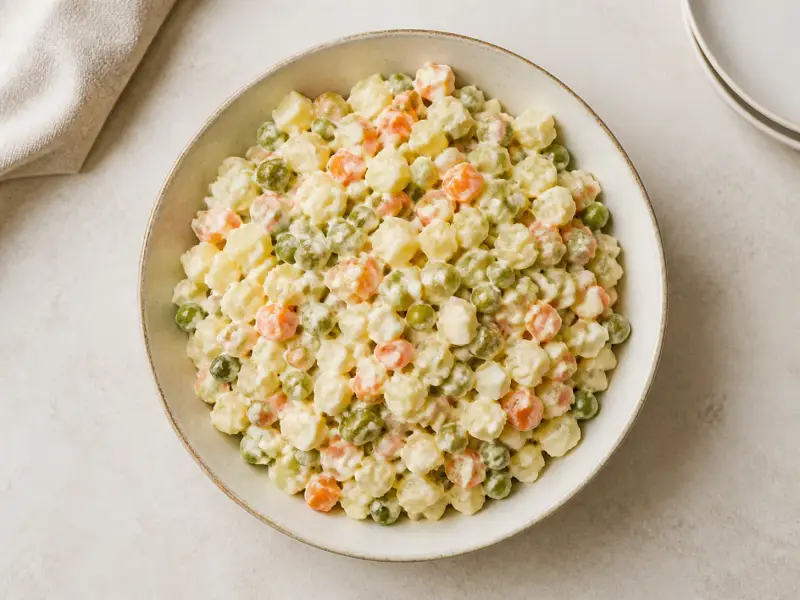 Olivier Salad
 Salat Mimosa
 Smoked Haddock Chowder
 Ukha
Ukha Vinegret