Olivier Salad
Салат Оливье
Salat Olivye
Салат Оливье — for Lucien Olivier, the Moscow chef who would not write the recipe down.
Potato, egg, pea and pickle in mayonnaise, cut to an even dice and dressed only once everything is properly cold.
- Prep
- 40 min
- Cook
- 30 min
- Resting
- 8 hr
- Total
- 9 hr 10 min
- Serves
- 8
- Revisions
- 6
Allergens
- Eggs
- Mustard (via Mayonnaise)
- Sulphites (via Mayonnaise)
Named from the ingredients as written, including those carried in from sub-recipes. This is not a guarantee — check the labels on what you actually buy, and note that a product’s recipe can change.
Ingredients
Serves
Method
Put the potatoes and carrots whole and unpeeled into a large pan of cold water with the 10g of fine salt.
Bring to a simmer and cook for 20-25 minutes, testing each vegetable separately with a skewer and lifting it out the moment the skewer meets no resistance.
Cook them whole and in their skins. Peeled and cubed, they take up water, give up flavour to it and collapse the moment they meet a thick dressing.
Stop before the skins split. A potato cooked that far has already started drinking.
Drain them and leave them to cool completely, which takes at least an hour on a tray or overnight in the fridge.
Boil the eggs for 9 minutes from the moment the water returns to the boil.
Cool the eggs under cold running water and peel them.
Cook the peas in boiling water for 2 minutes, then drain them and drop them straight into cold water, which stops them cooking and keeps them green.
Drain the peas again and leave them to dry on a plate.
Peel the cold potatoes and carrots, which should slip out of their skins under your thumb.
Cut the potato, carrot, egg, ham and cucumber all to the same 8mm dice.
The even dice is most of the recipe. Every spoonful should carry all of it, and pieces cut at different sizes give a bowl that reads as potato with things scattered through it.
Put the diced onion in a sieve and rinse it under cold running water for 30 seconds, then squeeze it dry in a cloth.
Rinsing takes the raw heat out of the onion. Left untreated it goes on getting stronger in the bowl, and by the second day it is the only thing anyone tastes.
Combine everything in a large bowl.
Loosen the mayonnaise with the tablespoon of cucumber brine, which makes it foldable and adds back a little of the sourness the mayonnaise flattens.
Fold the dressing through with a spatula, lifting from the bottom rather than stirring in circles, until everything is coated.
Dress it only when every component is cold. Mayonnaise on warm potato thins, separates and runs to the bottom of the bowl as oil, and there is no bringing it back.
Season with the ground peppercorns and then with fine salt, tasting first, because the ham and the pickles are already salty.
Cover and refrigerate for at least an hour before serving, which lets the dressing take up the pickle and the salt.
Fold the dill through just before it goes on the table, so it stays green.
Keep it covered in the fridge and eat it within two days. It is raw egg dressing over cooked potato and it belongs in the fridge rather than standing out on a table all evening.
Do not freeze it. Mayonnaise separates on thawing and the potato goes grainy.
Nobody has rated this recipe yet.
Sign in to rate this recipe. One rating per person, and you can change it.
What to expect
- Taste
Rich first, then sharp, and the sharpness is what stops it being stodgy. Mayonnaise is the dominant flavour by volume and everything else is set against it. Brined cucumber is the counterweight: salty, sour, fermented, and it needs to be the proper barrel-type rather than a sweet gherkin, because sweetness on top of mayonnaise is cloying. Potato and carrot are sweet and mild. Egg is rich and slightly sulphurous. Peas bring a distinct sweetness and are one of the few bright flavours in the bowl. Onion, diced small, is pungent and is the reason it divides opinion. Dill is the characteristic finish and is more assertive than it looks. Salt has to be judged at the end, because the pickles, the brine and the meat are all bringing their own.
- Aroma
Mild, which is characteristic of cold food. Dill is the most obvious note and is what makes the bowl smell Russian rather than generically of mayonnaise. Under it, pickle brine and egg. It is not an aromatic dish and never has been.
- Texture
Everything hinges on the dice. Eight millimetres, evenly, so that a spoonful carries several different things and each is distinguishable. Potato is soft, carrot firmer, pickle crunchy, pea bursting, egg soft, meat chewy — six textures in one mouthful, held in something smooth. Cut unevenly or overcooked, all of that collapses into one texture and the salad becomes what its reputation abroad suggests.
- Sound
None. It is a cold assembled dish and the only audible thing is the crunch of the pickle, which is a genuine cue that they were the right kind.
- How the flavour moves
Mayonnaise first and coating. Then the sweetness of pea and carrot. Then the pickle arriving sharp and salty and cutting through. Dill at the finish. The arc is short and the salad is designed to be eaten repeatedly across an evening rather than contemplated, which is exactly what happens to it.
- Serve it
Cold, from the fridge. It is noticeably worse at room temperature, where the mayonnaise loosens and the fat becomes obvious.
- Goes with
Everything else on a Russian holiday table, which is the honest answer — herring under a fur coat, cold cuts, pickles, black bread, and a great deal of vodka. Beyond that it is very good with cold roast meat and as part of a picnic. Where it fails is as a course on its own and next to anything else creamy.
Cook's notes
- Difficulty
Easy and tedious. There is no technique in it and there is a great deal of knife work, and the whole thing depends on patience with the cooling.
- Cost
Low. Potatoes, carrots, eggs, peas and whatever meat you use.
- Equipment
A large pan, a sharp knife and a very large bowl. Nothing else.
- When to make it
New Year, celebrations, and picnics. It is cold-weather food by association and warm-weather food by nature.
- Best season
None.
- You know it is done when
A skewer into a potato or a carrot should meet no resistance and the vegetable should not fall apart on the skewer. Overcooked potato turns the finished salad to paste when it is folded.
- And it feels like
Every dice should hold its shape and its edges after folding. If the bowl looks like mashed potato with peas in it, the vegetables were overcooked or over-stirred.
- Food safety
This is a cold dish containing egg, mayonnaise and cooked meat and it is traditionally left on a table for several hours, which is worth being plain about. Keep it refrigerated until it is served, do not leave it out for more than two hours in a warm room, and eat it within two days. If you have made your own mayonnaise, treat it as a raw-egg dish and be stricter still.
- Where it goes wrong
Dressing it warm, which is the fault — the mayonnaise thins, the salad goes greasy and it never recovers. Peeling and cutting the vegetables before boiling, which waterlogs them. Overcooking the potatoes. Uneven dice. Sweet pickled gherkins instead of brined cucumbers. And over-stirring after the mayonnaise goes in, which breaks the cubes down into paste.
- If it does go wrong
Thin and greasy: it was dressed warm. Chilling will firm it a little and will not fix it. Pasty: the potatoes were overcooked or it was over-mixed. Bland: salt, then more pickle brine — it is almost always short of acid rather than of salt. Too sharp: more mayonnaise or another boiled potato. Watery in the bowl the next day: the cucumbers were not drained.
- Making it ahead
Boil and cool everything a day ahead. Dress it a few hours before serving rather than the night before, since the salad is at its best in the first day.
- Keeping it
Two days in the fridge. The potato firms and the dressing thins slightly.
- Reheating
Never.
- Freezing
No.
- Leftovers
It is designed to produce them — Olivier is made in quantity and eaten over several days at New Year, which is the entire tradition.
- Scaling it
Freely, and it is traditionally made in absurd quantity. The dicing is the only limit on your enthusiasm.
- Substitutions
This is where the argument lives. Boiled beef is closer to the original spirit; boiled chicken is common; Soviet and post-Soviet households overwhelmingly use doktorskaya kolbasa, a soft boiled sausage, and anybody who grew up on that version considers it correct. Brined cucumbers — the salty fermented kind, not sweet pickled gherkins — are essential and sweet pickles make a genuinely worse salad. Homemade mayonnaise transforms it, and there is a recipe for it in this collection.
- Dietary swaps
Not vegan. Vegetarian without the meat, which is a normal variation rather than a compromise. Gluten-free and nut-free depending on the sausage. Contains eggs and mustard and sulphites through the mayonnaise.
- Shopping for it
Waxy potatoes, which hold their dice. Brined cucumbers from an eastern European shop — the salty fermented kind in a jar, not sweet gherkins. Good ham or a piece of beef boiled for the purpose. Fresh dill.
- Keeping the cost down
It is already cheap and it stretches whatever meat is in it a very long way — 300g across eight servings. Homemade mayonnaise costs a fraction of a jar and is the single biggest improvement available to this dish.
- Sustainability
Good — root vegetables, eggs, a small amount of meat spread across eight servings, and no waste.
- Nutrition
Around 380 calories a serving, most of it mayonnaise. Underneath that it is potato, carrot, egg and peas, which is a genuinely reasonable set of things; the dressing is what makes the numbers. Using less mayonnaise and a little more pickle brine cuts it meaningfully.
- Worth it?
Worth it, and worth doing carefully. Everything that gives Russian salad its dismal reputation abroad comes from carelessness — warm potatoes, sweet pickles, uneven dice, jarred mayonnaise — and every one of those is free to fix. Made properly with homemade mayonnaise and proper brined cucumbers it is a genuinely good thing, and it feeds eight for the price of a takeaway.
Where it comes from
- Origin
Moscow, in the 1860s, at the Hermitage restaurant.
- Also called
Salat Olivier. In Soviet canteen nomenclature it became Stolichny — 'of the capital' — which is the name the standardised recipe carried. Outside the former Soviet Union it is Russian salad, ensaladilla rusa in Spain, salade russe in France.
- Said out loud
sa-LAHT o-lee-vee-YEH.
- What the name means
The chef's surname. Lucien Olivier was Belgian-French and ran a French restaurant in Moscow, which makes 'Russian salad' a name given from the outside to a French dish that Russia adopted.
- History
Olivier's original was a luxury dish and its published descriptions — none of them from him — mention grouse, veal tongue, crayfish tails, capers and caviar, dressed with a mayonnaise he made himself and never disclosed. The story goes that he was so protective of it that no one ever learned the sauce, and that a sous-chef's attempted reconstruction was the beginning of everything that followed. What is certain is that the dish outlived both the chef and the restaurant, and that the Soviet period transformed it: shortage substituted potato and carrot for game and shellfish, doktorskaya kolbasa for veal tongue, and tinned peas for anything more elaborate. The result is a dish whose international reputation as bland and stodgy is entirely a product of what it became rather than what it was.
- Why it matters
It is the New Year dish. Russian and post-Soviet households make it in enormous quantities for New Year's Eve and eat it for days afterwards, and the smell of it is as tied to the holiday as a Christmas pudding is in Britain. It travelled with the Soviet sphere of influence and is a fixture from Cuba to Vietnam.
- When it is eaten
New Year above all. Birthdays, celebrations, and any table that needs filling.
- The traditional way
Nothing beyond dicing and patience. The evenness of the dice is treated as a real measure of care and is how a good Olivier is told from a careless one.
- How it changed
Completely, and downwards, and then partially back. The original was a restaurant luxury; the Soviet version was a canteen staple; modern Russian cooks increasingly make it with better meat and homemade mayonnaise, which brings it some way back towards where it started.
- Regional variations
The meat is the variable and it is regional and generational. Ham, boiled beef, boiled chicken and boiled sausage all have their partisans. Some versions include apple, which is common in Ukraine. Spanish ensaladilla rusa uses tuna and is genuinely good.
- How this version differs
It uses ham or boiled beef rather than sausage, which is a step towards the older version. The spoonful of pickle brine in the dressing is not universal and is a real improvement.
- Sources and credit
Lucien Olivier at the Hermitage, 1860s, which is the settled account of the dish's origin even though the recipe itself is not.
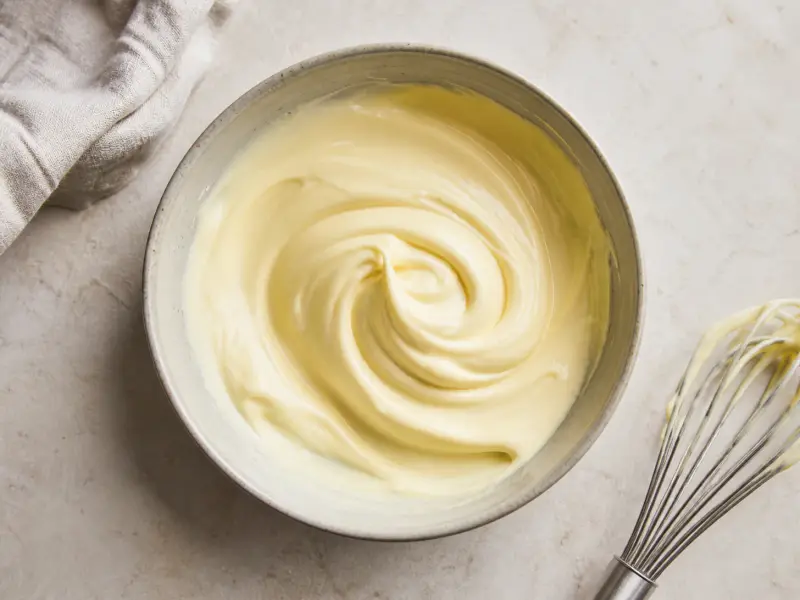 Mayonnaise
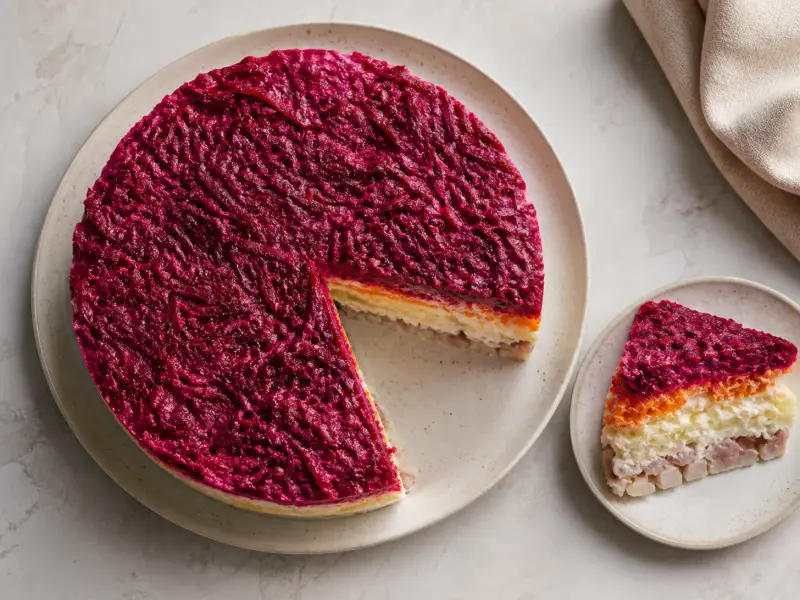 Herring Under a Fur Coat
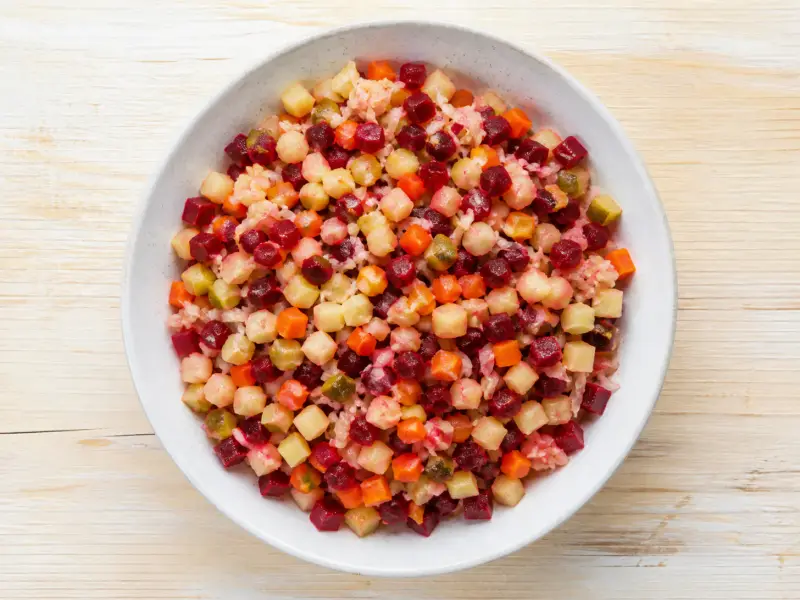 Vinegret
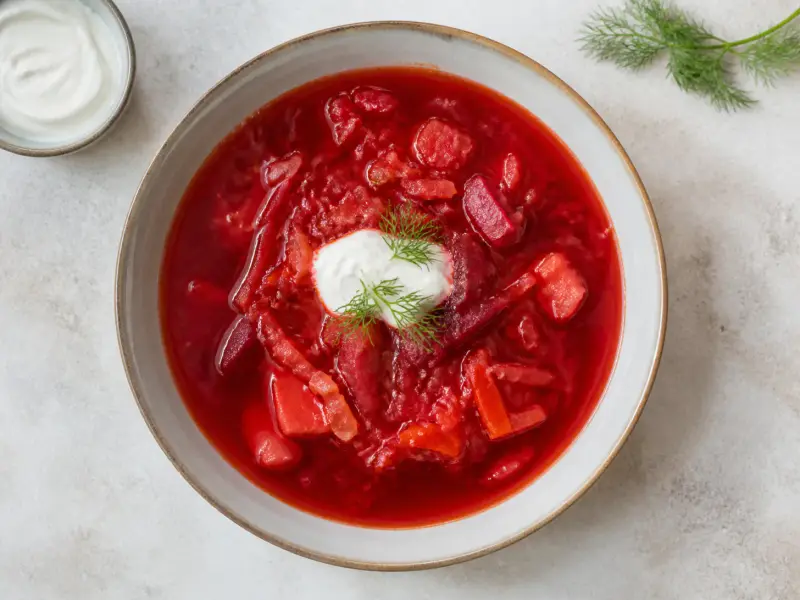 Borscht
 Buttery Mashed Potato
 Crisp Roast Potatoes
 Crushed Roast Potatoes