Smoked Haddock Chowder
Undyed smoked haddock poached in milk, with that milk becoming the soup and floury potato doing the thickening in place of flour.
- Prep
- 20 min
- Cook
- 35 min
- Resting
- 5 min
- Total
- 1 hr
- Serves
- 4
- Revisions
- 5
Allergens
- Fish
- Milk
Named from the ingredients as written, including those carried in from sub-recipes. This is not a guarantee — check the labels on what you actually buy, and note that a product’s recipe can change.
Ingredients
Serves
Method
Lay the haddock skin-side down in a wide pan, cutting the fillets to fit in a single layer.
Pour over the milk and the water, which should just cover the fish.
Drop in the bay leaves.
Bring it up slowly over 8-10 minutes, to the point where the surface trembles and steam rises but no bubble breaks.
Never let the milk boil with the fish in it. Boiled milk splits into grains sitting in a thin liquid, and smoked haddock held at a boil tightens and goes woolly within a couple of minutes.
Take the pan off the heat, cover it and stand it for 5 minutes, which finishes the fish in the residual heat.
Lift the fish out onto a plate with a fish slice.
Strain the poaching milk into a jug and discard the bay leaves.
Peel the skin off the fish, which should come away in one piece.
Break the flesh into large flakes and run your fingertips over every one of them, feeling for pin bones. Smoked haddock is boned inconsistently, and a bone found in a spoonful of soup is the only thing anyone will remember about it.
Melt the butter in a heavy pan over medium-low heat.
Cook the leek for 6-8 minutes, stirring now and then, until it has collapsed and gone soft without colouring.
Add the diced potato and turn it through the butter.
Pour in the strained poaching milk.
Simmer very gently for 12-15 minutes, with the surface barely moving, until a knife tip slides into a piece of potato with no resistance.
Crush about a third of the potato against the side of the pan with the back of a spoon.
That is the whole thickening. Floury potato falls apart into the milk and gives the soup its body, which is why no flour goes near this pan and why a waxy potato leaves it thin. The bechamel sauce in this collection is the other route to the same thickness, and it is the wrong one here.
Pour in the cream and warm it through for 2 minutes, still short of a simmer.
Slide the fish flakes in and take the pan off the heat.
Let them warm in the soup for a minute rather than cooking them again. They are already done, and a second simmer shreds them to nothing.
Season with the ground peppercorns.
Taste before adding any salt at all. Smoked haddock is cured, and between the fish and the milk this often needs none.
Ladle into warm bowls.
Scatter the chives over.
Serve with the lemon wedges, and squeeze one in if a bowl tastes rich rather than savoury.
Cool any left over in a shallow container, refrigerate within two hours and eat it the next day.
Reheat it gently to steaming and no further, and once only — the fish has been cooked twice already.
Nobody has rated this recipe yet.
Sign in to rate this recipe. One rating per person, and you can change it.
What to expect
- Taste
Smoky, salty and savoury from the cured haddock, carried through a rich, mildly sweet potato-and-milk base with the leek adding a soft, oniony sweetness rather than any real bite. Cream rounds it out further, and the lemon at the end is what stops the whole bowl reading as simply rich — a squeeze cuts straight through and brings the smoke back to the front.
- Aroma
Smoke is the dominant smell, unmistakable and slightly sweet, carried on the steam of the warm milk; leek and butter contribute a softer, more savoury undertone beneath it.
- Texture
Thick and hearty from the crushed potato, with large, tender flakes of fish that should still hold together as distinct pieces rather than dissolving into the broth — the contrast between the smooth base and the substantial fish flakes is the main textural interest.
- Sound
A quiet, gentle simmer throughout, since nothing here is ever meant to boil hard; the loudest moment is the initial pour of milk over the raw fish.
- How the flavour moves
Smoke arrives first and lingers longest, with the potato and cream's richness filling the middle of the mouthful, and the lemon, where used, cutting back through at the very end to stop the dish tipping into being simply heavy.
- Serve it
Served properly hot, though the fish itself is only ever warmed rather than boiled at any stage after its first gentle poach.
- Goes with
Crusty bread for the base, and the buttermilk soda bread in this collection would sit alongside it just as naturally as any plain loaf — this is a soup built to be mopped up rather than left in the bowl.
Cook's notes
- Difficulty
Easy, with one point of real care: the milk must never be allowed to boil with the fish in it.
- Cost
Moderate — smoked haddock is the main expense, with potato, leek and milk making up the bulk of the pot cheaply.
- Equipment
A wide pan for poaching the fish, a second heavier pan for the soup itself, and a fish slice.
- When to make it
Autumn and winter lunches especially, though it suits any cold-weather meal.
- Best season
None really — smoked haddock is available year-round, though the dish suits colder months best.
- You know it is done when
Large, pale flakes of fish suspended in a pale, creamy, potato-thickened soup flecked with green leek and chives.
- And it feels like
The potato should be soft enough to crush easily against the pan, giving the soup real body; the fish flakes should stay large and intact rather than shredding to nothing.
- Food safety
Fish that has already been poached once should not be simmered hard a second time — it has been cooked twice by the time it's reheated as leftovers, and a hard second boil turns it to rag. Cool and refrigerate within two hours if not serving straight away.
- Where it goes wrong
- Letting the milk boil at any point the fish is in it, which turns the fish woolly and can split the milk.
- Using a waxy rather than floury potato, which leaves the soup thin since it won't break down and thicken the pan.
- Simmering the flaked fish again once it's added back at the end, which shreds it after it has already been cooked once.
- Salting before tasting — smoked haddock is already cured and the soup often needs none at all.
- If it does go wrong
Thin soup: the potato wasn't floury enough, or not enough of it was crushed against the pan. Woolly, tough fish: the milk boiled during poaching. Too rich or one-note: a squeeze of lemon at the end usually fixes it rather than more salt.
- Making it ahead
Best made fresh or eaten the next day; the fish has already been cooked once by the time of any reheating, so a long hold isn't ideal.
- Keeping it
Refrigerated and eaten the next day; not a soup that holds well for several days given the delicate fish.
- Reheating
Gently, to steaming and no further, and only once — the fish has already been cooked twice by this point.
- Freezing
Not ideal — the potato and cream both change texture on freezing and thawing, becoming grainier.
- Leftovers
Best eaten the next day rather than kept longer; reheat with real care given how much cooking the fish has already had.
- Scaling it
Scales up cleanly in a bigger pan, keeping the same ratios of milk to potato to fish.
- Substitutions
Dyed smoked haddock, the bright yellow kind, works but changes the colour and says nothing about how it was actually smoked; undyed is the better choice for both flavour and honesty about what's in the pot. Any floury potato variety can replace Maris Piper.
- Dietary swaps
Contains fish and milk throughout and there is no straightforward way around either, since the fish is the point of the dish and the milk both poaches it and forms the soup's body. Naturally gluten-free, since no flour is used anywhere in the recipe.
- Shopping for it
Undyed smoked haddock, ideally from a fishmonger who can say how it was smoked, gives both a better flavour and a more honest colour than the bright yellow dyed version.
- Keeping the cost down
Smoked haddock is the main cost; buying it from a fishmonger rather than a supermarket often gets a better, less dyed product for a comparable price.
- Sustainability
Haddock stocks vary by fishery, so choosing a certified sustainable source is worth checking; smoking as a preservation method is itself a low-waste tradition.
- Nutrition
A rich, protein-forward soup owing to the smoked fish, moderated by the milk-and-potato base rather than a heavier cream-led one.
- Worth it?
A genuinely comforting, smoky soup that gets its whole body from a technique — crushed potato — rather than from cream or flour, which makes it lighter than it tastes.
Where it comes from
- Origin
North-east Scotland, with the specific dish this recipe is closest to — cullen skink — named for the fishing town of Cullen on the Moray Firth.
- Also called
Cullen skink.
- Said out loud
CULL-en skink, both words plain English.
- What the name means
Cullen is the fishing town on the Moray Firth the dish is named for; skink is an old Scots word for a soup or stock made from the shin or knuckle of an animal, later extended more loosely to soups of this substantial, hearty kind.
- History
Smoking fish over hardwood was originally a preservation method rather than a deliberate flavouring choice, practised long before refrigeration existed. The specific pairing of smoked haddock with milk, potato and onion into a named soup called cullen skink is a considerably later development, appearing in print as a regional Scottish speciality during the 20th century rather than being an ancient, precisely dated dish.
- Why it matters
A recognised Scottish regional dish eaten across Scotland and Britain more broadly as a lunch or a first course, and one of the clearest British examples of a soup built around a specific local cured product.
- When it is eaten
An everyday lunch or starter dish rather than a special-occasion one, though it appears often on menus positioning themselves as serving traditional Scottish or British food.
- The traditional way
Poaching smoked haddock gently in milk, then using that same milk as the base of the soup, thickened with potato rather than any separate roux or cream reduction.
- How it changed
Related fish chowders using similar techniques — smoked or cured fish, milk, potato — are standard in New England, Atlantic Canada and Ireland, suggesting a shared broader tradition of coastal, cold-climate fish-and-potato soups rather than a single dish that spread from one place.
- Regional variations
Finnan haddock, cold-smoked and named for the Aberdeenshire village of Findon, is the traditional fish for this soup; Arbroath smokies, hot-smoked and already cooked through, are a related but different product sometimes used instead. New England-style chowders follow a similar milk-and-potato logic with different fish and often the addition of bacon.
- How this version differs
This recipe insists on undyed smoked haddock specifically, noting that the bright yellow dyed version says nothing about how the fish was actually smoked, and thickens entirely with crushed potato rather than any flour-based roux.
- Sources and credit
No individual can be credited with cullen skink or the wider chowder tradition it belongs to; both are regional culinary traditions rather than composed or invented dishes.
 Herring Under a Fur Coat
 Smoked Haddock Kedgeree
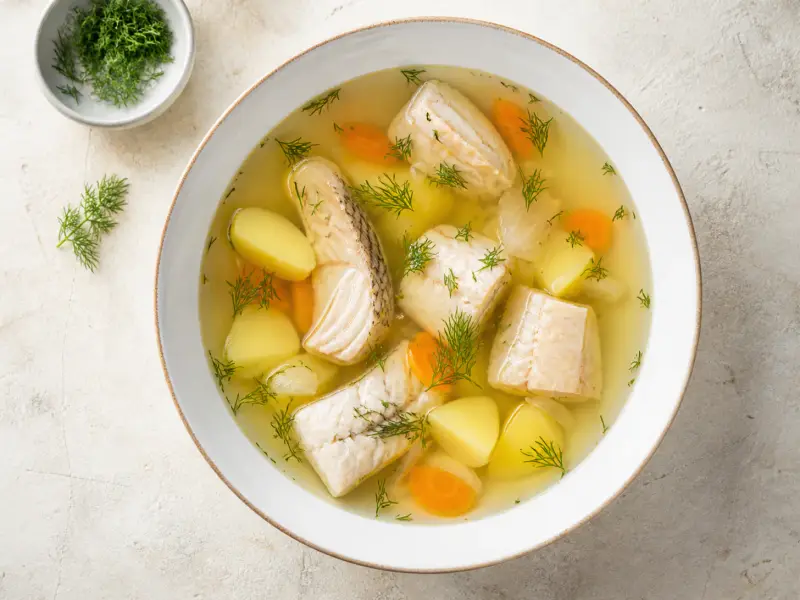 Ukha
Ukha Ackee and Saltfish
 Borscht
 Brown Stew Fish