Golubtsy
Голубцы
Голубцы — little pigeons.
Cabbage leaves rolled around seasoned mince and rice, then braised slowly in tomato and soured cream.
- Prep
- 40 min
- Cook
- 1 hr 40 min
- Resting
- 10 min
- Total
- 2 hr 30 min
- Serves
- 4
- Revisions
- 5
Allergens
- Celery (via Chicken Stock)
- Milk
Named from the ingredients as written, including those carried in from sub-recipes. This is not a guarantee — check the labels on what you actually buy, and note that a product’s recipe can change.
Ingredients
Serves
Method
Cut the core out of the cabbage, working the knife around it in a cone and lifting the whole plug out.
Lower the head core-side down into a large pan of boiling water and leave it for 3-4 minutes.
Peel the outer leaves away with tongs as they loosen, returning the head to the water each time the next layer stops giving. You want 12-14 whole leaves.
Lay each leaf flat and shave the thick rib down level with a knife held almost parallel to the board. A raised rib will not bend, and the leaf cracks along it as you roll.
Boil the rice in salted water for 6-7 minutes, until the grains have swollen but still have a hard white centre, then drain and cool.
Melt the butter in a frying pan and cook the onion over medium-low heat for 8 minutes, until soft and translucent.
Add the garlic and cook for 1 minute more, until it smells sweet rather than raw.
Mix both minces with the half-cooked rice, the onion and garlic, the dill, the fine salt and the ground peppercorns.
Fry a teaspoon of the mixture in the same pan and taste it, then correct the salt in the bowl. It is the only chance you get before the rolls are sealed.
Put a heaped tablespoon of filling at the stem end of a leaf.
Fold the two sides in over the filling, then roll the leaf up away from you into a tight parcel.
Do not pack them full. The rice still has swelling to do, and an overstuffed roll bursts along its seam in the oven.
Heat the oven to 160C/325F.
Line the base of a heavy lidded casserole with any torn or leftover leaves, which stop the rolls below from scorching against the metal.
Pack the rolls in seam-side down in a single tight layer, or two layers if the pan is small.
Whisk the tomato sauce with half the smetana and the hot stock and pour it over, so the rolls are three quarters submerged.
Tuck in the bay leaves.
Bring the pan to a simmer on the hob, then cover it and transfer it to the oven.
Braise for 80-90 minutes.
Check by pushing a skewer down through the middle of a roll: it should pass through the cabbage with no resistance, and the rice should be fully swollen and soft.
Rest the pan, still covered, for 10 minutes off the heat so the rolls firm up and lift out whole.
Serve two or three per person with the sauce spooned over and the remaining smetana on top.
Nobody has rated this recipe yet.
Sign in to rate this recipe. One rating per person, and you can change it.
What to expect
- Taste
A savoury, well-seasoned meat filling — beef and pork together giving more depth than either alone — bound with rice that's absorbed the surrounding tomato and cream sauce, wrapped in cabbage that's turned sweet and mellow rather than sharp after its long braise. The tomato sauce and smetana together give a rounded, faintly tangy sauce that sits between purely savoury and gently sour, with dill's fresh, aniseed-adjacent note cutting through the richness.
- Aroma
Sweet, softened cabbage and savoury braised meat, with the tomato sauce's acidity rising as steam off the pot, and dill's bright top note noticeable as soon as a roll is cut into.
- Texture
The cabbage should be fully soft and yielding with no crunch left at all, wrapped tight enough to hold its shape when lifted whole onto a plate but tender enough to cut easily with the side of a fork; the filling inside is moist and slightly loose rather than dense, with distinct grains of rice still visible through it.
- Sound
A soft give as a fork cuts through the cabbage wrapper, and the slow, thick sound of sauce being spooned rather than poured, given how much body the tomato and cream mixture has.
- How the flavour moves
The sweet, softened cabbage arrives first, giving way to the savoury meat-and-rice filling, with the tomato-and-cream sauce's tang running underneath the whole thing and dill's freshness the last note before the swallow.
- Serve it
Served hot, straight from the braise; it holds heat well given the volume of sauce and the density of the filling.
- Goes with
Extra smetana at the table, and bread or mashed potato alongside to take up the sauce — this is a dish built to be eaten with something plain to soak up what's left on the plate.
Cook's notes
- Difficulty
Moderate. Nothing here is technically hard, but there are several distinct stages — blanching the cabbage, half-cooking the rice, rolling and braising — that all need to be got right in sequence.
- Cost
Cheap — a cabbage, a modest amount of mixed mince, rice and tomato sauce feed four generously.
- Equipment
A large pan for blanching the cabbage, a heavy lidded casserole for the braise, and tongs.
- When to make it
Cold-weather family cooking especially, and a good dish to make ahead for the week given how well it holds and reheats.
- Best season
Cabbage is available year-round and cheapest in the colder months.
- You know it is done when
The cabbage should look fully translucent and soft, the sauce a rich, deep red-orange, the rolls holding their shape without any visibly split seams.
- And it feels like
A skewer should pass through the middle of a roll with no resistance, and the rice inside should be fully swollen and soft rather than still showing any hard white centre.
- Food safety
Minced meat needs to be cooked through fully — the extended braise well exceeds any safety threshold for both beef and pork mince, so texture rather than safety is the only real concern by the time the rolls are done.
- Where it goes wrong
- Using fully cooked rice in the filling, which collapses to paste during the long braise.
- Using raw, uncooked rice, which draws moisture out of the meat as it swells and leaves the filling dry.
- Overstuffing the rolls, which leaves no room for the rice to finish swelling and bursts the seam.
- Trying to roll the tight, small inner cabbage leaves rather than the larger, more pliable outer ones.
- If it does go wrong
Burst rolls: overstuffed, or the rice was too far along when it went in. Dry filling: the rice was raw rather than half-cooked when mixed with the meat. Tough cabbage: not blanched or frozen for long enough to soften properly.
- Making it ahead
Excellent made a day or more ahead — the flavour is widely considered to improve with a rest, and it reheats reliably.
- Keeping it
Three to four days refrigerated, and it is widely made in large batches specifically because it reheats and improves well.
- Reheating
Gently, in the sauce, until warmed through — the rolls are sturdy enough to take a second simmer without falling apart.
- Freezing
Freezes well, either before or after braising; freezing the cabbage head itself beforehand is also a standard shortcut for softening the leaves.
- Leftovers
Often made deliberately in large batches and reheated over several days, since the flavour is generally considered to improve with a day's rest.
- Scaling it
Scales up well for a crowd; the main constraint is having a casserole or pan large enough to hold all the rolls in one or two snug layers.
- Substitutions
Lazy golubtsy, lenivye golubtsy, skip the rolling entirely and layer or cook the same filling with shredded cabbage in one pot, which is a legitimate and much faster variant rather than a shortcut taken by necessity. All-beef or all-pork mince can replace the mixed mince, though the traditional balance of the two is worth keeping if possible.
- Dietary swaps
Contains milk from the smetana or soured cream finish, which could be omitted or replaced with a plant-based alternative for a dairy-free version. Not vegetarian or vegan as written, since the filling is built entirely around the two minces; a vegetable or mushroom-based filling would be a genuinely different dish rather than a simple substitution.
- Shopping for it
A firm, tight white cabbage with large outer leaves makes rolling considerably easier than a smaller, looser head.
- Keeping the cost down
A single cabbage and a modest amount of mince stretch to feed four generously, which is the historical logic behind the dish's popularity in lean times.
- Sustainability
An efficient way of stretching a modest amount of meat across a filling family meal, using an inexpensive and widely available vegetable as the main bulk.
- Nutrition
A substantial, protein-and-carbohydrate-rich main course given the mince and rice both being present in real quantity.
- Worth it?
A genuinely satisfying braise that rewards the fiddly rolling stage with rolls that hold together on the plate and a sauce worth mopping up afterwards.
Where it comes from
- Origin
Russia and the wider East Slavic region, part of a much larger family of stuffed cabbage dishes with no single point of invention.
- Also called
Golubtsy (голубцы).
- Said out loud
guh-loop-TSY, stress on the final syllable.
- What the name means
Usually explained as the diminutive of golub, pigeon, on the theory that the small rolled parcels resemble the roast game birds they replaced — this is the standard account repeated in most sources rather than a documented etymology, and is presented here as such rather than as settled fact.
- History
Documented in Russian cookery writing by the 19th century, golubtsy became a canteen and household staple during the Soviet period specifically because cabbage, rice and a relatively modest amount of mince could feed considerably more people than a dish built on meat alone.
- Why it matters
Standard household cooking across Russia, Ukraine, Belarus and Poland, closely related to Romanian sarmale, Turkish lahana sarma and the holishkes of Ashkenazi Jewish cooking — evidence of how widely the stuffed-cabbage form travelled rather than of any one culture's exclusive claim to it.
- When it is eaten
Everyday family cooking, and a dish frequently made in large batches specifically because it reheats well and is often considered better on a second day.
- The traditional way
Blanching or freezing the cabbage to soften the leaves, half-cooking the rice so it finishes swelling during the braise rather than before or after it, and a long, slow braise in a tomato-and-cream sauce.
- How it changed
Lazy golubtsy, which skip the rolling and cook the same filling with shredded cabbage in one pot, are a modern, faster variant that has become common in its own right rather than being seen purely as a shortcut.
- Regional variations
Romanian sarmale, Turkish lahana sarma and Ashkenazi Jewish holishkes are all closely related stuffed-cabbage dishes from the same broad culinary family, each with its own regional filling and sauce conventions.
- How this version differs
This recipe uses a mixed beef-and-pork filling and a tomato-and-smetana sauce, braised in the oven rather than purely on the hob, which gives more even, gentle heat across the whole pot.
- Sources and credit
No individual can be credited with golubtsy; it is a regional culinary tradition shared, with variation, across a wide part of Europe and the Near East.
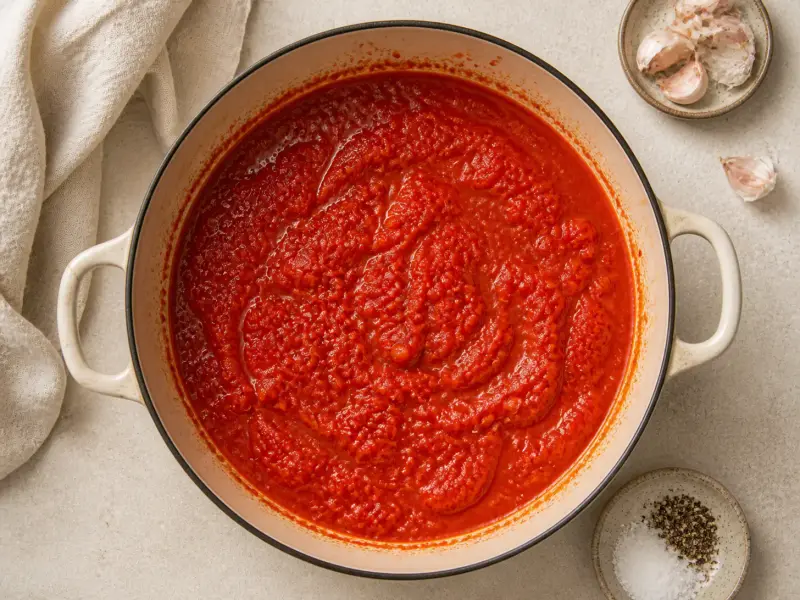 Simple Tomato Sauce
 Chicken Stock
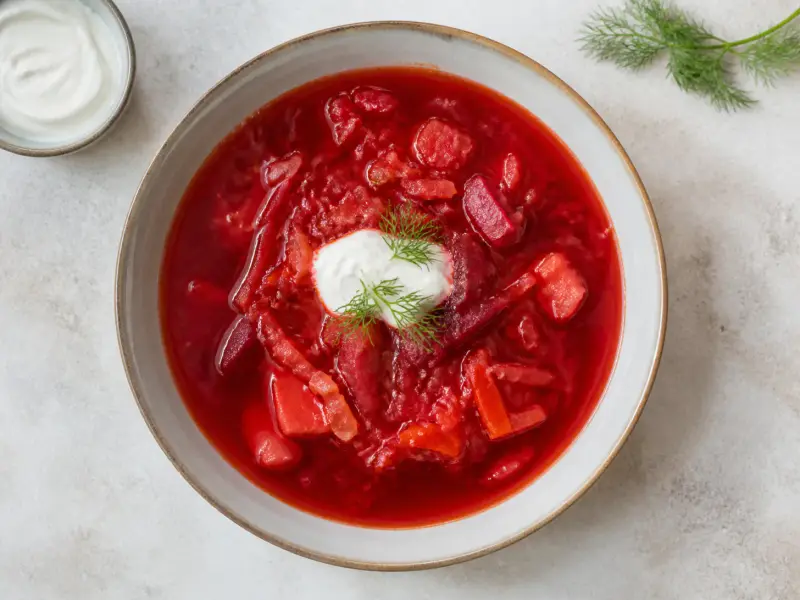 Borscht
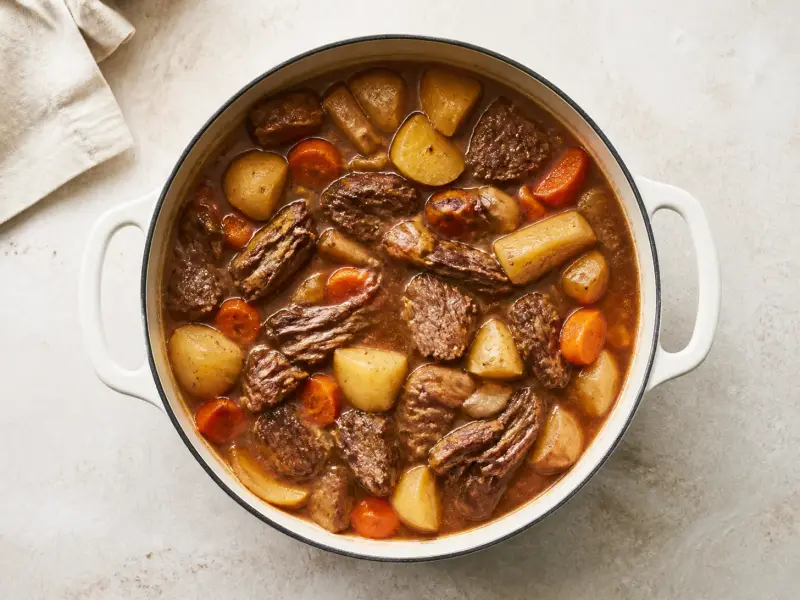 Zharkoye
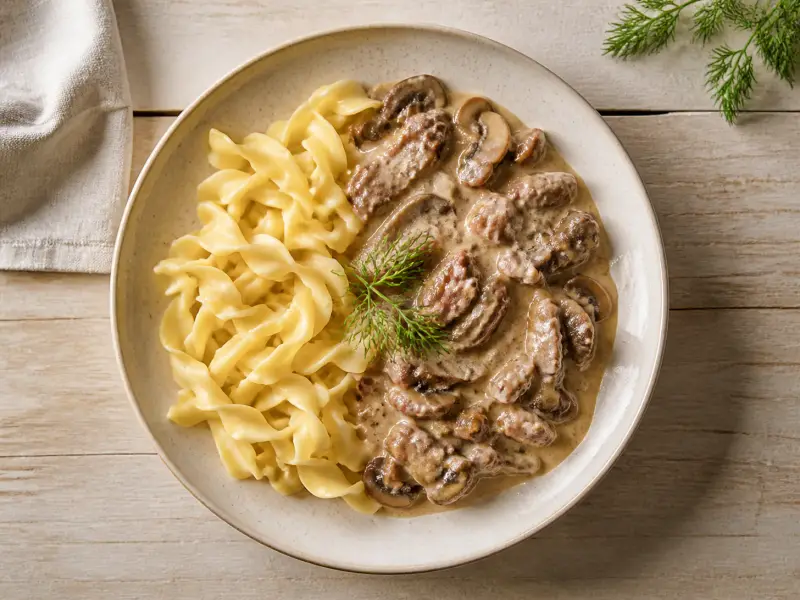 Beef Stroganoff
 Buckwheat Kasha with Mushrooms
 Chickpea and Spinach Stew
 Mushroom Julienne