Chicken and Prawn Paella
Paella mixta
Paella mixta — paella is the pan, not the rice.
Bomba rice cooked flat and never stirred in a wide pan, which keeps the grains separate and toasts a crust onto the base.
- Prep
- 25 min
- Cook
- 50 min
- Resting
- 5 min
- Total
- 1 hr 20 min
- Serves
- 4
- Revisions
- 5
Allergens
- Celery (via Chicken Stock)
- Crustaceans
Named from the ingredients as written, including those carried in from sub-recipes. This is not a guarantee — check the labels on what you actually buy, and note that a product’s recipe can change.
Ingredients
Serves
Method
Use the widest shallow pan you own, 38-40cm if you have a paella pan. Depth is the enemy here: rice piled more than about 2cm deep steams in the middle instead of drying out, and you lose both the separate grains and the crust.
Pat the chicken dry and season it all over with the 6g of fine salt.
Crush the saffron threads between your fingers into a small bowl, pour over 3 tbsp of the hot stock and leave it to steep while you cook.
Heat the olive oil in the pan over medium-high heat until it shimmers.
Brown the chicken skin-side down for 6-8 minutes, without moving it, until the skin is deep gold and lifts off the metal cleanly.
Turn the pieces and brown the second side for 4 minutes, then move them to a plate.
Fry the prawns in the same fat for 1 minute a side, until they have just turned pink, and lift them onto the plate as well.
Take them out while they are still underdone. They go back in at the end, and prawns cooked through twice are rubber.
Turn the heat to medium and cook the onion and red pepper for 8-10 minutes, stirring, until soft and sweet.
Stir in the garlic and cook for 1 minute.
Add the grated tomato and cook for 5-6 minutes, stirring, until it has darkened to brick and the oil separates back out at the edges. That reduction is the sofrito, and it is where the flavour of the rice comes from.
Pull the pan off the heat and stir in the smoked paprika for 20 seconds. Paprika scorches in seconds over direct heat and turns acrid, and it is stirred into a pan already off the flame for that reason.
Return the pan to the heat and add the green beans and the rice.
Stir for 1-2 minutes, until every grain is coated in the sofrito.
Pour in the hot stock and the saffron with its liquid.
Tuck the chicken pieces back in among the rice, skin-side up and standing proud of the liquid so the skin stays crisp.
Shake the pan to level the rice into an even layer, and taste the liquid for salt now while there is still liquid to taste.
Do not stir it again from this point. That single instruction is the whole difference between this and the risotto in this collection: stirring rubs the starch off the grains into the liquid and gives a creamy pan, where paella wants dry, separate grains and a toasted base.
Boil hard for 8-10 minutes, turning the pan on the burner every couple of minutes so the heat reaches all of it.
Turn the heat down and simmer for a further 8-10 minutes, until the liquid has dropped to the level of the rice and craters open across the surface.
Lay the prawns on top for the last 4 minutes.
Taste a grain from the edge of the pan rather than the middle, since the edges always run ahead. It should be tender with the faintest bite left.
Turn the heat up to high for 1-2 minutes at the very end and listen. When the liquid has gone the rice starts to crackle against the metal and the smell turns toasted and nutty — that is the socarrat forming.
Take the pan off the heat the moment you smell toast. It goes from toasted to burnt in under a minute, and the nose is the only instrument that works.
Cover the pan loosely with foil or a clean cloth and rest it for 5 minutes.
Before serving, check the chicken. Cut into the thickest thigh at the bone: the juices should run clear and the meat should be opaque all the way through, and if you have a thermometer it should read 74C/165F at the bone. Bone-in thighs buried in rice cook unevenly, and the pieces at the cooler edge of the pan finish last. Return anything underdone to the pan, cover, and give it another 5 minutes.
Scatter over the parsley and serve straight from the pan, with the lemon wedges.
Nobody has rated this recipe yet.
Sign in to rate this recipe. One rating per person, and you can change it.
What to expect
- Taste
Deeply savoury from the reduced sofrito and the toasted socarrat, with saffron's distinct, slightly medicinal floral note running through the rice, smoked paprika adding a gentle smokiness, and sweet prawn and chicken meat throughout.
- Aroma
Sweet cooked onion and pepper, deep reduced tomato, a rounding smokiness from the paprika, and, right at the end, the toasted, nutty smell of the socarrat forming on the base.
- Texture
Dry, separate grains of rice with a slight bite, a crisp base where the socarrat has formed, tender chicken and prawns, and crisp green beans throughout.
- Sound
A hard, rolling boil for the first stage, settling to a gentler simmer, and a distinct, audible crackle against the metal in the final minute as the socarrat forms.
- How the flavour moves
The savoury depth of the sofrito registers first, saffron's distinct floral note builds through the middle, and the toasted, nutty flavour of the socarrat is what lingers longest, alongside the sweetness of the chicken and prawns.
- Serve it
Served hot, straight from the pan, and rested briefly under foil before serving to let the rice finish absorbing any remaining moisture.
- Goes with
A wedge of lemon squeezed over at the table, and little else — the dish is built to be a complete meal on its own.
Cook's notes
- Difficulty
Moderate — the technique of not stirring and judging the socarrat by smell both take some getting used to.
- Cost
Moderate to high — chicken and prawns together, plus saffron, add up more than a plainer rice dish.
- Equipment
The widest, shallowest pan available, ideally 38-40cm, since depth is the main enemy of a good paella.
- When to make it
A weekend lunch, in keeping with the dish's traditional serving time.
- Best season
None; every ingredient is shelf-stable or standard fresh produce available year round.
- You know it is done when
The rice should sit dry with no standing liquid once cooked, the chicken skin should stay visibly crisp having been kept proud of the liquid throughout, and the base should show a light golden crust once the socarrat has formed.
- And it feels like
The rice should be tender with the faintest bite remaining at the edge of the pan, dry and separate rather than creamy or clumped together.
- Food safety
The chicken must reach a safe internal temperature, which the combination of initial browning and the full simmering time in the pan should achieve; check the thickest piece if there is any doubt. The prawns are added only in the last four minutes specifically so they do not overcook.
- Where it goes wrong
- Using a deep pan instead of a wide, shallow one, which steams the rice rather than letting it dry out and crust properly.
- Stirring the rice once the liquid is added, which rubs starch off the grains and makes the dish creamy rather than dry and separate.
- Overcooking the prawns by adding them too early, which makes them rubbery.
- Leaving the pan on too long chasing a socarrat, which turns from toasted to burnt within under a minute.
- If it does go wrong
Creamy, risotto-like texture rather than separate grains: the rice was stirred after the liquid went in. Soggy, undercooked middle: the pan was too deep or too narrow for the quantity of rice. No socarrat forming: the final high-heat stage was cut short, or the pan was not listened to closely enough at the end. Rubbery prawns: they were added too early rather than in the final four minutes.
- Making it ahead
The sofrito base can be made ahead and reheated, but the rice itself should be cooked fresh and served immediately for the best texture.
- Keeping it
Keeps for up to two days refrigerated, though the socarrat and the rice's separate texture do not survive being reheated in the same form.
- Reheating
Reheat gently in a covered pan with a splash of water or stock; a microwave tends to make the rice gluey.
- Freezing
Not recommended — the rice's texture and the crisp chicken skin both suffer badly on thawing.
- Leftovers
Edible reheated, though best treated as a different, softer dish rather than expecting the same texture as fresh.
- Scaling it
Scales with real care needed for pan size — a wider pan is required for a larger quantity rather than simply using more liquid in the same pan, since the rice depth is what the whole method depends on.
- Substitutions
Bomba or calasparra rice are specifically chosen for their ability to absorb around three times their volume in liquid without splitting, which is what allows a fixed-ratio, no-stirring method to work; ordinary long-grain or risotto rice will not behave the same way.
- Dietary swaps
Contains crustaceans. Naturally free of gluten, milk, egg and nut allergens as written.
- Shopping for it
Genuine bomba or calasparra rice, and real saffron rather than a substitute colouring, both matter considerably to the final result.
- Keeping the cost down
Using chicken thighs rather than a whole chicken and a modest quantity of prawns keeps the cost more reasonable than an all-seafood version.
- Sustainability
Worth checking the sourcing of the prawns specifically, since shrimp and prawn fishing and farming practices vary considerably in their environmental impact.
- Nutrition
A good source of protein from both the chicken and prawns, with a moderate amount of fat from the chicken skin and olive oil.
- Worth it?
A dish where the single rule not to stir does more for the final result than any other piece of technique, and one worth practising specifically to learn to judge the socarrat by smell.
Where it comes from
- Origin
The Albufera lagoon region south of Valencia, Spain.
- Also called
Paella; this specific combination is more precisely called arroz a la marinera or arroz de marisco y pollo by many in Valencia.
- Said out loud
pah-EH-yah.
- What the name means
Paella is the Valencian word for the wide, shallow pan the dish is cooked in, from the Latin patella — the dish is named for its cooking vessel rather than its ingredients.
- History
Paella took its present form during the 19th century in the rice-growing country around the Albufera lagoon, originally as an outdoor field lunch cooked by agricultural workers over vine clippings. The traditional Valencian version is built on rabbit, chicken, beans and snails; combining meat with shellfish, as this recipe does, is genuinely contested within Valencia as to whether it deserves the name paella at all, with many preferring the terms arroz a la marinera or simply arroz for such combinations.
- Why it matters
One of the dishes most associated with Spain internationally, and Sunday and holiday food across the Valencian Community specifically, almost always eaten at lunch.
- When it is eaten
Sunday and holiday meals, traditionally cooked outdoors, and now eaten throughout Spain at any point during the week.
- The traditional way
Cooking in a wide, shallow pan without stirring once the liquid is added, and forming a socarrat — a toasted crust on the base — in the final minutes of cooking.
- How it changed
The addition of seafood alongside meat, as in this recipe, is a departure from the traditional Valencian rabbit-and-chicken version and remains a genuine point of debate over whether the result should be called paella.
- Regional variations
The traditional Valencian version uses rabbit, chicken, snails and beans with no seafood at all; seafood-only and mixed meat-and-seafood versions are more commonly found outside Valencia or are given different names within it.
- How this version differs
This recipe combines chicken and prawns, which is not the traditional Valencian combination and is a version some in Valencia would not call paella at all.
- Sources and credit
No individual is credited with inventing paella; it developed among agricultural workers in the Albufera region rather than through any documented single origin.
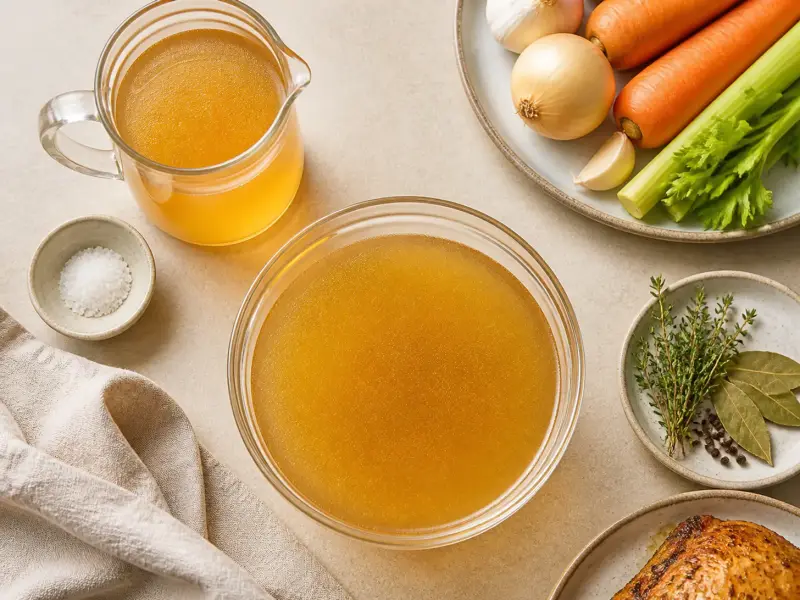 Chicken Stock
 Chickpea and Spinach Stew
 Beef and Ale Stew with Herb Dumplings
 Chicken à la King
 Chicken Kiev
 Chicken Thigh and Potato Traybake
 Chicken Tikka Masala