Kulebyaka
Кулебяка
An enriched pastry loaf layered with salmon, rice, egg and dill, baked until the crust sounds hollow.
- Prep
- 45 min
- Cook
- 1 hr
- Resting
- 1 hr 25 min
- Total
- 3 hr 10 min
- Serves
- 6
- Revisions
- 5
Allergens
- Cereals containing gluten
- Eggs
- Fish
- Milk
Named from the ingredients as written, including those carried in from sub-recipes. This is not a guarantee — check the labels on what you actually buy, and note that a product’s recipe can change.
Ingredients
Serves
Method
Mix the flour, the yeast, the sugar, the 6g of fine salt, the warmed milk and the 2 eggs into a soft dough.
Knead for 5 minutes, then add the 80g of softened butter in three additions, kneading each one fully in before the next.
Keep kneading for 8-10 minutes after the last butter goes in, until the dough is smooth, glossy and pulls away from the bowl in one piece. Enriched dough always looks hopeless for the first few minutes after the fat goes in; it comes together.
Cover and prove at room temperature for 60-75 minutes, until roughly doubled.
Meanwhile, put the rice and the 350ml of water in a pan, bring to a boil, then cover and cook on the lowest heat for 10-12 minutes.
Take the rice off the heat and leave it covered for 10 minutes, then fork it through and spread it on a tray to cool.
Melt the 40g of butter in a frying pan and cook the onion over medium heat for 8 minutes, until soft.
Add the chopped mushrooms and cook for 10-12 minutes, until every drop of water has gone and the pan is dry and squeaking.
Take the mushrooms well past the point where they look cooked. Wet filling is the single reason a kulebyaka leaks, and once the base has gone to paste nothing recovers it.
Spread the mushroom mixture on a plate and cool it completely, along with everything else. Warm filling melts the butter in the dough and the loaf slumps before it ever reaches the oven.
Mix the chopped hard-boiled eggs with the dill, the lemon zest and juice, and half the 5g of fine salt.
Season the salmon on both sides with the remaining fine salt and the ground peppercorns. It goes in raw and cooks inside the loaf.
Knock the dough back and roll it out on a floured sheet of baking paper to a rectangle about 30cm by 40cm and 5mm thick.
Lay half the cooled rice down the centre in a strip the length and width of the salmon fillet.
Spread the mushroom mixture over the rice.
Lay the salmon on top.
Cover the salmon with the egg and dill mixture, then with the remaining rice.
Build the layers upward in a tight block. A wide, flat pile leaves the dough too much distance to travel and the seam will not meet.
Brush the border of the dough with beaten egg, fold the two long sides up and over, and pinch them together into a seam along the top.
Fold the two short ends up and press them closed, then turn the whole loaf over on the paper so the seams are underneath.
Slide it, still on its paper, onto a baking tray and chill for 30 minutes.
Heat the oven to 190C/375F.
Cut four steam vents through the top with the point of a knife, each about 2cm long.
Cut the vents. Steam has to leave, and a sealed loaf splits itself open along a seam at the base, where you will not see it until the juices are already on the tray.
Brush the whole loaf with the beaten egg glaze.
Bake for 35-40 minutes, until deep gold all over and hollow-sounding when tapped underneath.
Push a thermometer through a vent into the middle of the fish: 55C/130F gives salmon that is just set and still translucent at the centre, and 63C/145F is the official food-safety figure if you prefer it firm.
Rest the loaf for 15 minutes before cutting. Cut hot, the layers slide apart and the slice falls over on the plate.
Cut into thick slices with a serrated knife, using a sawing action rather than pressing down.
Nobody has rated this recipe yet.
Sign in to rate this recipe. One rating per person, and you can change it.
What to expect
- Taste
Rich, and the richness is layered rather than uniform. The dough itself is faintly sweet — there is 20g of sugar and 80g of butter in it — which is unexpected against a savoury filling and is what makes the crust read as a bread rather than a pastry. The mushroom layer is deeply earthy and concentrated because every drop of water has been driven out of it. The salmon, cooked gently inside its own steam, is mild and sweet rather than assertive. Cutting across all of it is the egg-and-dill layer, where the lemon juice and zest are doing deliberate work: without them the middle of the loaf would be uniformly rich, and with them there is a clean, grassy sharpness that resets each mouthful.
- Aroma
For the last twenty minutes of baking it smells like an enriched loaf — butter, milk and sugar browning — and barely of fish at all. The fish and dill only arrive when the knife goes in and the steam comes out of the cut, which is the single most dramatic moment of the dish and lasts about ten seconds.
- Texture
The whole point is that five distinct textures survive in one slice. A crisp glazed shell. A soft, close crumb beneath it. Loose separate rice. Finely chopped mushroom that is dense and almost meaty from being cooked dry. Salmon in large flakes. And chopped egg, which is the softest thing in it. The base is the texture that tells you whether it worked: it should still be dry and firm rather than grey and paste-like.
- Sound
The hollow tap on the underside of the loaf, which is the doneness cue and a genuinely satisfying test. Then the saw of a serrated knife through a crust that resists slightly before it gives. The dish is otherwise quiet.
- How the flavour moves
Buttery crust first, and slightly sweet with it. Then the lemon and dill arrive early and brightly and cut straight through that richness. Salmon and mushroom fill the middle of the mouthful and are the savoury body of it. The finish is egg and dill again, softer, with the crumb of the dough carrying it. Each slice is slightly different depending on how much of each band the fork took.
- Serve it
Warm rather than hot, because it has rested fifteen minutes — and that rest is not optional: cut hot, the layers slide apart and the slice falls over on the plate. Steam still lifts out of the cut face, which reads as far hotter than the slice actually is on the fork.
- Goes with
Soured cream with more dill in it, a sharp salted or pickled cucumber, and something acidic to drink. It needs no starch alongside — there is rice inside it and bread around it.
Cook's notes
- Difficulty
The most involved dish in this group. Nothing in it is technically hard, but there are three separate fillings to cook and cool before the assembly can start, and the assembly itself is the part that decides whether it holds together.
- Cost
Moderate to high. The 500g salmon fillet is most of it.
- Equipment
A baking tray, a sheet of baking paper large enough to roll and turn the loaf on, and a probe thermometer for the fish.
- When to make it
A weekend, a celebration, or any occasion where the cutting of it happens in front of people — most of the pleasure of this dish is the cross-section.
- Best season
None, though it belongs to cold weather and to holiday tables in practice.
- You know it is done when
Deep gold all over and hollow-sounding when tapped underneath. Cut, the cross-section should show five clean bands — rice, mushroom, salmon, egg and dill, rice — with the base of the pastry still visibly dry rather than grey and soaked, and steam coming straight up out of the cut.
- And it feels like
A crust that gives with a slight crackle under a serrated knife, a soft enriched crumb inside it, and salmon that flakes in large pieces rather than shredding. The slice should stand up on the plate rather than sliding apart.
- Food safety
The salmon goes in raw and cooks inside the loaf, so the thermometer is how you know — through a vent into the middle of the fish. 63C/145F is the official figure; 55C/130F is a judgement about texture rather than a safe-cooking number and is worth knowing as such. Cool the fillings quickly rather than leaving them standing warm on the side while the dough proves.
- Where it goes wrong
- Leaving the mushrooms even slightly wet, which is the single reason a kulebyaka leaks, and once the base has gone to paste nothing recovers it.
- Assembling while anything is still warm, which melts the butter in the dough and makes the loaf slump before it reaches the oven.
- Building the layers wide and flat, so the dough has too far to travel and the seam will not meet.
- Forgetting the steam vents, so the loaf splits along a seam at the base where you cannot see it until the juices are on the tray.
- Cutting it hot, which makes the layers slide apart and the slice fall over.
- Guessing at the fish instead of probing it, when the whole difficulty of this dish is that the salmon is invisible.
- If it does go wrong
Soggy base: the mushrooms or rice went in wet, or the loaf was not chilled before baking. Split at the base with juice on the tray: no vents, or too few. Slice collapses: it was cut before it rested, or the layers were built too wide. Dry salmon: it was taken past 63C, and there is no repair. Pale crust: it needed the egg glaze, or a hotter oven.
- Making it ahead
The three fillings can all be made a day ahead and refrigerated, which turns this from a four-hour job into a two-hour one. The shaped loaf can be chilled several hours before baking.
- Keeping it
Keeps 2 days refrigerated. The crust softens overnight and does not fully recover.
- Reheating
In a 160C/325F oven for 15 to 20 minutes rather than a microwave, which steams the crust to sogginess.
- Freezing
Freezes cooked for a month and is best refreshed in a hot oven from frozen. Freezing it raw is not recommended, since the dough and the raw fish want different treatment on thawing.
- Leftovers
Cold slices are genuinely good, and are closer to how a pirog is eaten in Russia than a hot slice is.
- Scaling it
Better to make two loaves than one larger one — a fatter loaf leaves the salmon in the middle under-cooked while the crust is already dark.
- Substitutions
Puff pastry is the restaurant route and makes a lighter, flakier loaf; the enriched yeast dough here is the domestic Russian one and is sturdier, which matters when there is a wet filling inside it. Chestnut mushrooms can be any firm mushroom cooked equally dry. Salmon is the version that travelled — sturgeon is the older Russian fish and cabbage, meat and mushroom-only fillings are all traditional.
- Dietary swaps
Contains cereals containing gluten, eggs, fish and milk. There is no straightforward swap for any of the four: the dough needs the egg and butter, and the fish is the point of this particular version. A cabbage-and-egg or cabbage-and-mushroom filling makes a fish-free kulebyaka that is entirely traditional.
- Shopping for it
One even piece of skinless salmon rather than two overlapping ones. Fresh dill in quantity — 20g is a lot and it is meant to be. An unwaxed lemon, because the zest is being used.
- Keeping the cost down
The salmon is the expense and a tail piece works as well here as a centre cut, since it is being wrapped rather than displayed. Mushroom and cabbage fillings make an entirely traditional version at a fraction of the cost.
- Sustainability
Farmed salmon varies considerably in its impact and a certified or traceable source is worth choosing. The dish stretches 500g of fish across six people, which is a better ratio than a fillet each.
- Nutrition
Substantial: a complete meal in a slice, with protein from the fish and eggs and most of the fat in the dough.
- Worth it?
A project rather than a dinner, and worth it for the moment the first slice falls open. The fillings can all be made the day before, which is what makes it manageable.
Where it comes from
- Origin
Russia.
- Also called
Кулебяка (kulebyaka); coulibiac in French.
- Said out loud
koo-lee-BYA-ka.
- What the name means
Not settled. Several derivations are offered and all of them are guesses rather than evidence, so the honest position is that the origin of the word is unknown.
- History
A kulebyaka is defined by its layers: a pirog with a single filling is not one, and the word describes the construction rather than the ingredients. It is recorded in Russian cookery by the nineteenth century, when grand versions ran to several separate fillings divided by thin pancakes, which absorbed the juices the fish and mushrooms gave off and kept the base from going to paste — the classical solution to exactly the problem this recipe solves by drying the mushrooms instead. The old Russian filling included vesiga, the dried spinal cord of the sturgeon, which swells to a gelatinous layer when cooked; it is now rare and almost always left out. French kitchens adapted the dish from around the end of the nineteenth century as coulibiac, keeping the layering and formalising the pastry, and that is the route by which it entered international restaurant cooking.
- Why it matters
A festive and Sunday dish in Russia, served warm in thick slices as a main course, and a restaurant set piece in France and Britain under the name coulibiac. It is one of very few Russian dishes to have been adopted wholesale into classical French cooking.
- When it is eaten
Name days, holidays and Sunday tables. It is a dish that is carried in whole and cut in front of people, which is most of its function.
- The traditional way
Separate fillings built upward in a tight block rather than mixed, and vents cut through the top so steam can leave — a sealed loaf splits itself open along a seam at the base, where you will not see it until the juices are already on the tray.
- How it changed
Puff pastry displaced enriched yeast dough in restaurant versions, vesiga disappeared, and salmon largely replaced sturgeon as sturgeon became scarce and expensive.
- Regional variations
Cabbage, meat, mushroom-only and buckwheat fillings are all traditional in Russia; the salmon version is the one that travelled abroad and is now the best known internationally.
- How this version differs
The classical pancakes between the layers are left out, and the mushrooms are cooked completely dry instead — the same job done a simpler way. The dough is the domestic enriched one rather than puff pastry.
- Sources and credit
No author for the Russian dish. The French adaptation is associated with late nineteenth-century professional kitchens generally rather than with a named cook.
 Ackee and Saltfish
 Beef Stroganoff
 Blini
Blini Brown Stew Fish
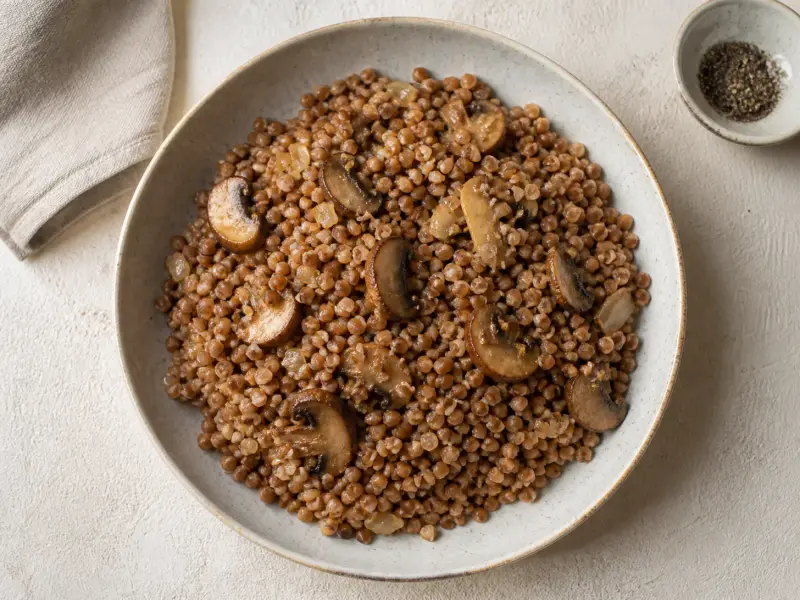 Buckwheat Kasha with Mushrooms
 Chicken Kiev